Markets
What Is the Gambler’s Fallacy?
Quick answer
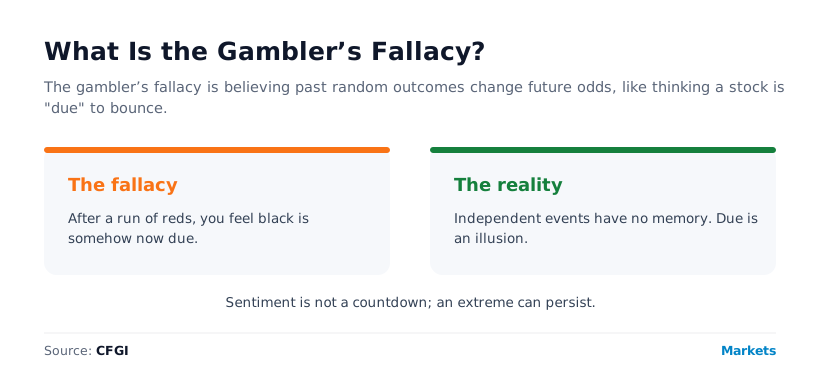
The gambler’s fallacy is the mistaken belief that past independent outcomes change the probability of future ones, like thinking a coin that landed heads five times is "due" for tails. In investing it shows up as assuming a stock that has fallen for days is "due" to bounce, or a winning streak must end soon. Each is a misread of probability that can lead investors to act on a pattern that is not really there. This is education, not financial advice.
CFGI data
The gambler’s fallacy is why sentiment is context, not a countdown. A market in Extreme Fear is not mechanically "due" to rebound on any given day. CFGI tells you the mood is stretched, but extremes resolve on no fixed schedule, treating a low reading as a guaranteed bounce is the fallacy at work.
Source: CFGI dataset and behavioural-finance research, June 2026.
Key takeaways
- The gambler’s fallacy is thinking past outcomes change future odds.
- Example: a stock is "due" to bounce after falling.
- It stems from expecting short sequences to "look random".
- It is not the same as genuine mean reversion.
- It leads investors to act on patterns that are not there.
The "Due for a Turn" Trap
If a fair coin lands heads five times, the odds of heads on the next flip are still 50%, the coin has no memory. The gambler’s fallacy is forgetting that. In markets it appears as "this stock has dropped five days running, it must bounce tomorrow," or "this rally has gone on too long, it has to end." Neither follows from the recent run alone. It is the mirror image of recency bias: where recency bias assumes a streak will continue, the gambler’s fallacy assumes it must reverse. Both treat a random or uncertain sequence as if it owes you an outcome.
Why Our Brains Fall for It
The fallacy springs from a deep quirk of human psychology: we expect even short, random sequences to "look" random and balanced, so a run of one outcome feels increasingly "unnatural" and we sense the universe must be about to correct it. But probability does not work that way over the short run; randomness is perfectly happy to deliver long streaks. The most famous illustration is the "Monte Carlo fallacy", named after a night in 1913 when the roulette wheel at a Monte Carlo casino landed on black 26 times in a row. As the streak lengthened, gamblers piled ever-larger bets on red, convinced it was overwhelmingly "due", and lost fortunes, because each spin remained an independent 50/50 (or worse) event, utterly indifferent to the 25 spins before it. The wheel, like the coin, had no memory, and no obligation to balance the books on any human timetable.
The Monte Carlo Wheel
In 1913, roulette landed on black 26 times running. Gamblers bet fortunes on red being "due", and lost. Each spin was independent, indifferent to the streak. Past outcomes do not change future odds.
The Fallacy In Investing
In markets, the gambler’s fallacy is dangerous because it dresses up as intuition. It is the voice that says a stock "has fallen so far it must rebound", tempting you to catch a falling knife, or that a long bull run is "too old" and must end, prompting you to sell a perfectly healthy trend. It also fuels "revenge trading", the gambler’s conviction that after a string of losses a win is owed, leading to bigger, more reckless bets to "win it back". In each case the investor is treating an uncertain market as if it has a memory and a duty to balance out. It does not. A stock’s next move depends on its actual prospects and the flow of buyers and sellers, not on how many days it has already risen or fallen, and acting as though a streak guarantees its own reversal is a reliable way to lose money on a pattern that exists only in the mind.
Gambler’s Fallacy Versus Mean Reversion
Here is the crucial subtlety, because it is easy to confuse the two. Markets are not pure coin flips: mean reversion is a genuine tendency, stretched prices and extreme sentiment really do tend to revert toward the average over time. So is "it has fallen a lot, it may rebound" always the fallacy? Not quite. The difference is the word "due", and the element of timing. Mean reversion is a tendency without a timer: an overstretched market is more likely to revert eventually, but with no fixed schedule. The gambler’s fallacy is the belief that a reversal is owed on a specific timeframe, that five down days mechanically make a sixth-day bounce more likely. Genuine mean reversion is about probability over an uncertain horizon; the fallacy is about a guaranteed correction on a countdown. Respecting the first while avoiding the second is one of the finer skills in reading markets.
A Tendency, Not a Timer
Mean reversion is real: extremes do tend to revert eventually. The fallacy is expecting that reversal on a schedule. Respect the tendency; never assume the universe owes you a turn today.
Why Sentiment Is Not a Countdown
The gambler’s fallacy is exactly why a Fear and Greed Index is context, not a timer. Extreme Fear means sentiment is stretched and tends to revert eventually, but it is not "due" to bounce on any particular day, the market can stay fearful, and keep falling, for a good while yet. Treating a low reading as a guaranteed turn is the fallacy in action; treating it as context, a sign that risk and opportunity have shifted, without assuming a precise timetable, is using the index correctly. This is the honest way to read any extreme: it raises the odds of an eventual reversal without ever promising one tomorrow. The index measures how stretched the rubber band is, not the exact moment it will snap back.
Frequently asked questions
What is the gambler’s fallacy?
The mistaken belief that past independent outcomes change future odds, like thinking a coin that landed heads five times is "due" for tails. In investing it appears as assuming a stock is "due" to bounce after falling, or a rally must end because it is "old".
What is the Monte Carlo example?
In 1913, a Monte Carlo roulette wheel landed on black 26 times in a row. Gamblers bet fortunes on red being "due" and lost, because each spin was an independent event, indifferent to the streak. It is the classic illustration of the fallacy.
How is the gambler’s fallacy different from mean reversion?
Mean reversion is a real tendency, extremes revert toward the average over time, but with no fixed timer. The gambler’s fallacy is believing a reversal is owed on a specific timeframe. The difference is the word "due": a tendency over an uncertain horizon versus a guaranteed correction on a countdown.
How does it relate to the Fear and Greed Index?
It is why the index is context, not a countdown. Extreme Fear tends to revert eventually but is not "due" to bounce on any given day. Treating it as a timer is the fallacy; treating it as context is using it correctly. This is education, not financial advice.
CFGI.io, Market sentiment research
The CFGI research team builds and maintains the CFGI Fear and Greed Index: a 0 to 100 sentiment score from 10 sub-indicators across hundreds of crypto assets and the equity market, refreshed every 15 minutes. We have tracked market emotion through multiple full crypto and equity cycles.
Think we missed something?
Spotted a gap, disagree with a take, or think we should cover a new topic? Message us and we'll act on your input.
Message us on TelegramKeep reading
This article is educational and is not financial advice. Crypto and equities are volatile and you can lose money. See our disclaimer.