Markets
What Is Mean Reversion?
Quick answer
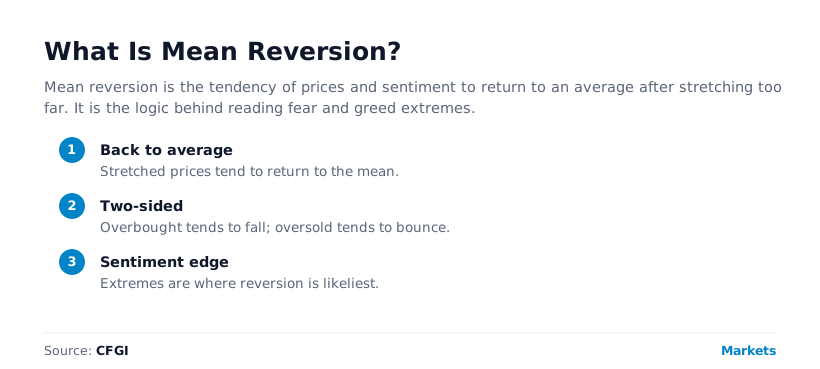
Mean reversion is the idea that prices, valuations and sentiment tend to return toward their long-run average after stretching too far in either direction. Extremes rarely last: a market that runs far above normal often cools, and one that falls far below often recovers. Traders spot it with tools like RSI and Bollinger Bands, but it is unreliable in strong trends, where stretched conditions can persist. Mean reversion is the logic behind reading a Fear and Greed Index, because extreme fear and greed are, by definition, stretched conditions. This is education, not financial advice.
CFGI data
Sentiment is one of the most mean-reverting series there is. CFGI has swung between Extreme Fear and Extreme Greed since 2021 and always returned toward the middle of its 0 to 100 range, never staying pinned at 0 or 100. That tendency to revert is exactly why extreme readings draw attention.
Source: CFGI dataset, 2021 to June 2026.
Key takeaways
- Mean reversion is the pull back toward an average after an extreme.
- It happens because extremes attract opposing forces.
- Traders spot it with tools like RSI and Bollinger Bands.
- It works in range-bound markets and fails in strong trends.
- Sentiment is strongly mean-reverting, the basis for reading extremes.
The Pull Toward Normal
Many things in markets oscillate around a long-run average rather than drifting forever in one direction. Valuations stretch and compress; volatility spikes and fades; sentiment swings between fear and greed. Mean reversion is the observation that, after a big move away from normal, the odds tilt toward a move back. The crucial caveat is timing: mean reversion says extremes tend to resolve, but not when. A stretched market can stay stretched far longer than expected, which is why reversion is a lens, not a trigger.
Why Mean Reversion Happens
Reversion is not magic; it is the result of opposing forces that strengthen as a move becomes extreme. When a price runs far above its average, it becomes expensive, which attracts sellers and profit-takers and discourages new buyers. When it falls far below, it becomes cheap, which tempts bargain-hunters and deters sellers. The same logic applies to the fundamentals beneath prices: unusually high profit margins invite competition that erodes them, and depressed ones get repaired. Think of it as a rubber band, the further something is stretched from its centre, the greater the tension pulling it back. That tension is what mean reversion describes.
How Traders Spot It
Traders use specific tools to measure how far a price has stretched from its mean. The Relative Strength Index, or RSI, flags a market as "overbought" above 70 and "oversold" below 30. Bollinger Bands plot a moving average with bands a couple of standard deviations above and below it, so a price touching the outer band is statistically stretched. A classic mean-reversion trade "fades" these extremes: buying when a market is oversold and near the lower band, selling when it is overbought and near the upper one, betting on a snap back to the middle. The reading itself is just a measure of tension in the rubber band.
Fading the Extreme
Mean-reversion traders do the opposite of the crowd: they sell strength and buy weakness, betting that a stretched price will return to its average rather than keep going.
Mean Reversion Versus Trend-Following
Mean reversion has a direct opposite: trend-following, or momentum. The two strategies make contradictory bets about the same move.
| Mean reversion | Trend-following | |
|---|---|---|
| Belief | Extremes snap back | Trends persist |
| Action on a big rise | Sell, fade it | Buy, ride it |
| Works best in | Range-bound markets | Strong trends |
| Worst enemy | A runaway trend | A choppy, flat market |
Two opposite philosophies.
Neither is right all the time. They suit different market "regimes", and knowing which regime you are in matters more than which philosophy you prefer.
When It Works, and When It Fails
Mean reversion shines in calm, range-bound, choppy markets, where prices genuinely oscillate around a stable centre and stretched readings reliably snap back. Its great danger is the strong trend. In a powerful bull market, a price can stay "overbought" for months while it keeps climbing, and RSI above 70 is confirmation of momentum, not a signal to sell. Fading a real trend is one of the fastest ways to lose money, because the price may simply never return to the old mean, the mean itself is moving. This is the practical face of the warning that "the market can stay irrational longer than you can stay solvent". Mean reversion is a probability, not a promise, and it is most dangerous exactly when a trend feels most extreme.
Mean Reversion and Sentiment
Sentiment is strongly mean-reverting, which is the whole basis for watching a Fear and Greed Index. Unlike a price, which can in theory trend upward forever, a sentiment gauge is bounded, it cannot exceed 100 or fall below 0, and emotion physically cannot stay at fever pitch indefinitely. Extreme Fear and Extreme Greed are stretched conditions that historically do not persist, which is why contrarians treat them as moments to pay attention. The same caveat applies, though: sentiment reverts eventually, but the gauge cannot tell you the day, so the extreme is a lens on the odds, never a trigger by itself.
Frequently asked questions
What is mean reversion?
The tendency of prices, valuations and sentiment to return toward their long-run average after stretching too far. Extremes rarely last, because they attract opposing forces that pull conditions back toward normal.
How do traders measure it?
With tools like the RSI, which flags overbought above 70 and oversold below 30, and Bollinger Bands, which show when a price is statistically stretched from its moving average. A mean-reversion trade "fades" these extremes.
When does mean reversion fail?
In strong trends. A price can stay overbought for months while it keeps rising, and may never return to its old mean, because the mean itself is moving. Fading a real trend is a fast way to lose money.
How does it apply to the Fear and Greed Index?
Sentiment is strongly mean-reverting and bounded between 0 and 100, so extreme fear and greed tend to resolve back toward the middle. That is why contrarians watch them, though it cannot time the turn. This is education, not financial advice.
CFGI.io, Market sentiment research
The CFGI research team builds and maintains the CFGI Fear and Greed Index: a 0 to 100 sentiment score from 10 sub-indicators across hundreds of crypto assets and the equity market, refreshed every 15 minutes. We have tracked market emotion through multiple full crypto and equity cycles.
Think we missed something?
Spotted a gap, disagree with a take, or think we should cover a new topic? Message us and we'll act on your input.
Message us on TelegramKeep reading
This article is educational and is not financial advice. Crypto and equities are volatile and you can lose money. See our disclaimer.