Markets
Fear and Greed Index vs RSI
Quick answer
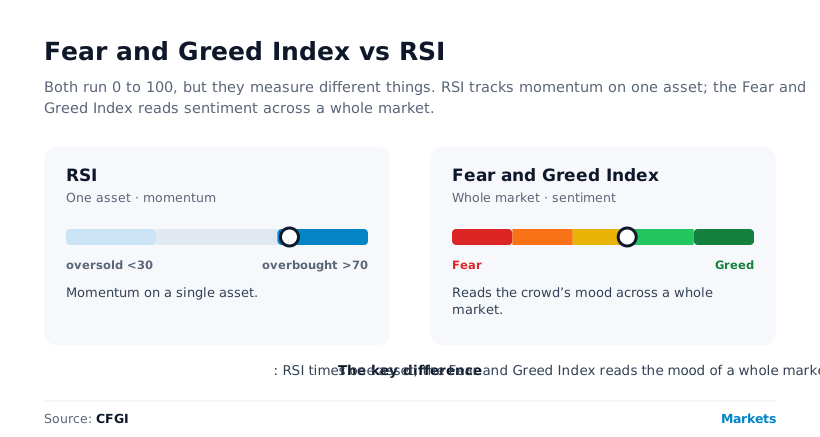
RSI and the Fear and Greed Index both run from 0 to 100, but they measure different things. RSI is a momentum oscillator for one asset: it reads how fast and far price has moved, flagging overbought above 70 and oversold below 30. The Fear and Greed Index reads crowd sentiment across a market from several signals. One is about a single price; the other is about the mood of the crowd, and momentum is just one of the signals it uses. This is education, not financial advice.
CFGI data
RSI scores one asset from its own price momentum. CFGI scores Fear and Greed from 10 indicators across hundreds of assets, refreshed every 15 minutes since March 2022. Price momentum is one of those 10 inputs, so RSI-style information is folded into the CFGI score rather than standing alone.
Source: CFGI dataset, March 2022 to June 2026.
Key takeaways
- RSI is a momentum oscillator for one asset; overbought above 70, oversold below 30.
- It compares average gains to average losses over a period.
- The Fear and Greed Index reads crowd sentiment across a market from several signals.
- Both use a 0 to 100 scale but measure different things.
- Momentum is one of the inputs a Fear and Greed Index uses.
What Does Each One Measure?
RSI, the Relative Strength Index, is a momentum oscillator. It looks at how fast and far a single asset has moved and scores it from 0 to 100, with readings above 70 called overbought and below 30 oversold. It says nothing about other assets or the wider crowd. A Fear and Greed Index measures sentiment across a market, combining several signals, momentum among them, into one score. It is about the mood of the crowd, not the momentum of one price.
How RSI Works
RSI, developed by J. Welles Wilder in 1978, is one of the most popular tools in technical analysis. It works by comparing the magnitude of an asset’s recent gains to its recent losses over a set period, usually the last 14 days, and converting that ratio into a number between 0 and 100. The interpretation is intuitive: a high reading means the asset has been rising strongly and may be "overbought", potentially due for a pullback, while a low reading means it has been falling hard and may be "oversold", potentially due for a bounce. The conventional thresholds are 70 (overbought) and 30 (oversold). Traders also watch for "divergences", where price makes a new high but RSI does not, hinting that momentum is fading beneath the surface. Crucially, RSI is purely a measure of one asset’s own price action, a mechanical read on whether a single price has moved too far, too fast, with no knowledge of news, fundamentals or how anyone else feels.
RSI vs the Fear and Greed Index, Side by Side
| RSI | Fear and Greed Index | |
|---|---|---|
| Measures | Momentum of one asset | Crowd sentiment of a market |
| Inputs | Price only | Several signals (CFGI uses 10) |
| Scope | One asset at a time | A market, or per asset in CFGI |
| Scale | 0 to 100 | 0 to 100 |
| Extremes | Over 70 / under 30 | Over 80 / under 20 |
How RSI and a Fear and Greed Index differ.
The shared 0 to 100 scale invites confusion, but the two answer different questions. RSI asks "has this one price moved too far, too fast?" while a Fear and Greed Index asks "how does the whole crowd feel?"
The Key Difference: One Price Versus the Crowd
The fundamental distinction is one of scope and source. RSI is derived from a single input, the price of one asset, and tells you only about that asset’s recent momentum. A Fear and Greed Index is derived from many inputs across a whole market and tells you about the collective emotional state of the participants. In fact, the relationship between them is hierarchical: momentum, the very thing RSI measures, is just one of the categories of signal that feed into a Fear and Greed Index, so RSI-style information is effectively one ingredient within the broader sentiment score. This means RSI can tell you a specific coin or stock looks stretched on its own chart, but it cannot tell you whether the broader crowd is gripped by fear or greed, that wider, emotional context is precisely what a sentiment index adds. The two operate at different levels: RSI zooms in on the technical state of one price, while the Fear and Greed Index pulls back to read the mood of the entire market.
A Part Within the Whole
RSI reads one asset’s price momentum; the Fear and Greed Index reads a whole market’s mood from many signals, momentum among them. RSI is, in effect, one ingredient inside the broader sentiment score.
Do They Work Together?
Yes. RSI tells you whether a specific asset is stretched on momentum; the Fear and Greed Index tells you whether the wider crowd is fearful or greedy. Used together, an oversold RSI during Extreme Fear is a stronger picture than either alone, the broad sentiment context confirms the single-asset signal, and vice versa. A common workflow is to use the Fear and Greed Index for the big-picture market mood, then drop to RSI on the specific asset you care about to help time an entry or exit within that context. CFGI already uses momentum as one of its 10 inputs, so the two overlap by design, but watching RSI directly on an individual chart still adds precise, asset-level timing detail that the broad sentiment number does not provide.
Frequently asked questions
What is RSI?
The Relative Strength Index, a momentum oscillator that compares an asset’s recent gains to its recent losses (usually over 14 days) and scores it 0 to 100. Above 70 is "overbought" (may pull back), below 30 is "oversold" (may bounce). It reads one asset’s price action only.
Is RSI a sentiment indicator?
RSI measures price momentum on a single asset, not crowd sentiment directly. It reflects sentiment indirectly through price, but it is narrower than a Fear and Greed Index, and momentum is in fact just one of the signals such an index combines across a market.
Do RSI and Fear and Greed use the same 0 to 100 scale?
Both run 0 to 100, but the numbers mean different things. RSI flags overbought above 70 and oversold below 30 for one asset; Fear and Greed flags Extreme Greed above 80 and Extreme Fear below 20 for a whole market.
Which is better?
Neither, they answer different questions. RSI is about one asset’s momentum, Fear and Greed about the crowd’s mood. They are most useful together, the index for context and RSI for asset-level timing, and neither predicts price on its own. This is education, not financial advice.
CFGI.io, Market sentiment research
The CFGI research team builds and maintains the CFGI Fear and Greed Index: a 0 to 100 sentiment score from 10 sub-indicators across hundreds of crypto assets and the equity market, refreshed every 15 minutes. We have tracked market emotion through multiple full crypto and equity cycles.
Think we missed something?
Spotted a gap, disagree with a take, or think we should cover a new topic? Message us and we'll act on your input.
Message us on TelegramKeep reading
This article is educational and is not financial advice. Crypto and equities are volatile and you can lose money. See our disclaimer.