Markets
What Is Contrarian Investing?
Quick answer
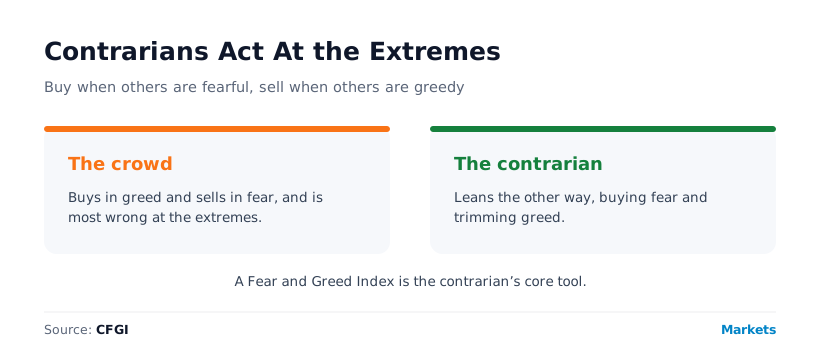
Contrarian investing means going against the crowd: buying when others are fearful and selling when others are greedy. The logic is that the crowd is most wrong at the extremes, because by the time everyone is greedy there are few buyers left, and when everyone is fearful there are few sellers left. It is psychologically hard and risky, since early can be the same as wrong, and measuring the crowd is how a contrarian finds those extremes. This is education, not financial advice.
CFGI data
Contrarian investing acts at the extremes, and CFGI marks them precisely: Extreme Fear under 20, Extreme Greed 80 or above. Those readings are rare, which is the contrarian’s point, the crowd is most one-sided exactly when it is most stretched.
Source: CFGI methodology, 0 to 100 sentiment model.
Key takeaways
- Contrarian investing means going against the crowd at the extremes.
- The crowd tends to be most wrong when it is most one-sided.
- Peak greed leaves few buyers; peak fear leaves few sellers.
- It is hard because it means standing against your own instincts.
- A sentiment reading helps find the extremes, but never times them.
What Is Contrarian Investing?
A contrarian deliberately leans against the prevailing mood. When the crowd is euphoric and buying, the contrarian grows cautious; when the crowd is panicking and selling, the contrarian looks for opportunity. Warren Buffett’s line is the motto: be fearful when others are greedy, and greedy when others are fearful. The underlying belief is not that the crowd is always wrong, most of the time it is roughly right, but that at the emotional extremes, the crowd reliably overshoots, and those overshoots create the gap between price and value that a contrarian aims to exploit.
Why Does It Work At the Extremes?
Because of how fear and greed exhaust themselves. At a top, almost everyone is greedy and has already bought, so there is little buying power left to push prices higher, the market simply runs out of fuel. At a bottom, almost everyone is fearful and has already sold, so it takes little buying to turn the market. The crowd is, in effect, most committed exactly when it is most stretched, and a position with no one left to join it is a position primed to reverse. Note the "at the extremes" part. Going against a mild trend is not contrarian, it is just guessing, and often a good way to fight a perfectly healthy move. The edge, such as it is, sits only at the edges, where sentiment has become genuinely one-sided.
Why Contrarian Investing Is So Hard
If the logic is so simple, why doesn’t everyone do it? Because it runs against every social and emotional instinct we have. Buying during Extreme Fear means purchasing assets when the news is uniformly terrible, prices are crashing, and everyone you know is selling in a panic, it feels reckless, even frightening. Selling during Extreme Greed means cashing out while prices are soaring and everyone is euphoric and getting rich, it feels like you are missing out and being a fool. Humans are deeply wired to seek safety in the herd, so going against it triggers real psychological discomfort. And that is precisely the point: the discomfort is the edge. If acting contrarian felt easy and obvious, everyone would do it and the opportunity would vanish. The reason the extremes offer a potential edge is that so few people have the emotional fortitude to act against the crowd at exactly the moment it is hardest to do so. Contrarian investing is, at bottom, a test of temperament more than intellect.
The Discomfort Is the Edge
Buying when everyone is panicking and selling when everyone is euphoric runs against deep herd instincts. It is hard precisely because it works, if it felt easy, the edge would disappear.
The Risk: Early Is the Same As Wrong
Contrarian investing is far from a guaranteed win, and its central danger is timing. A market in Extreme Fear can become more fearful, and a falling price can keep falling, the trap known as "catching a falling knife". You can be entirely correct that an asset is oversold and still be ruined by buying too early, because, as the saying goes, "the market can stay irrational longer than you can stay solvent". The same is true on the greed side: euphoric markets can stay euphoric and keep rising well past the point any contrarian thinks reasonable. This is why thoughtful contrarians never treat an extreme reading as a precise signal to bet the farm. They manage the risk with patience (waiting for some confirmation rather than catching the exact bottom), with conservative position sizing, and by scaling in gradually rather than all at once. Contrarianism is a philosophy of leaning against extremes with humility and risk control, not a magic formula for calling tops and bottoms.
Why Is Sentiment the Contrarian’s Tool?
Because you cannot lean against the crowd without knowing where the crowd is. A Fear and Greed Index puts a number on it: extreme greed (80 or above) and extreme fear (under 20) flag the moments a contrarian watches for, turning a vague sense that "everyone seems euphoric" into an objective, measurable reading. CFGI has marked the poles at 12 and 87. The honest limit is essential, though: the score reads the present, not the future (79% same-day, 49% next-day). It shows you a stretched crowd, the necessary condition for a contrarian opportunity, but it does not tell you the move has finished stretching, which is exactly why patience and risk management matter so much. The index is the contrarian’s radar for finding the extremes; it is not, and cannot be, the trigger that times them.
Frequently asked questions
What is contrarian investing?
Going against the crowd: buying when others are fearful and selling when others are greedy, on the belief that the crowd overshoots at the emotional extremes. Warren Buffett’s "be fearful when others are greedy, and greedy when others are fearful" is the motto.
Why does it work at the extremes?
Because fear and greed exhaust themselves. At a top, almost everyone has already bought, so there is little buying left to push prices higher; at a bottom, almost everyone has sold, so it takes little to turn the market. The crowd is most committed exactly when it is most stretched.
Why is contrarian investing so hard?
Because it runs against deep herd instincts: buying amid panic and selling amid euphoria feels reckless and triggers real discomfort. That difficulty is the point, if it felt easy, everyone would do it and the edge would vanish. It is a test of temperament more than intellect.
Is contrarian investing risky?
Yes. Being early is the same as wrong: a falling market can keep falling ("catching a falling knife"), and the market can stay irrational longer than you can stay solvent. Contrarians manage that with patience, position sizing and scaling in, not certainty. This is education, not financial advice.
CFGI.io, Market sentiment research
The CFGI research team builds and maintains the CFGI Fear and Greed Index: a 0 to 100 sentiment score from 10 sub-indicators across hundreds of crypto assets and the equity market, refreshed every 15 minutes. We have tracked market emotion through multiple full crypto and equity cycles.
Think we missed something?
Spotted a gap, disagree with a take, or think we should cover a new topic? Message us and we'll act on your input.
Message us on TelegramKeep reading
This article is educational and is not financial advice. Crypto and equities are volatile and you can lose money. See our disclaimer.