Markets
What Is Supply and Demand?
Quick answer
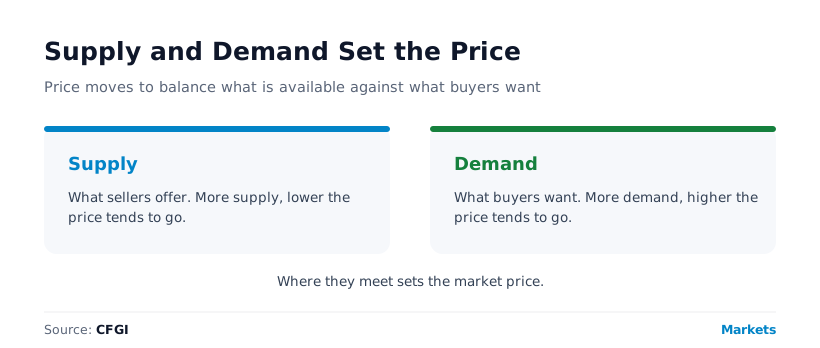
Supply is how much of something is available to sell; demand is how much buyers want it. Price moves to balance the two: scarce and wanted means a higher price, plentiful and unwanted means a lower one. In markets, supply and demand show up as buy and sell orders meeting in real time, and that constant tug between buyers and sellers is also a direct read on whether the crowd is fearful or greedy. This is education, not financial advice.
CFGI data
Supply and demand are sentiment in motion. CFGI reads the flow that drives them, coins moving onto exchanges to sell (fear) versus stablecoins moving in to buy (greed), as part of a 0 to 100 Fear and Greed score, tracked across hundreds of assets every 15 minutes since March 2022.
Source: CFGI methodology and dataset, March 2022 to June 2026.
Key takeaways
- Supply is what is available to sell; demand is what buyers want.
- Price moves to balance the two at an equilibrium.
- When supply is fixed, price moves entirely on demand.
- Scarce plus wanted pushes price up; plentiful plus unwanted pushes it down.
- The flow of buyers and sellers is a direct sentiment signal.
What Is Supply and Demand?
It is the most basic engine in any market. Supply is the amount available for sale. Demand is how much buyers want it. When demand outstrips supply, price rises until the two balance; when supply outstrips demand, price falls. Everything from a coffee to a coin obeys the same rule. It is worth pausing on how universal this is: there is no price anywhere, for any asset, that is not ultimately the outcome of this single tug-of-war between what is available and what is wanted.
How Price Finds Its Balance
Price is the mechanism that brings supply and demand into balance, settling at the point economists call equilibrium, where the amount buyers want exactly matches the amount sellers offer. If a price is set too high, supply exceeds demand, a surplus, and the price must fall to clear it; if too low, demand exceeds supply, a shortage, and competition among buyers drives the price up. A market is constantly hunting for this balancing point, and because the underlying conditions never stop changing, the point itself is always moving. This is the "invisible hand" at work: no one decrees the price, it simply emerges from the collective push and pull of countless buyers and sellers, each acting in their own interest, continuously negotiating until supply and demand meet.
How Does It Set Prices In Markets?
In a financial market, supply and demand show up as sell orders and buy orders meeting in real time. How a price is set is simply where those two pressures balance at that instant, recorded in the "order book" of bids and offers. A wall of buyers lifts the price as they compete for limited shares or coins; a wave of sellers sinks it as they undercut each other to get out. In crypto this is unusually visible, because orders and on-chain flows can be read directly on a crypto exchange, letting you watch supply and demand shift almost in real time. Every tick of a price chart is, at bottom, a tiny adjustment in this balance, the market re-pricing itself as the weight of buying and selling pressure changes.
When Supply Is Fixed
Things get especially interesting when supply cannot grow, because then price moves almost entirely on demand. Bitcoin is the textbook case: its supply is capped at 21 million coins and the rate of new issuance is cut roughly every four years at the halving, so unlike a company that can issue more shares or a central bank that can print more money, there is a hard ceiling. Against a fixed or shrinking supply, any surge in demand has nowhere to go but into the price, which is a large part of why scarce assets, from Bitcoin to gold to limited-edition goods, can move so sharply. This is also why "supply shocks", a sudden change in how much of something is available, such as an oil disruption, can send prices lurching: when supply is rigid, demand does all the work.
Fixed Supply, Demand-Driven Price
When supply cannot grow, like Bitcoin’s 21 million cap, price reflects demand almost alone. A rush of buyers against a hard ceiling has nowhere to go but up.
Why Is It a Sentiment Signal?
Because the choice to buy or sell is an emotional one. A surge of selling supply is fear made visible; a surge of buying demand is greed. Behind every shift in the balance of supply and demand is a human decision driven by mood, so the flow of orders is, in effect, sentiment in motion. CFGI reads exactly this flow, coins moving to exchanges to be sold, stablecoins moving in to buy, as part of its Fear and Greed Index. So supply and demand is not just an economics term; it is the raw material of sentiment. When the crowd turns fearful and rushes to sell, that is a surge of supply; when it turns greedy and piles in, that is a surge of demand, and the index translates the resulting flow into a single number from 0 to 100.
Frequently asked questions
What is supply and demand?
Supply is how much of something is available to sell; demand is how much buyers want it. Price moves to balance the two: scarce and wanted means a higher price, plentiful and unwanted means a lower one. Every price is the outcome of this tug-of-war.
How does supply and demand set price?
Price settles at equilibrium, where the amount buyers want matches the amount sellers offer. Too high a price leaves a surplus and must fall; too low leaves a shortage and rises. In markets, this happens through buy and sell orders meeting in the order book.
What happens when supply is fixed?
Price moves almost entirely on demand. With a fixed supply, like Bitcoin’s 21 million cap, a surge in demand has nowhere to go but into the price, which is why scarce assets can move so sharply.
How is supply and demand a sentiment signal?
Because buying and selling are emotional choices. A surge of selling supply is fear; a surge of buying demand is greed. CFGI reads the flow, sell-side coins onto exchanges versus buy-side stablecoins, as part of its 0 to 100 score. This is education, not financial advice.
CFGI.io, Market sentiment research
The CFGI research team builds and maintains the CFGI Fear and Greed Index: a 0 to 100 sentiment score from 10 sub-indicators across hundreds of crypto assets and the equity market, refreshed every 15 minutes. We have tracked market emotion through multiple full crypto and equity cycles.
Think we missed something?
Spotted a gap, disagree with a take, or think we should cover a new topic? Message us and we'll act on your input.
Message us on TelegramKeep reading
This article is educational and is not financial advice. Crypto and equities are volatile and you can lose money. See our disclaimer.