Markets
What Is Mental Accounting?
Quick answer
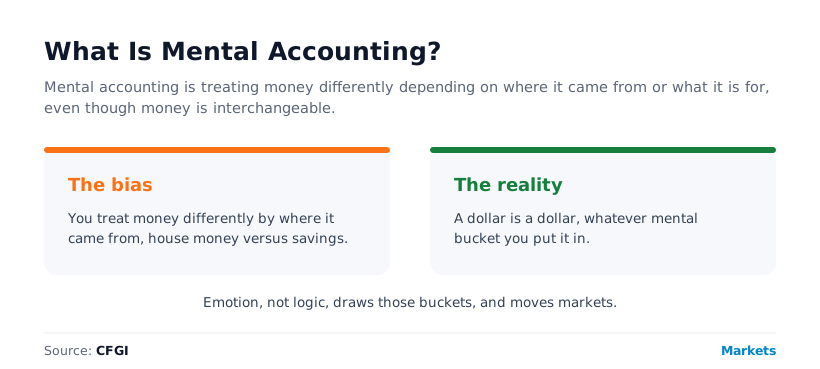
Mental accounting is the habit of treating money differently depending on its source or label, even though a dollar is a dollar wherever it comes from. People will gamble winnings they would never risk from their salary, splurge a tax refund they would have saved as wages, or cling to a losing stock kept in its own mental bucket. In investing, this habit quietly drives inconsistent, often irrational decisions about risk and money.
CFGI data
Mental accounting splits money into separate buckets; CFGI deliberately scores the crowd as one. Its single reading on a 0 to 100 scale, tracked since March 2022, treats the whole market as one pool of emotion, the exact opposite of the fragmented, bucket-by-bucket view this bias creates in an individual investor.
Source: CFGI methodology, 0 to 100 sentiment model.
Key takeaways
- Mental accounting means treating money differently by its source or label.
- It violates fungibility, the principle that a dollar is a dollar.
- The "house-money effect" makes people risk winnings far more freely.
- It is linked to the sunk-cost fallacy and judging positions in isolation.
- The fix is to treat all your money and holdings as one pool.
Money In Separate Buckets
In strict economic terms, money is fungible: a dollar of salary and a dollar of lottery winnings are identical and should be treated the same. Mental accounting breaks that rule. The mind sorts money into separate buckets, savings, winnings, bonus, "fun money", holiday fund, and applies different rules to each. People will take wild risks with "house money" from a lucky trade while fiercely guarding the money in their salary account, even though every dollar buys exactly the same things.
Where the Idea Comes From
Mental accounting was developed by the economist Richard Thaler, who won the 2017 Nobel Memorial Prize in Economics partly for this work. His insight was that people value things in relative rather than absolute terms and take pleasure not just from what they own but from the perceived quality of the deal, what he called transaction utility. That focus on labels and feelings, rather than cold arithmetic, is why the same person can be reckless and cautious with identical sums of money depending only on the story attached to them.
The House-Money Effect
The sharpest example is the house-money effect. A gambler who is up for the night will bet the winnings freely, reasoning that it is "the casino’s money", not their own, even though the moment it was won it became entirely theirs. The same instinct runs straight through investing. After a big gain, a run in a hot stock, a windfall from a crypto rally, people often treat the profit as play money and pile it into riskier and riskier bets they would never have made with their original capital.
The Hidden Cost
Once money is yours, it is all equally yours. "House money" is a story, not a category, and the risks you take with it are just as real as any other.
Windfalls, Refunds and Bonuses
The same bias shapes everyday choices. A tax refund, a work bonus or an unexpected gift, "windfall" money, tends to be spent far more readily than the identical amount earned as wages, which would more likely be saved. The label, "found money" versus "earned money", changes the behaviour, even though the bank balance is the same. None of this is stupid; it is deeply human, and marketers know it well. But recognising it is the first step to not being quietly steered by it.
The Sunk-Cost Connection
Mental accounting is closely tied to the sunk-cost fallacy, the urge to keep going because of money already spent. Thaler’s own example: a family pays 40 dollars for basketball tickets to a game 60 miles away, then a snowstorm hits. They drive through it anyway, yet admit that had the tickets been free, they would have stayed home safe. The money was already gone either way, but it had been "booked to an account" that the mind wanted to balance. In markets this becomes holding a losing position long past sense, just to avoid closing the account at a loss.
Why It Trips Investors Up
In a portfolio, mental accounting shows up in three recurring ways: judging each position in isolation instead of as part of the whole portfolio, holding a big loser because it sits in a separate mental bucket from the winners, and speculating recklessly with gains relabelled as house money. It is one of the most common traps in behavioural finance. The remedy is simple to state and hard to do: treat all your money and every position as one pool, and make each decision on the merits of the total picture, not the label you have stuck on the part.
Mental Accounting and Sentiment
The house-money effect is not just an individual quirk; in aggregate it helps drive bull-market excess. After a long run of gains, a whole market full of investors treating profits as free money takes greater and greater risks, which is exactly the behaviour that pushes a Fear and Greed Index toward greed on its 0 to 100 scale. Watching the crowd’s mood as one number is a useful counterweight to a bias that constantly tempts you to carve your own money into separate, inconsistent pieces.
Frequently asked questions
What is mental accounting?
The habit of treating money differently depending on its source or label, such as risking winnings more freely than salary or splurging a windfall, even though money is fungible and a dollar is a dollar.
What is the house-money effect?
The tendency to take bigger risks with money seen as winnings, "the house’s money", than with your original capital, even though once won it is entirely yours. It often drives reckless bets after a gain.
Who came up with mental accounting?
The economist Richard Thaler, who won the 2017 Nobel Memorial Prize in Economics. It is a cornerstone idea of behavioural finance and is closely linked to the sunk-cost fallacy.
How do you avoid mental accounting?
Treat all your money and holdings as one single pool and make decisions on the total picture, not the label attached to each part. This is education, not financial advice.
CFGI.io, Market sentiment research
The CFGI research team builds and maintains the CFGI Fear and Greed Index: a 0 to 100 sentiment score from 10 sub-indicators across hundreds of crypto assets and the equity market, refreshed every 15 minutes. We have tracked market emotion through multiple full crypto and equity cycles.
Think we missed something?
Spotted a gap, disagree with a take, or think we should cover a new topic? Message us and we'll act on your input.
Message us on TelegramKeep reading
This article is educational and is not financial advice. Crypto and equities are volatile and you can lose money. See our disclaimer.