Markets
Fear and Greed Index vs Google Trends
Quick answer
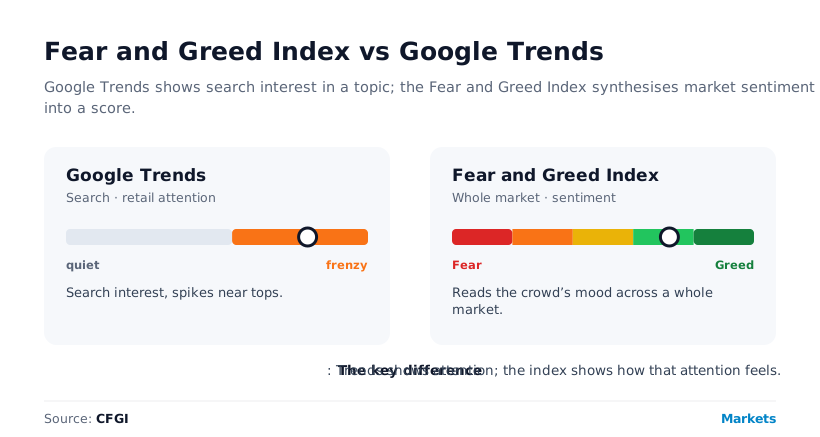
Google Trends measures how often people search for a term, a proxy for public attention and curiosity. The Fear and Greed Index measures something deeper: market sentiment itself, synthesised from 10 indicator groups into a 0 to 100 score. A spike in searches for "buy bitcoin" can hint at retail interest, often near a top, but it does not tell you whether the market is fearful or greedy. The two answer different questions. This is education, not financial advice.
CFGI data
Search interest is a single, noisy signal; CFGI is a synthesis. CFGI blends 10 indicators, including momentum and volatility, into one 0 to 100 score across hundreds of assets and four timeframes since March 2022, capturing sentiment that raw search volume cannot.
Source: CFGI dataset and public information on search-trend data, June 2026.
Key takeaways
- Google Trends measures search interest in a term.
- It is a proxy for public attention, not market sentiment.
- Peak public search interest often clusters near tops.
- The Fear and Greed Index synthesises 10 indicators into 0 to 100.
- Search spikes can flag retail interest but not fear or greed directly.
Attention vs Sentiment
Google Trends is a measure of curiosity. When a topic spikes in searches, more people are paying attention, which can mark moments of retail FOMO or panic. But a search is not a position; high interest in "is bitcoin crashing" and "buy bitcoin now" can both spike at once, and Trends alone cannot separate fear from greed. The Fear and Greed Index is built to read that mood directly. Search-style attention can be one input among many, but the score also weighs volatility, momentum and volume into a single 0 to 100 reading.
| Google Trends | Fear and Greed Index | |
|---|---|---|
| Measures | Search interest | Market sentiment |
| Tells you | How many are curious | How fearful or greedy |
| Source | Search queries | 10 indicator groups |
| Direction | Ambiguous on its own | Fear to greed, 0 to 100 |
| Best as | An attention proxy | A sentiment gauge |
Google Trends versus the Fear and Greed Index.
What Google Trends Actually Shows
Google Trends reports the relative popularity of a search term over time, scaled from 0 to 100 against its own peak, rather than an absolute number of searches. As a market tool, it is essentially a gauge of mainstream, retail attention: when search interest in "Bitcoin" or "how to buy crypto" surges, it tells you the general public, not just existing investors, is suddenly paying attention. This makes it genuinely useful for spotting the arrival of fresh retail interest, the new money that often pours in late in a rally. The catch, as noted, is direction: a search term is ambiguous. A spike could reflect greedy newcomers searching "how to buy" or frightened holders searching "is it a scam", and the raw trend line cannot distinguish the two. It measures the volume of attention, not its emotional content, which is precisely the gap a dedicated sentiment gauge fills.
Attention As a Contrarian Signal
Where Google Trends earns its keep is as a rough contrarian gauge of retail mania, and the logic is the same that underpins a Fear and Greed Index at its extremes. When search interest in an asset goes parabolic, when "everyone" is suddenly googling how to buy it, it often signals that the move is in its late, euphoric stage. The reasoning is intuitive: the general public tends to notice and chase an asset only after a huge run-up, so a peak in mainstream search attention frequently arrives near a price top, just as the last wave of FOMO buyers piles in. Historically, the biggest spikes in retail search interest for crypto have clustered around major market peaks. The mirror, total public indifference after a long decline, can mark the apathy of a bottom. So while it is noisy and not a precise tool, a parabolic spike in search interest is worth treating, like Extreme Greed, as a reason for caution rather than excitement, a sign the crowd has arrived.
When Everyone Is Googling It
Peak retail search interest tends to arrive near tops, as the public chases an asset only after a big run-up. Like Extreme Greed, a parabolic search spike is a reason for caution, not excitement.
Using Them Together
They can be complementary. A surge in Google searches for a coin alongside an Extreme Greed reading is a powerful late-cycle combination: the index confirms the mood is euphoric, while Trends confirms that fresh retail attention is pouring in to feed it, exactly the conditions that often precede a top. The index tells you the mood; Trends hints at how much new attention is arriving and from whom. Used this way, search data adds a useful dimension the sentiment score alone does not capture, the influx of the general public, while the Fear and Greed Index supplies the emotional read and direction that raw search volume lacks. Neither predicts a top on its own, but together they paint a richer picture of a crowded, attention-fuelled market than either could alone.
Frequently asked questions
What does Google Trends show?
The relative popularity of a search term over time, scaled 0 to 100 against its own peak. As a market tool it is a proxy for mainstream, retail attention: a surge means the general public is suddenly paying attention to an asset.
Is Google Trends a sentiment indicator?
It is an attention proxy, not a direct sentiment measure. It shows how many people are searching for a term, but not whether they are fearful or greedy, "is it crashing" and "how to buy" can spike together. The Fear and Greed Index reads the mood itself.
Can Google Trends predict markets?
It can flag spikes in retail attention, which often cluster near tops as the public chases an asset after a big run-up, a rough contrarian signal. But on its own it is noisy and ambiguous on direction, so it is best paired with a sentiment gauge, not used alone.
Which should I use?
For attention, Google Trends; for fear and greed, the Fear and Greed Index. A parabolic search spike alongside an Extreme Greed reading is a telling late-cycle combination, more useful than either alone. This is education, not financial advice.
CFGI.io, Market sentiment research
The CFGI research team builds and maintains the CFGI Fear and Greed Index: a 0 to 100 sentiment score from 10 sub-indicators across hundreds of crypto assets and the equity market, refreshed every 15 minutes. We have tracked market emotion through multiple full crypto and equity cycles.
Think we missed something?
Spotted a gap, disagree with a take, or think we should cover a new topic? Message us and we'll act on your input.
Message us on TelegramKeep reading
This article is educational and is not financial advice. Crypto and equities are volatile and you can lose money. See our disclaimer.