Crypto
Fear and Greed Index vs Social Sentiment
Quick answer
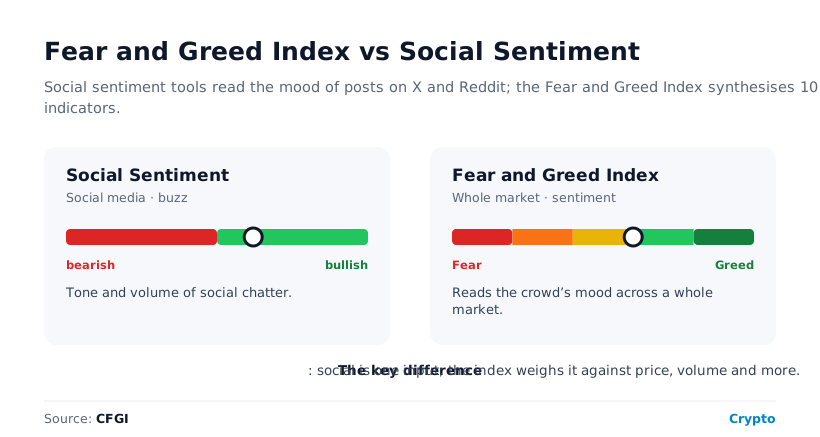
Social sentiment tools analyse the tone of posts on platforms like X and Reddit to gauge whether the crowd is bullish or bearish. The Fear and Greed Index is broader: social chatter is just one of 10 indicator groups it folds into a single 0 to 100 score. Social-only signals are fast but noisy and easy to manipulate with bots and coordinated hype; a synthesised index is steadier because no single input can swing it. This is education, not financial advice.
CFGI data
Social is one input to CFGI, deliberately not the whole. CFGI blends 10 indicators into one 0 to 100 score across hundreds of assets and four timeframes since March 2022, so coordinated hype or a bot-driven spike cannot move the reading the way it can move a social-only score.
Source: CFGI dataset and public information on social-sentiment tools, June 2026.
Key takeaways
- Social sentiment reads the tone of posts on X and Reddit.
- It uses language analysis to classify mood and mentions.
- It is fast but noisy and vulnerable to manipulation.
- The Fear and Greed Index treats social as one of 10 inputs.
- No single input can swing a synthesised score.
Why Social Alone Is Fragile
Social sentiment analysis is appealing because it is immediate, it reads the crowd in real time. But it has a weakness: social feeds are noisy and can be gamed. Coordinated hype, bot networks and a handful of viral posts can all distort a social-only reading, making the crowd look more bullish or bearish than it really is. The Fear and Greed Index guards against that by design. Social signal is one of 10 indicator groups, weighed against volatility, momentum, volume and more, so a spike in posts alone does not dominate the score.
| Social sentiment | Fear and Greed Index | |
|---|---|---|
| Input | Posts on X, Reddit | 10 indicators blended |
| Speed | Real-time | Refreshed every 15 min |
| Weakness | Noisy, gameable | No single input dominates |
| Per asset | Varies | Yes, hundreds of assets |
| Best as | A buzz read | A balanced gauge |
Social sentiment versus the Fear and Greed Index.
What Social Sentiment Analysis Is
Social sentiment analysis uses natural-language processing, a form of AI that "reads" text, to scan huge volumes of posts across platforms like X (Twitter), Reddit, Telegram and Discord, and classify their tone as bullish, bearish or neutral. Typically it tracks two things: the volume of mentions (how much an asset is being talked about) and the polarity of that conversation (how positive or negative it is), then aggregates them into a real-time sentiment reading. The appeal is obvious, it offers a direct, instantaneous pulse of what the crowd is actually saying, often picking up a shift in mood or an emerging narrative before it fully shows up in price. For spotting what is suddenly catching fire in the community, it is a genuinely useful, fast-moving signal, and it is exactly the kind of data that social-focused platforms specialise in surfacing.
The Manipulation Problem
The fundamental weakness of pure social sentiment, especially in crypto, is that social media is uniquely easy to manipulate, and crypto is uniquely motivated to manipulate it. Bot armies and fake "sockpuppet" accounts can manufacture the appearance of a groundswell of enthusiasm for a coin; paid influencers and coordinated "shill" campaigns can flood the timeline with bullish messaging on cue; and a single viral post from a big account can swing the apparent mood in minutes. On top of deliberate manipulation, the technology itself struggles with the irony, sarcasm and in-jokes that saturate crypto culture, an account posting "great, my bags are down 90% again" may be read as positive by a naive algorithm. All of this means a social-only sentiment score can be loud, fast and badly wrong at the same time. It is precisely because of this fragility that a well-built Fear and Greed Index treats social as just one input among ten: by weighing it against hard, harder-to-fake market data like volatility, volume and price action, the index ensures that a manufactured social spike cannot, by itself, hijack the reading.
Loud, Fast, and Easily Faked
Bots, paid shills and viral posts can manufacture social "sentiment" on demand, and algorithms misread crypto irony. That fragility is why a Fear and Greed Index treats social as one input among ten, not the whole.
Which Should You Trust?
Social sentiment is useful for spotting what is catching attention, but it is shaky as a standalone signal. A synthesised index is the steadier read of fear and greed, precisely because it does not rely on chatter alone, a manufactured wave of hype that fools a social-only tool will barely move a score anchored in hard market data. The buzz can flag a theme worth investigating; the index tells you whether that theme is really moving the broader mood or just making noise. The sensible approach is to treat social sentiment as an early-warning radar for narratives and attention, while leaning on a balanced sentiment gauge for your actual read on whether the crowd is fearful or greedy, using the fast-but-fragile signal to ask questions and the steadier one to answer them.
Frequently asked questions
What is social sentiment analysis?
Using natural-language processing (a form of AI) to scan posts across X, Reddit, Telegram and Discord and classify their tone as bullish, bearish or neutral, tracking both the volume of mentions and the polarity of the conversation into a real-time reading.
Is the Fear and Greed Index based on social sentiment?
Only partly. Social chatter is one of 10 indicator groups in the CFGI score. Pure social-sentiment tools rely on posts alone, which makes them faster but noisier and easier to manipulate.
Why is social-only sentiment risky?
Because social feeds are easily gamed, bot armies, paid shills and coordinated campaigns can manufacture hype, and algorithms misread crypto irony and sarcasm. A few viral posts can swing the reading. A synthesised index resists this because no single input dominates.
Should I use social sentiment at all?
It is useful as an early radar for trending themes and emerging narratives, but pair it with a broader sentiment gauge rather than trusting it alone. Use the fast signal to ask questions and the steadier one to answer them. This is education, not financial advice.
CFGI.io, Market sentiment research
The CFGI research team builds and maintains the CFGI Fear and Greed Index: a 0 to 100 sentiment score from 10 sub-indicators across hundreds of crypto assets and the equity market, refreshed every 15 minutes. We have tracked market emotion through multiple full crypto and equity cycles.
Think we missed something?
Spotted a gap, disagree with a take, or think we should cover a new topic? Message us and we'll act on your input.
Message us on TelegramKeep reading
This article is educational and is not financial advice. Crypto and equities are volatile and you can lose money. See our disclaimer.