Markets
What Is Availability Bias?
Quick answer
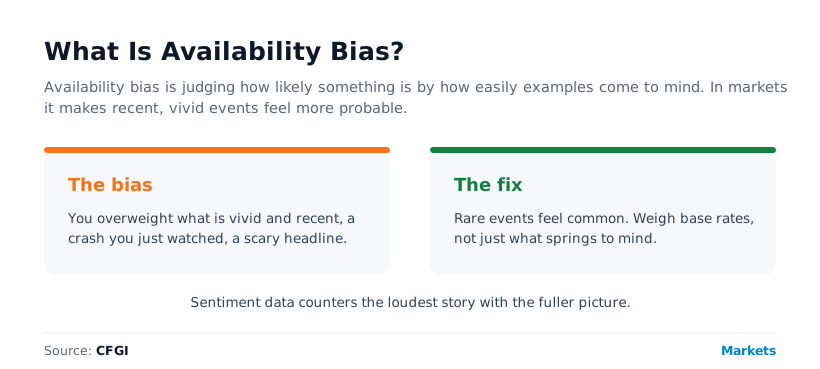
Availability bias is the tendency to judge how likely something is by how easily examples spring to mind, rather than by its real probability. In markets, a recent crash or a dramatic headline feels far more likely to repeat than the data suggests, simply because it is fresh and vivid. The result is that investors over-fear what just happened and over-chase whatever is in the news, mistaking how memorable something is for how probable it actually is.
CFGI data
Availability bias is part of what pushes sentiment to extremes. A vivid crash keeps fear elevated long after the data has moved on; a viral winner fuels greed well past reason. CFGI measures the crowd mood these biases produce on a 0 to 100 scale, tracked since March 2022, where the readings often run hotter or colder than the facts alone would justify.
Source: CFGI dataset, March 2022 to June 2026.
Key takeaways
- Availability bias judges likelihood by ease of recall, not real odds.
- Vivid, recent, emotional events feel more probable than they are.
- It was identified by Tversky and Kahneman in 1973.
- It makes investors over-fear crashes and over-chase hyped winners.
- The cure is to anchor on base rates and long-run data, not the loudest story.
What Comes to Mind Feels Likely
The brain estimates probability with a shortcut: if examples come to mind easily, it assumes the thing must be common. Most of the time that shortcut is useful, but it misfires badly when vivid or recent events dominate memory. After a dramatic market crash, another crash feels imminent, even when history says such events are rare, simply because the last one is so easy and so painful to recall.
Where It Comes From
Availability bias was identified by the psychologists Amos Tversky and Daniel Kahneman in 1973, as part of the research that founded behavioural economics. Their finding was stranger than "people are bad at probability". They showed that people often do not calculate probability at all; instead they substitute an easier question, "how easily can I think of an example?", and answer that one without noticing the swap. Ease of recall stands in for actual frequency, and we rarely realise we have made the trade.
What Makes a Memory "Available"
The trouble is that what is easy to recall has little to do with what is actually common. Retrievability is driven by vividness, recency, emotional intensity and sheer repetition, none of which track the real odds. A single dramatic, frightening or much-repeated event lodges in memory and then dominates our sense of how likely it is. The modern news cycle supercharges this: the more sensational an event, the more coverage it gets, the more available it becomes, and the more we overestimate its probability, a self-reinforcing feedback loop running between the media and our own memory.
The Classic Examples
Outside markets, the bias is everywhere. People fear shark attacks and plane crashes, which are vivid and heavily reported, far more than car accidents and drownings, which are vastly more common but rarely make headlines. People rush to buy disaster insurance right after a disaster, when the risk feels real, and let it lapse once the memory fades, even though the underlying odds barely changed. In each case, the feeling of risk follows the vividness of the example, not the statistics.
The Tell
If your sense of how likely something is rests on one vivid story rather than the long-run numbers, availability bias is probably steering you. Ask what the base rate actually says.
How It Distorts Investing
In markets the bias is costly in both directions. After a crash, the vivid memory of falling prices keeps investors fearful and on the sidelines long after the danger has passed, so they miss the recovery. During a boom, a friend’s spectacular, easy gains become the most available example, inflating everyone’s sense of the typical return and fuelling a rush to chase whatever is hot. It overlaps closely with recency bias, the habit of assuming the recent past will simply continue. Both lead to the same trap: buying high on a vivid success story and selling low on a vivid disaster.
How to Counter It
- Anchor on base rates: ask what the long-run history actually says, not what the latest headline suggests.
- Distrust the vivid: the more dramatic and memorable an event, the more likely you are overweighting it.
- Widen the sample: one friend’s windfall or one scary crash is an anecdote, not a probability.
- Write down your reasoning before the news, so a single event cannot quietly rewrite your view.
Availability Bias and Sentiment
Availability bias is one of the engines that pushes a market’s mood past where the facts justify. A vivid crash keeps the crowd fearful long after conditions improve, and a viral success story keeps it greedy well after valuations stretch, which is exactly the gap between feeling and fundamentals that a Fear and Greed Index captures on a 0 to 100 scale. Seeing the bias for what it is helps you read an extreme sentiment reading correctly: often it reflects how loud and recent the story is, rather than how likely the outcome actually turns out to be.
Frequently asked questions
What is availability bias?
The tendency to judge how likely something is by how easily examples come to mind, rather than by actual probability. Vivid, recent and emotional events feel more probable than they really are.
Who discovered availability bias?
The psychologists Amos Tversky and Daniel Kahneman identified the availability heuristic in 1973, as part of the work that founded behavioural economics.
How does availability bias affect investing?
It makes investors overweight whatever is in the news: over-fearing a recent crash and missing the recovery, or over-chasing a hyped winner after one vivid success story, instead of weighing the real odds.
How do you counter availability bias?
Anchor decisions on base rates and long-run data rather than the most memorable story, distrust vivid one-off examples, and be wary when a single dramatic event is driving your view. This is education, not financial advice.
CFGI.io, Market sentiment research
The CFGI research team builds and maintains the CFGI Fear and Greed Index: a 0 to 100 sentiment score from 10 sub-indicators across hundreds of crypto assets and the equity market, refreshed every 15 minutes. We have tracked market emotion through multiple full crypto and equity cycles.
Think we missed something?
Spotted a gap, disagree with a take, or think we should cover a new topic? Message us and we'll act on your input.
Message us on TelegramKeep reading
This article is educational and is not financial advice. Crypto and equities are volatile and you can lose money. See our disclaimer.