Crypto
Buy the Fear, Sell the Greed: What It Means
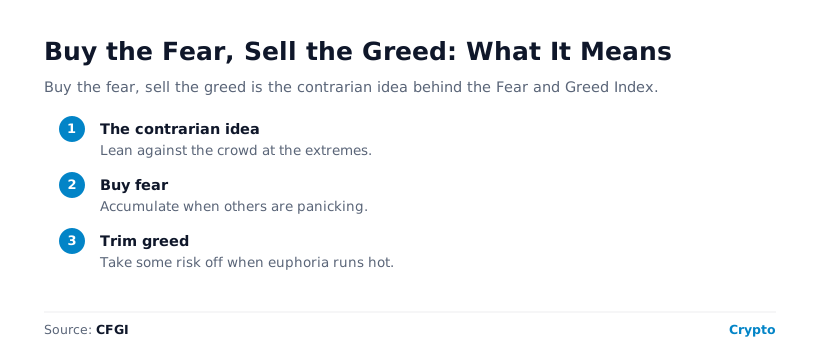
Quick answer
Buy the fear, sell the greed means leaning against the crowd: looking for value when sentiment is extremely fearful and trimming risk when it is extremely greedy. It does not mean mechanically buying every dip or selling every rally. The logic is that the crowd is most one-sided at turning points, but it is a framework, not a guarantee, because fear and greed can both persist far longer than expected. This is education, not financial advice.
CFGI data
The idea rests on extremes being rare and meaningful. In CFGI crypto data since March 2022, Extreme readings cluster near turning points but do not mark them precisely, the index matches same-day market direction 79% of the time and the next day only 49%, so timing off sentiment alone is unreliable.
Source: CFGI dataset, March 2022 to June 2026.
Key takeaways
- It means leaning against the crowd at sentiment extremes.
- It is a bias and a framework, not a mechanical buy/sell rule.
- Buy interest rises at Extreme Fear; risk is trimmed at Extreme Greed.
- The logic is that the crowd is most one-sided near turning points.
- The risk is real: fear and greed can persist for a long time.
Where the Phrase Comes From
It is a plain version of Warren Buffett’s line about being greedy when others are fearful and fearful when others are greedy. The Fear and Greed Index puts a number on the crowd, so the idea becomes concrete: extreme fear, under 20, is when others are most fearful; extreme greed, over 80, is when they are most greedy. The reasoning is that markets overshoot. When everyone has already sold in fear, there is little selling left; when everyone has already bought in greed, there is little buying left. Extremes mark where the crowd is most stretched, and therefore most likely to reverse.
What It Really Means, and What It Does Not
It is easy to misread this phrase, so it is worth being precise. "Buy the fear, sell the greed" is a contrarian bias to apply at the extremes, not a mechanical trading system. "Buy the fear" does not mean reflexively buying every dip or catching every falling knife; it means that, when sentiment reaches genuine Extreme Fear, you lean toward looking for value, accumulating quality assets gradually, and resisting the urge to panic-sell with the crowd. "Sell the greed" does not mean dumping everything or trying to short the top; it means that, when sentiment reaches Extreme Greed, you lean toward trimming risk, taking some profits, and growing more cautious. The whole idea operates only at the extremes, in the noisy middle of the scale, it gives no signal at all. And it is a directional bias, a tilt in how you manage exposure, not a precise instruction to go all-in or all-out. Read this way, it is a discipline for resisting your own emotions; read mechanically, it is a recipe for fighting strong trends.
A Bias, Not a System
"Buy the fear" means look for value and resist panic at Extreme Fear; "sell the greed" means trim risk at Extreme Greed. It is a directional tilt at the extremes, not a rule to go all-in or all-out, or to buy every dip.
Why It Can Work, and When It Fails
It can work because sentiment extremes do cluster near turning points, the exhaustion of buyers at a top and sellers at a bottom is real. It fails when sentiment stays extreme: in a deep downtrend, fear can read low for weeks while price keeps falling, and in a strong run, greed can stay high while price climbs further. The phrase is a bias to lean on, not a trigger to act on blindly. There is also an asymmetry worth knowing: "buy the fear" tends to be the more reliable half, because fear is a violent, self-exhausting emotion that burns out quickly near bottoms, while greed can simmer and persist for a long time, making "sell the greed" the trickier, more easily-too-early side of the trade.
The Honest Risk
Buying every Extreme Fear and selling every Extreme Greed can lose money if the trend persists. Sentiment is context for a plan, not a substitute for one. Combine it with trend, position sizing and your own risk limits. This is education, not financial advice.
Applying It Sensibly
Most people use it to size decisions rather than make them: leaning slightly more cautious as greed builds, slightly more interested as fear deepens, while respecting the trend. A practical way to put it to work is to scale gradually rather than betting on a single moment, accumulating in increments as fear deepens, trimming in stages as greed builds, which sidesteps the impossible task of calling the exact turn and keeps any one decision survivable. Waiting for an extreme and for the price trend to begin confirming, rather than acting on the first low or high reading, adds a layer of safety. Per-asset scoring helps a great deal too, because you can act on the specific coin sitting at an extreme rather than the whole market average, sharpening the idea from a vague market call into a focused, asset-level decision. Applied with patience, gradual sizing and respect for the trend, "buy the fear, sell the greed" becomes a sound discipline rather than a reckless gamble.
Frequently asked questions
What does "buy the fear, sell the greed" mean?
Leaning against the crowd at sentiment extremes: looking for value and resisting panic when the Fear and Greed Index is in Extreme Fear, and trimming risk and growing cautious when it is in Extreme Greed. It is a plain version of Buffett’s "be greedy when others are fearful".
Is it a mechanical trading rule?
No. It is a contrarian bias to apply at the extremes, not a system. "Buy the fear" does not mean catching every falling knife, and "sell the greed" does not mean dumping everything or shorting the top, it is a directional tilt in how you manage exposure, and it gives no signal in the noisy middle.
Does it actually work?
Sometimes. Sentiment extremes cluster near turning points, but they can also persist. CFGI data matches same-day direction 79% of the time and the next day only 49%, so it is a bias to lean on, not a reliable trigger. "Buy the fear" tends to be more dependable than "sell the greed".
How should I apply it?
Use it to size decisions, not make them: scale in gradually as fear deepens and trim in stages as greed builds, wait for the trend to confirm, act on the specific asset at an extreme, and always combine it with risk management. This is education, not financial advice.
CFGI.io, Market sentiment research
The CFGI research team builds and maintains the CFGI Fear and Greed Index: a 0 to 100 sentiment score from 10 sub-indicators across hundreds of crypto assets and the equity market, refreshed every 15 minutes. We have tracked market emotion through multiple full crypto and equity cycles.
Think we missed something?
Spotted a gap, disagree with a take, or think we should cover a new topic? Message us and we'll act on your input.
Message us on TelegramKeep reading
This article is educational and is not financial advice. Crypto and equities are volatile and you can lose money. See our disclaimer.