Markets
How to Use the Fear and Greed Index
Quick answer
Use the Fear and Greed Index as a contrarian gauge and a discipline check. Extreme Fear, under 20, suggests the crowd may be too pessimistic; Extreme Greed, over 80, suggests it may be too optimistic. It is most informative at the extremes and noise in the middle, the direction it is travelling matters as much as the level, and it works best as one input alongside price, trend and a plan. This is education, not financial advice.
CFGI data
The index reads the present well and the future barely: CFGI data matches same-day market direction 79% of the time and the next day only 49%, since March 2022. That is the core rule of using it, treat it as context for now, not a forecast of tomorrow.
Source: CFGI dataset, March 2022 to June 2026.
Key takeaways
- Read it as a contrarian gauge: fear extremes versus greed extremes.
- It is most useful at the extremes, noise in the neutral middle.
- The direction it is travelling matters as much as the level.
- It reads the present well, not the future.
- Use it with price, trend and a plan, never alone.
A Simple Way to Use It
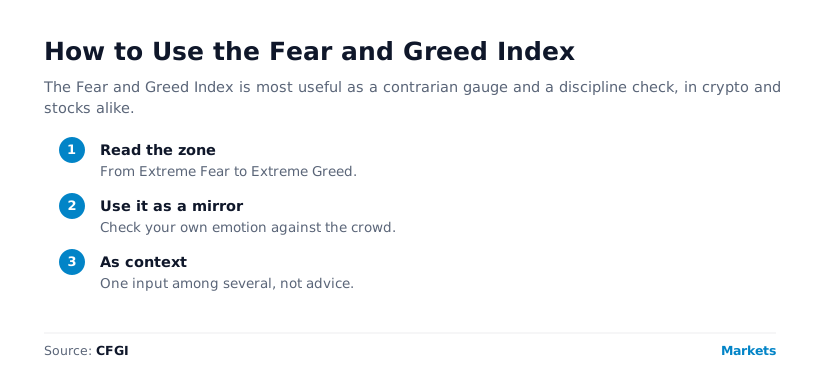
The Fear and Greed Index turns crowd emotion into a 0 to 100 number. The simplest sound way to use it is in three steps: watch the extremes, ignore the middle, and never act on it alone.
- Watch the extremes. Under 20 and over 80 are where the crowd is most one-sided, and where the index is most informative.
- Ignore the middle. Around 40 to 59, sentiment is balanced and the reading is mostly noise.
- Combine it. Check it against price and trend. Persistent fear in a downtrend is a warning, not a green light.
Use It As a Contrarian Gauge
The primary, time-tested way to use the index is as a contrarian tool, captured in Warren Buffett’s maxim to "be fearful when others are greedy, and greedy when others are fearful". The logic is that the crowd is usually most wrong at the extremes, so a reading of Extreme Greed is a prompt to grow cautious and manage risk, because optimism may have run too far, while a reading of Extreme Fear is a prompt to look for opportunity, or at least resist panic-selling, because pessimism may be overdone. This does not mean mechanically buying every low reading and selling every high one, but rather using the extremes to lean against the prevailing mood and to question your own emotions. If the index is screaming Extreme Greed and you feel a powerful urge to buy, that alignment is itself the warning. The contrarian use is the heart of why the tool exists at all.
Lean Against the Crowd
Extreme Greed is a prompt for caution; Extreme Fear a prompt to look for opportunity. The index is most useful for leaning against the prevailing mood, and for checking your own emotions against the crowd’s.
Read Direction, Not Just Level
A more advanced habit, and one many people miss, is to pay attention to the direction the score is travelling, not only where it currently sits. A reading of 40 means something very different depending on its trajectory: a 40 that has been falling fast out of greed describes a market cooling and turning nervous, while a 40 climbing steadily up out of the single digits describes one rebuilding its confidence after a panic. The momentum of the mood often carries more information than the static number. The same applies to speed: a sharp, sudden plunge into fear is the signature of a shock, while a slow grind lower suggests a more gradual erosion of nerve. Reading the index as a moving line, on its chart, rather than as a single live dial, lets you see whether the crowd is moving toward an extreme or away from one, which is frequently the more useful question than simply "where is it now?"
It Works the Same In Crypto and Stocks
The method is identical across markets, only the speed differs: crypto refreshes every 15 minutes, stocks daily. Because CFGI scores both on one scale and scores assets individually, you can apply the same reading to a single coin, a single stock, or a whole market. One refinement worth knowing is that different crowds reach the extremes differently, the equity crowd rarely hits Extreme Greed, so a high stock reading is a notable event, while crypto reaches both extremes more readily, so its high and low readings need to be judged against crypto’s own, wider range. The core method, though, watch the extremes, read the direction, combine with price, never act alone, is the same wherever you point it.
What It Cannot Do
Finally, it is essential to be clear about the index’s limits, because misusing it is the fastest way to be disappointed by it. The index does not predict price. It reads the present mood accurately but forecasts the next move poorly, matching the same day 79% of the time but the next day only 49%, essentially a coin flip. Crucially, sentiment can stay extreme for a long time: markets can remain greedy, or fearful, far longer than seems reasonable, so an extreme reading is context, not a trigger to act immediately. The disciplined approach is to decide your rules in advance, size positions to your risk, and use sentiment as one input among several, alongside the price trend, fundamentals and your own plan. Treated as a thoughtful gauge of the crowd’s emotional state, the index is genuinely useful; treated as a buy or sell button, it will let you down.
Context, Not a Trigger
The index does not predict price, and sentiment can stay extreme for a long time. Decide your rules in advance, size to your risk, and use it as one input among several. This is education, not financial advice.
Frequently asked questions
How do you use the Fear and Greed Index?
Watch the extremes, ignore the neutral middle, read the direction it is travelling, and combine it with price and trend. Extreme Fear under 20 and Extreme Greed over 80 are the readings that matter most. It is context, not a standalone signal.
How do you use it as a contrarian gauge?
Lean against the prevailing mood at the extremes: treat Extreme Greed as a prompt for caution and risk management, and Extreme Fear as a prompt to look for opportunity or resist panic-selling, per Buffett’s "be fearful when others are greedy, and greedy when others are fearful".
When should I ignore the Fear and Greed Index?
In the neutral band, roughly 40 to 59, where sentiment is balanced and the reading is mostly noise. The index earns its keep at the extremes, and the direction it is moving matters as much as the level.
Can it tell me when to buy or sell?
No. It measures how emotional the crowd is, which reads the present well but the future poorly, matching same-day direction 79% of the time and the next day only 49%, and sentiment can stay extreme for a long time. Treat it as context, not a forecast. This is education, not financial advice.
CFGI.io, Market sentiment research
The CFGI research team builds and maintains the CFGI Fear and Greed Index: a 0 to 100 sentiment score from 10 sub-indicators across hundreds of crypto assets and the equity market, refreshed every 15 minutes. We have tracked market emotion through multiple full crypto and equity cycles.
Think we missed something?
Spotted a gap, disagree with a take, or think we should cover a new topic? Message us and we'll act on your input.
Message us on TelegramKeep reading
This article is educational and is not financial advice. Crypto and equities are volatile and you can lose money. See our disclaimer.