Crypto
What Is a Crypto Bear Market?
Quick answer
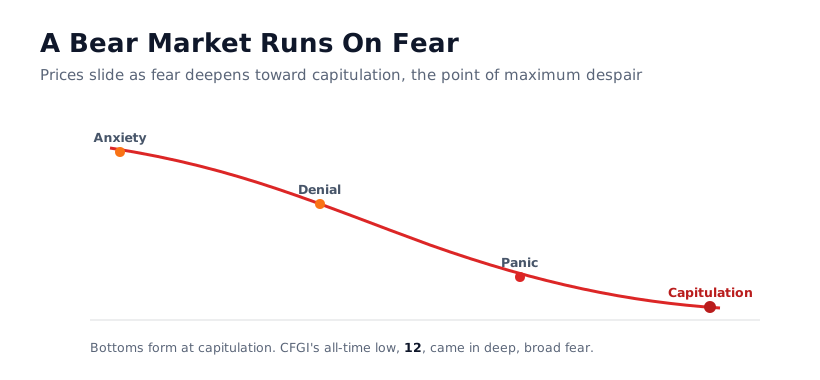
A crypto bear market is a sustained period of falling prices, driven by fear, fading attention and forced selling. Like a bull market it is defined by mood as much as price: it runs on fear, moving through anxiety to denial to panic to despair, and it tends to bottom at capitulation, when the last sellers give up. Crypto bears are especially brutal, with major assets often losing 70 to 80% of their value. That extreme is exactly what a sentiment reading is built to catch. This is education, not financial advice.
CFGI data
A bear market is fear that will not lift. CFGI hit its all-time low of 12, Extreme Fear, on 5 February 2026, below even FTX week at 16 and the Luna collapse at 17. That 0 to 100 score has tracked the mood across hundreds of assets every 15 minutes since March 2022.
Source: CFGI dataset, March 2022 to June 2026.
Key takeaways
- A bear market is a sustained fall in prices, powered by fear.
- It moves from anxiety to denial to panic to despair.
- Crypto bears are brutal, often 70 to 80% drawdowns.
- Bottoms often form at capitulation, when the last sellers give up.
- CFGI’s all-time low, 12, came in a moment of deep, broad fear.
What Is a Crypto Bear Market?
A bear market is an extended fall in prices, the mirror of a bull market. The name comes from a bear attacking by swiping its paws downward. In crypto these declines can be brutal, with major assets losing most of their value before the mood turns. It is fear sustained: the longer prices fall, the more the crowd expects them to keep falling, a self-reinforcing pessimism that feeds on itself just as greed does on the way up.
What Defines a Crypto Bear Market
In stocks, a bear market is conventionally a fall of 20% or more from a peak, but crypto operates on a different scale of severity. A crypto bear market routinely involves declines of 50%, 70% or even 80%-plus from the highs, drops that would be considered catastrophic crashes in equities are simply a normal phase of a crypto cycle. The deepest and most prolonged of these are nicknamed a "crypto winter": a long, grinding bear market, often lasting a year or more, in which prices stay depressed, attention fades, and the speculative froth of the previous boom is completely washed out. What defines a crypto bear market, then, is not just a percentage but a sustained reversal of the entire mood, from the greed and FOMO of the bull to a pervasive fear and disillusionment that can take a long time to thaw.
How Does a Bear Market Feel At Each Stage?
- Anxiety: the first sharp drops; buyers tell themselves it is a dip.
- Denial: prices keep sliding, but holders refuse to sell at a loss.
- Panic: the slide accelerates and selling becomes urgent.
- Capitulation: the last holders give up, and that exhaustion often marks the bottom.
This emotional descent is the mirror image of a bull market’s climb, and recognising which stage the crowd is in, especially telling early denial from final capitulation, is one of the hardest and most valuable skills in a downturn.
Why Crypto Bears Are So Brutal
Crypto bear markets are more savage than equity ones for the same structural reasons crypto is more volatile generally. Most importantly, many crypto assets have no fundamental floor: a stock has earnings and assets that eventually attract value buyers and catch a falling price, but a speculative coin with no cash flow can keep falling with nothing underneath to stop it, and many never recover, fading to near-zero permanently. Layered on top are crypto’s other amplifiers: it trades 24/7 with no closing bell to halt a panic, it is saturated with leverage whose forced liquidations turn declines into cascades, and its heavily retail crowd is prone to mass panic. The result is the gut-wrenching 70 to 80% drawdowns that define a crypto winter, falls so deep they test even the strongest conviction. The brutal upside, if there is one, is that this same ferocity means crypto bears tend to reach the kind of total, exhausted capitulation from which sharp recoveries can eventually spring.
No Floor, No Closing Bell
With no earnings to catch a falling coin, 24/7 trading and leverage cascades, crypto bears routinely cut 70 to 80% off prices, and many coins never recover. The depth is the price of having no fundamental floor.
Why Does Capitulation Mark the Bottom?
A bottom forms when there is no one left to sell. Once fear is total and the determined sellers have sold, even modest buying can turn the market. That is why extreme fear readings cluster near bottoms. CFGI’s all-time low of 12, Extreme Fear, on 5 February 2026, sat below the FTX collapse (16) and the Luna unwind (17), a measured snapshot of capitulation, the moment of maximum, exhausted despair from which recoveries tend to begin. This is the deep logic behind contrarian thinking in a bear market: the point of greatest pessimism, when it feels most foolish to buy, is frequently the point of greatest opportunity, precisely because the selling is finally spent. An extreme fear reading does not ring a bell at the exact low, nothing can, but it tells you the conditions a bottom forms from are in place. Read deep fear as it happens on the Crypto Fear and Greed Index, and see how it fits the wider market cycle.
Frequently asked questions
What is a crypto bear market?
A sustained period of falling prices driven by fear, the mirror of a bull market. It runs on fear through anxiety, denial, panic and capitulation, and in crypto routinely involves 50 to 80% declines, far deeper than the 20% that defines a stock bear market.
What is a crypto winter?
The deepest, most prolonged kind of crypto bear market: a long, grinding decline, often a year or more, in which prices stay depressed, attention fades, and the speculative froth of the previous boom is washed out entirely.
Why are crypto bear markets so brutal?
Because many coins have no fundamental floor to catch a falling price (unlike a stock with earnings), and crypto trades 24/7, is saturated with leverage whose liquidations cascade, and has a panic-prone retail crowd. The result is 70 to 80% drawdowns, with many coins never recovering.
Does extreme fear mean it is time to buy?
No indicator says that. Extreme fear tells you the crowd is one-sided, stretched and near capitulation, which historically clusters near turning points, but fear can deepen further. It is context, not a signal to act. This is education, not financial advice.
CFGI.io, Market sentiment research
The CFGI research team builds and maintains the CFGI Fear and Greed Index: a 0 to 100 sentiment score from 10 sub-indicators across hundreds of crypto assets and the equity market, refreshed every 15 minutes. We have tracked market emotion through multiple full crypto and equity cycles.
Think we missed something?
Spotted a gap, disagree with a take, or think we should cover a new topic? Message us and we'll act on your input.
Message us on TelegramKeep reading
This article is educational and is not financial advice. Crypto and equities are volatile and you can lose money. See our disclaimer.