Crypto
What Is a Bitcoin Halving?
Quick answer
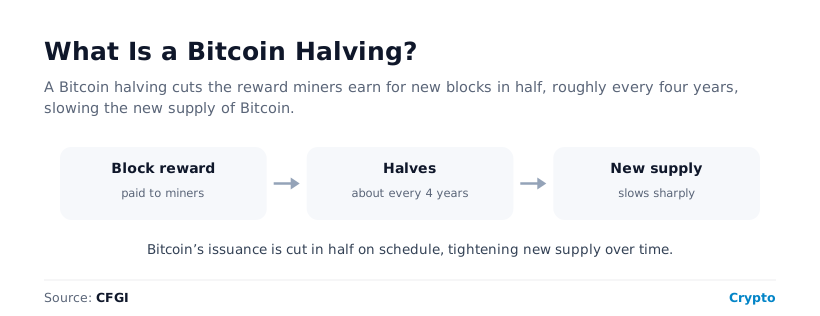
A Bitcoin halving is a programmed event, roughly every four years, that cuts the reward miners receive for adding a block in half. It slows the rate at which new Bitcoin is created, tightening supply on the way to a hard cap of 21 million coins. Halvings are surrounded by intense sentiment, fear and greed both run high, because the crowd treats them as scheduled turning points in a four-year cycle, even though whether they actually drive price is increasingly debated. This is education, not financial advice.
CFGI data
Halvings draw out the extremes of crowd emotion that CFGI measures. CFGI scores Bitcoin sentiment from 0 to 100 every 15 minutes since March 2022, so the swings in fear and greed around a halving are visible in real time rather than only in hindsight.
Source: CFGI dataset, March 2022 to June 2026.
Key takeaways
- A halving cuts the block reward in half, about every four years.
- It slows the creation of new Bitcoin, tightening supply.
- Supply is capped at 21 million coins, reached through halvings.
- A popular theory ties a four-year price cycle to halvings.
- Whether the halving still drives price is increasingly debated.
How the Halving Works
Bitcoin is created when miners add blocks to the blockchain, and they are paid a reward in new coins for doing so. Every 210,000 blocks, about four years at one block roughly every ten minutes, that reward is cut in half. This is written into Bitcoin’s code and is how its total supply is capped at 21 million coins: each halving slows new issuance until, eventually, around the year 2140, no new coins are created at all.
The Halving Schedule
Four halvings have happened so far, each cutting the reward in half on a predictable path that anyone can read years in advance.
| Year | Block reward after |
|---|---|
| 2012 | 25 BTC (from 50) |
| 2016 | 12.5 BTC |
| 2020 | 6.25 BTC |
| 2024 | 3.125 BTC |
| ~2028 | 1.5625 BTC |
Bitcoin halvings, past and next.
The 2024 halving, in April at block 840,000, took the reward to 3.125 BTC; the next, expected around 2028, will halve it again. This relentless, transparent schedule is one of Bitcoin’s defining features.
Why It Matters: Programmed Scarcity
The halving is the mechanism behind Bitcoin’s "digital gold" narrative. Unlike fiat currencies, where central banks can create new money at will, Bitcoin’s supply schedule is fixed in code, fully transparent, and impossible to change, with issuance automatically slowing every four years toward a hard 21 million cap. Each halving makes the flow of new coins scarcer relative to the existing stock, which proponents argue should, all else equal, support the price over time. This predictable, ever-tightening scarcity is precisely what distinguishes Bitcoin from money that can be printed, and it is the foundation of the long-term bull case its supporters make.
Scarcity by Design
No committee decides Bitcoin’s supply. The halving is baked into the code, so the slowing of new issuance toward 21 million coins is as certain as anything in markets gets.
The Four-Year Cycle Theory
A widely held theory holds that Bitcoin moves in a roughly four-year cycle anchored to the halving. The story goes that each halving, by cutting new supply, sets off a bull run that peaks somewhere in the 12 to 18 months afterward, followed by a deep bear market, before the next halving resets the cycle. Believers point out that each of the first three halvings was indeed followed by a major price surge within that window, which has made the "halving cycle" one of the most popular frameworks in all of crypto. For many in the crowd, the halving is not just a technical event but a calendar around which they plan their entire market outlook.
Does the Halving Really Move Price?
Here the honest answer gets more nuanced. A scheduled, universally known event should, in theory, already be reflected in the price well before it happens, so skeptics argue the halving is "priced in" and that past surges may be coincidence or driven by the wider cycle rather than the supply cut itself. The 2024 cycle gave this view real ammunition: it produced some of the weakest post-halving returns yet, suggesting that other forces, the launch of spot Bitcoin ETFs, surging institutional participation, and the macro backdrop of interest rates, may now matter far more than the halving’s shrinking supply. The reduction in new issuance is also tiny next to the vast stock of coins already in circulation. The halving remains a genuine, certain event, but its power as a price catalyst is increasingly contested.
Why Halvings Stir Fear and Greed
Whatever the halving does to supply, its effect on sentiment is undeniable. Because halvings are scheduled and well known, the crowd builds narratives around them, expecting a supply squeeze to lift price. That makes them magnets for fear and greed: greed as anticipation builds in the months before, and fear or disappointment if the expected move does not arrive on schedule. Whether halvings drive price or simply coincide with cycles is debated, but the sentiment around them is real and measurable, which is exactly what a Bitcoin Fear and Greed reading captures, the crowd’s halving hopes and fears, turned into a number you can watch unfold.
Frequently asked questions
What is a Bitcoin halving?
A programmed event, every 210,000 blocks or roughly every four years, that cuts the reward miners earn for new blocks in half, slowing the creation of new Bitcoin and tightening supply toward the 21 million cap.
When are the Bitcoin halvings?
Halvings have occurred in 2012, 2016, 2020 and 2024, taking the reward from 50 BTC down to 3.125 BTC. The next is expected around 2028, cutting it to about 1.5625 BTC, and they continue until roughly 2140.
Does the halving make the price go up?
It is debated. The first three were followed by major rallies, but the 2024 cycle was the weakest yet, suggesting ETFs, institutions and macro now matter more than the halving’s small supply cut. A widely known, scheduled event may already be priced in.
Why does the halving affect sentiment?
Because it is scheduled and well known, the crowd builds narratives around it, greed as anticipation grows and fear if the expected move stalls. A Fear and Greed Index captures that emotion in real time. This is education, not financial advice.
CFGI.io, Market sentiment research
The CFGI research team builds and maintains the CFGI Fear and Greed Index: a 0 to 100 sentiment score from 10 sub-indicators across hundreds of crypto assets and the equity market, refreshed every 15 minutes. We have tracked market emotion through multiple full crypto and equity cycles.
Think we missed something?
Spotted a gap, disagree with a take, or think we should cover a new topic? Message us and we'll act on your input.
Message us on TelegramKeep reading
This article is educational and is not financial advice. Crypto and equities are volatile and you can lose money. See our disclaimer.