Crypto
What Is Staking?
Quick answer
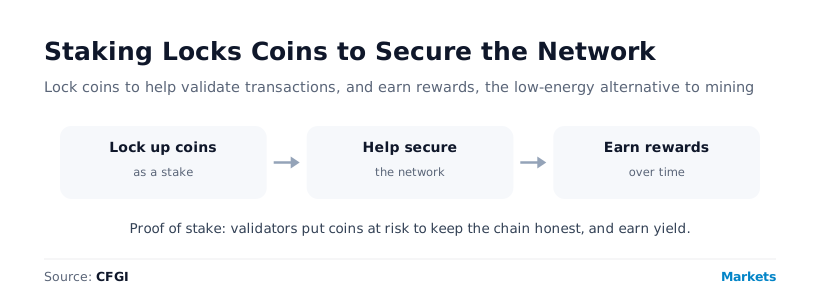
Staking is how proof-of-stake networks like Ethereum stay secure. Holders lock up their coins to help validate transactions, and earn rewards for doing so. It is the energy-light alternative to mining, securing the network with capital rather than electricity. Staked coins are locked away rather than sitting ready to sell, which makes the amount staked a quiet signal about conviction, though staking carries its own risks. This is education, not financial advice.
CFGI data
Staked coins are locked, so they are not for sale, which is a quiet conviction signal. CFGI reads the broader flow of coins on and off exchanges as one of the 10 inputs behind its 0 to 100 Fear and Greed score, tracked every 15 minutes since March 2022, where coins leaving exchanges leans toward holding.
Source: CFGI methodology and dataset, March 2022 to June 2026.
Key takeaways
- Staking locks up coins to help secure a proof-of-stake network, for a reward.
- It is the low-energy alternative to mining, used by Ethereum and others.
- It secures the network with capital at stake, not electricity.
- It carries risks: lock-ups, slashing penalties and platform risk.
- Coins leaving exchanges to be held or staked leans toward conviction.
What Is Staking?
Staking is how proof-of-stake blockchains agree on what is true. Instead of computers racing to solve puzzles (mining), holders lock up, or stake, their coins to become validators. Validators are chosen to confirm transactions and are rewarded with more coins. Try to cheat and your stake can be taken away, which keeps everyone honest. Ethereum, Cardano and Solana all use versions of this, and it uses a tiny fraction of the energy that mining does, which is a major part of its appeal.
How Staking Works
Where mining secures a network with physical work (energy), staking secures it with economic skin in the game. To become a validator, you commit a quantity of the network’s coin as collateral, on Ethereum, a full validator requires 32 ETH, though "staking pools" and exchanges let people stake smaller amounts together. The network then selects validators to propose and verify new blocks of transactions, rewarding honest work with freshly issued coins. The security comes from the threat of "slashing": if a validator tries to cheat or behaves badly, a portion of their staked collateral is destroyed. This flips the incentive elegantly, an attacker would have to buy and stake an enormous amount of the coin, then watch their own holdings get slashed for misbehaving, making an attack self-defeating. So instead of "whoever burns the most energy", proof of stake says "whoever risks the most capital", achieving the same goal, honest agreement without a central authority, far more efficiently.
Why Do People Stake?
- Rewards: stakers earn a yield, a bit like interest, for locking up coins.
- Security: more staked coins means a more expensive network to attack.
- Commitment: staking usually involves a lock-up, so it is a bet on holding, not trading.
- Accessibility: staking pools and "liquid staking" let people stake small amounts and stay flexible.
For many long-term holders, staking is simply a way to earn a return on coins they intend to hold anyway, putting otherwise-idle assets to work while helping secure the network.
The Risks of Staking
Staking rewards are not free money, and the risks deserve respect. The most obvious is the lock-up: staked coins are often committed for a period and cannot be sold instantly, so if the price crashes you may be unable to exit while your funds are locked or in an "unbonding" queue. There is "slashing" risk, the chance of losing part of your stake if your validator misbehaves or suffers technical faults, which matters even for honest stakers running unreliable setups. If you stake through a third party, an exchange or a staking service, you take on platform and custodial risk: you are trusting them with your coins and the promised reward. And "liquid staking" protocols, which give you a tradable token representing your staked coins, add smart-contract risk on top. Finally, the headline yield is denominated in the coin, so a juicy percentage return means little if the coin’s own price falls further. Staking can be a sensible way to earn on a long-term holding, but it trades liquidity and adds risks that the advertised yield alone does not reveal.
Yield Is Not Free
Staking locks up your coins (you may not be able to sell in a crash), risks slashing for validator faults, and adds platform or smart-contract risk through third parties. The advertised yield does not capture those costs.
How Does Staking Connect to Sentiment?
Staked coins are committed. They are off the table for selling, at least until they are unstaked. So a large staked supply quietly reduces the coins available to dump in a panic, and the choice to stake rather than keep coins liquid on an exchange leans toward conviction, it is a statement that a holder intends to keep the coin for the long term rather than trade it. CFGI watches the broader version of this through exchange flows: coins leaving exchanges (to be held or staked) reads as holding, while coins arriving reads as intent to sell. It is one of the 10 inputs behind the Crypto Fear and Greed Index. In this way, the simple, quiet act of locking coins away to stake them is part of the on-chain behaviour the index reads to gauge whether the crowd is leaning toward holding in conviction or selling in fear.
Frequently asked questions
What is staking?
How proof-of-stake networks like Ethereum stay secure: holders lock up (stake) their coins to become validators that confirm transactions, and earn rewards for doing so. It secures the network with committed capital rather than the electricity that mining uses.
How does staking work?
You commit coins as collateral to become a validator (32 ETH on Ethereum, or less via pools). The network selects validators to verify blocks and rewards honest work. "Slashing" destroys part of a cheating validator’s stake, making attacks self-defeating, security through capital at risk rather than energy.
What is the difference between staking and mining?
Mining secures proof-of-work coins with computing power and energy ("whoever burns the most energy"); staking secures proof-of-stake coins by locking up capital ("whoever risks the most capital"). Both confirm transactions and earn rewards, but staking uses far less energy.
Is staking safe?
It has real risks: lock-up periods (you may not be able to sell in a crash), slashing penalties for validator faults, platform risk if you stake through a third party, and smart-contract risk in liquid staking. The yield is also in the coin, so it means little if the price falls. This is education, not financial advice.
CFGI.io, Market sentiment research
The CFGI research team builds and maintains the CFGI Fear and Greed Index: a 0 to 100 sentiment score from 10 sub-indicators across hundreds of crypto assets and the equity market, refreshed every 15 minutes. We have tracked market emotion through multiple full crypto and equity cycles.
Think we missed something?
Spotted a gap, disagree with a take, or think we should cover a new topic? Message us and we'll act on your input.
Message us on TelegramKeep reading
This article is educational and is not financial advice. Crypto and equities are volatile and you can lose money. See our disclaimer.