Crypto
What Is a Hot Wallet?
Quick answer
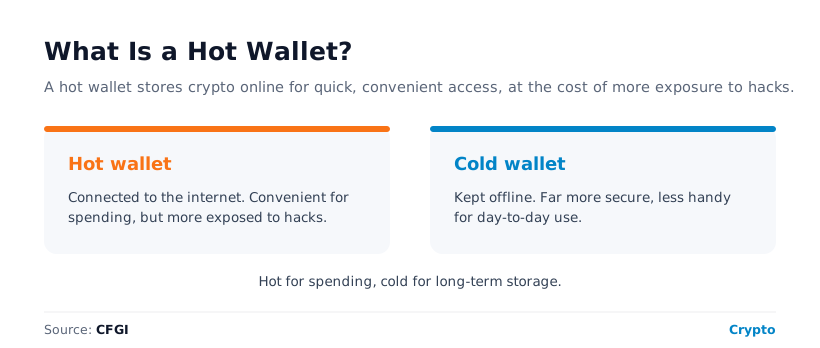
A hot wallet is a crypto wallet whose private key stays connected to the internet, like a phone app, a browser extension or your account on an exchange, so you can send, receive and trade in seconds. That always-on convenience is also its weakness: an online key can be reached by malware, phishing and exchange breaches. The rule of thumb is to keep small, active amounts in a hot wallet and long-term savings in a cold wallet offline.
CFGI data
When confidence in where crypto is held collapses, the fear shows up in the data. CFGI has tracked crypto sentiment on a 0 to 100 scale since March 2022, and its low of 17 on 12 May 2022 is what a sudden drain of confidence looks like, the same trust a hot wallet on an exchange quietly depends on.
Source: CFGI dataset, March 2022 to June 2026.
Key takeaways
- A hot wallet keeps your private key on an internet-connected device or service.
- It is built for convenience: spending, trading and moving funds fast.
- Being online is the trade-off, exposing it to malware, phishing and breaches.
- Exchange wallets are custodial, so you are trusting a third party with your keys.
- Keep only active spending money in a hot wallet, savings belong in cold storage.
What a Hot Wallet Is
A crypto wallet does not really store coins. It stores a private key, the secret that proves you own funds recorded on the blockchain and lets you move them. A hot wallet is simply any wallet that keeps that key on a device connected to the internet. Because the key is always reachable, signing a transaction takes a tap, which is exactly what you want for everyday payments and active trading.
Hot wallets come in three common forms. A mobile or desktop app such as MetaMask or Trust Wallet holds the key on your own device. A browser extension does the same inside your browser for connecting to apps. And an exchange account holds the key for you on the company servers, which is the version most people start with.
Hot Versus Cold
The opposite of a hot wallet is a cold wallet: a device that keeps the private key offline, so it never touches the internet and cannot be reached remotely. Cold storage trades speed for safety. A hardware wallet might take a minute and a physical button press to send funds, which is a feature, not a flaw, when the balance is your savings.
The practical model most experienced holders use is the wallet equivalent of cash and a bank vault. Keep a small, replaceable amount in a hot wallet for spending and trading, the way you carry cash in your pocket, and keep the bulk in cold storage where a phishing link or a hacked exchange cannot touch it.
Rule of Thumb
Only keep in a hot wallet what you would be willing to lose if your phone, browser or exchange were compromised tomorrow. Everything else belongs offline.
Custodial Or Self-Custody?
There is a second, deeper split that matters more than hot versus cold: who actually holds the key. With a self-custody hot wallet, the key lives on your device and only you can sign. With a custodial wallet, an exchange holds the key on your behalf and you simply have an account balance, an IOU, on their books.
This is the meaning behind the phrase "not your keys, not your coins". If the company is hacked, freezes withdrawals or fails, your access depends entirely on them. The 2022 collapse of FTX is the textbook case: customer balances looked real on screen right up until the exchange could not honour withdrawals. A custodial hot wallet adds counterparty risk on top of the normal online risk.
- Self-custody hot wallet: you hold the key, you carry the responsibility, no third party can freeze or lose your funds.
- Custodial wallet: the exchange holds the key, more convenient and recoverable by support, but you inherit their security and solvency.
What the Big Breaches Teach
Hot wallets are where exchanges keep the funds they need to move, which is exactly why attackers target them. Security analysts attribute roughly 80% of major exchange losses to hot wallet and private-key exposure rather than flaws in the blockchain itself. The blockchain rarely breaks. The keys around it do.
| Exchange | When | Approx. loss | How |
|---|---|---|---|
| Bybit | Feb 2025 | $1.5 billion | Key access during a transfer, the largest crypto theft on record |
| DMM Bitcoin | May 2024 | $308 million | 4,502 BTC drained from compromised keys |
| WazirX | Jul 2024 | $230 million | Multi-signature wallet exploit |
| Phemex | Jan 2025 | $85 million | Hot wallets siphoned across chains |
A sample of major exchange hot wallet breaches, 2024 to 2025.
The common thread is not weak cryptography. It is that an online key, by definition, can be reached, whether through stolen credentials, a malicious software update or a phishing message that tricks a human. Self-custody removes the exchange as a single point of failure, but it hands you the job of guarding the key, so the risk moves rather than vanishing.
How to Use a Hot Wallet Safely
A hot wallet is a tool, not a danger, as long as you size it correctly and treat the key with care.
- Keep balances small. Move anything you are not actively using to a cold wallet.
- Back up your seed phrase offline, on paper or metal, never in a photo, email or cloud note.
- Turn on two-factor authentication on any exchange account, and use an authenticator app rather than SMS.
- Be ruthless about phishing: bookmark sites, check the address bar, and never enter a seed phrase into a website.
- Review and revoke old token approvals you no longer need, which is a common drain on browser wallets.
Hot Wallets and Market Sentiment
Custody is ultimately a confidence story, and confidence is what the Crypto Fear and Greed Index measures. A large exchange breach does more than drain one company. It reminds the whole market that funds held by others can vanish, and that doubt spreads into fear, withdrawals and selling. Watching where conviction sits, on a 0 to 100 scale, is a useful backdrop to a decision every holder makes: how much to keep online, and how much to lock away.
Frequently asked questions
What is a hot wallet?
A crypto wallet that keeps your private key on an internet-connected device or service, such as a phone app, a browser extension or an exchange account, so you can send, receive and trade quickly.
Are hot wallets safe?
They are safe enough for small, active amounts, but more exposed than cold wallets because the key is online and reachable by malware, phishing and exchange breaches. Analysts tie roughly 80% of major exchange losses to hot wallet and key exposure.
What is the difference between a custodial and a self-custody hot wallet?
With self-custody the key lives on your own device and only you can sign. With a custodial wallet, an exchange holds the key for you, which is convenient but adds counterparty risk: if they are hacked or fail, your access depends on them.
How much crypto should I keep in a hot wallet?
Only what you are actively spending or trading, the amount you could afford to lose if the device or exchange were compromised. Keep long-term savings in a cold wallet offline.
Should I use a hot or cold wallet?
Most people use both: a hot wallet for everyday spending and trading, a cold wallet for long-term savings. Keep only what you need online. This is education, not financial advice.
CFGI.io, Market sentiment research
The CFGI research team builds and maintains the CFGI Fear and Greed Index: a 0 to 100 sentiment score from 10 sub-indicators across hundreds of crypto assets and the equity market, refreshed every 15 minutes. We have tracked market emotion through multiple full crypto and equity cycles.
Think we missed something?
Spotted a gap, disagree with a take, or think we should cover a new topic? Message us and we'll act on your input.
Message us on TelegramKeep reading
This article is educational and is not financial advice. Crypto and equities are volatile and you can lose money. See our disclaimer.