Crypto
What Is a Crypto Pump and Dump?
Quick answer
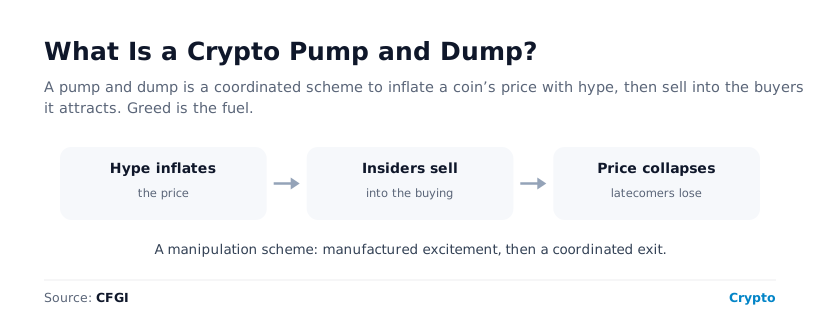
A pump and dump is a manipulation scheme where organisers buy a low-value coin cheaply, hype it to drive the price up (the pump), then sell their holdings into the rush of new buyers (the dump), collapsing the price. The latecomers, drawn in by FOMO, are left holding the losses as deliberate "exit liquidity". It runs entirely on manufactured greed and the greater-fool logic that someone will always buy higher, which makes a sudden spike of extreme sentiment on an obscure coin a serious red flag. This is education, not financial advice.
CFGI data
Pump and dumps weaponise greed. The scheme works only while FOMO is rising, so a thin coin spiking into Extreme Greed on per-asset sentiment is a classic signature. CFGI scores assets individually, which is what lets such an isolated, manufactured surge stand out.
Source: CFGI dataset and public information on market manipulation, June 2026.
Key takeaways
- A pump and dump inflates a coin’s price with hype, then sells into it.
- Organisers profit; latecomers drawn by FOMO are the exit liquidity.
- It runs on manufactured greed and greater-fool logic.
- It differs from a rug pull, which abandons the project entirely.
- A spike of extreme sentiment on an obscure coin is a red flag.
Manufactured Greed
The scheme is old, predating crypto, but thrives in thinly traded coins. Organisers accumulate a cheap, low-liquidity token, then coordinate a wave of hype, social posts, group chats, influencer shills, to drive the price up fast. As FOMO pulls in outside buyers, the organisers sell into that demand, and the price collapses. Everyone who bought the hype after the early accumulators is, by design, the exit liquidity. It is closely related to a rug pull, differing mainly in mechanics.
The Anatomy of a Pump and Dump
A pump and dump runs through a predictable sequence, often coordinated in private groups.
- Accumulation: organisers quietly buy a large position in a cheap, obscure coin.
- The pump: they unleash coordinated hype, group signals, influencer posts, sometimes fake volume, to make the coin look like it is taking off.
- The FOMO rush: outsiders see the vertical chart and pile in, afraid to miss the move.
- The dump: the organisers sell their entire holding into that buying, all at once.
- The collapse: with the organisers gone, the price craters, leaving latecomers with near-worthless coins.
The whole cycle can play out in minutes on a small enough coin, which is part of why it is so hard for outsiders to escape in time.
Pump and Dump Versus Rug Pull
Pump and dumps and rug pulls are cousins, both built on manufactured greed, but they differ in mechanics. In a pump and dump, the organisers inflate an existing coin’s price and sell into the spike; the coin itself usually survives, just crashing back down, and the manipulation is about timing the exit. In a rug pull, the creators of a project abandon it entirely, often draining its liquidity so holders cannot even sell, and disappear with the funds. One is a manipulation of price; the other is the wholesale theft of a project. Both leave latecomers with losses, and both exploit the same FOMO, but knowing the difference helps you read which kind of trap you are looking at.
The Greater-Fool Logic
A pump and dump weaponises the greater fool theory: the idea that you can profit from an overpriced asset as long as a "greater fool" will buy it from you for even more. Buyers in a pump are not betting on the coin’s value, which is usually near zero; they are betting that someone else will pile in behind them and let them sell higher. The scheme works precisely because enough people accept that bet, until, abruptly, no greater fool remains. When the organisers dump and the buying dries up, whoever is holding becomes the final fool, the "bag-holder". Understanding that you are playing a game of musical chairs with hidden insiders is the clearest reason to stay out of it entirely.
Someone Is Always the Last Buyer
A pump and dump only profits those who sell to a greater fool. The organisers know when the music stops; outside buyers do not, which is why so many end up holding the bag.
Pump and Dumps and Greed
A pump and dump cannot work without greed: it needs a crowd willing to chase a vertical move without questioning it. A sudden spike into extreme greed on an otherwise obscure coin, visible through per-asset sentiment, is exactly the pattern to be wary of. A Crypto Fear and Greed Index reading at the extreme on a thin, no-name token is a cue for caution rather than excitement, because that isolated euphoria is precisely what an organised pump manufactures. The same FOMO that makes the chart irresistible is the tool being used against you, and a calm, numerical read of how stretched the sentiment has become is one of the few defences against getting swept up in it.
Frequently asked questions
What is a crypto pump and dump?
A manipulation scheme where organisers hype a cheap coin to drive its price up, then sell into the new buyers they attract, collapsing the price and leaving latecomers with losses as deliberate "exit liquidity".
How does a pump and dump work step by step?
Organisers accumulate a cheap coin, unleash coordinated hype to spike the price, let FOMO pull in outside buyers, dump their entire holding into that demand, and the price then collapses. The whole cycle can take minutes.
Is it the same as a rug pull?
They are related scams. A pump and dump inflates an existing coin and sells into the spike, with the coin surviving but crashing; a rug pull abandons the project entirely, often draining its liquidity. Both run on manufactured greed.
How do you spot a pump and dump?
Watch for a thin, obscure coin spiking vertically on coordinated hype, with extreme sentiment appearing from nowhere. The latecomers drawn by FOMO are the intended exit liquidity, so treat a spike into per-asset extreme greed on a no-name token as a red flag. This is education, not financial advice.
CFGI.io, Market sentiment research
The CFGI research team builds and maintains the CFGI Fear and Greed Index: a 0 to 100 sentiment score from 10 sub-indicators across hundreds of crypto assets and the equity market, refreshed every 15 minutes. We have tracked market emotion through multiple full crypto and equity cycles.
Think we missed something?
Spotted a gap, disagree with a take, or think we should cover a new topic? Message us and we'll act on your input.
Message us on TelegramKeep reading
This article is educational and is not financial advice. Crypto and equities are volatile and you can lose money. See our disclaimer.