Crypto
Combining the Fear and Greed Index With Technical Analysis
Quick answer
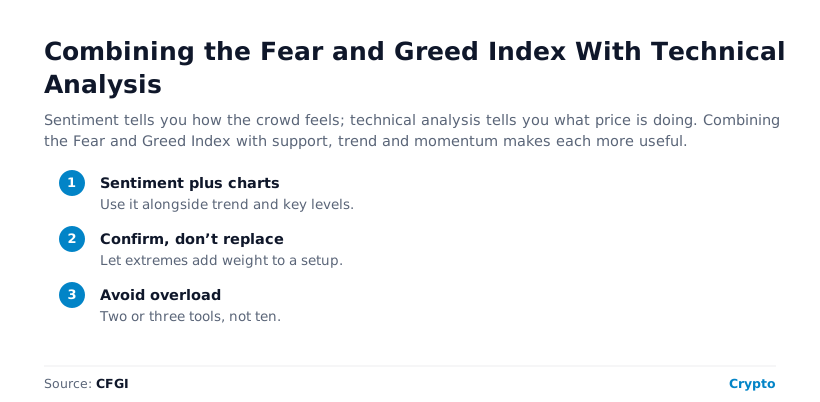
The Fear and Greed Index reads sentiment; technical analysis reads price. They are stronger together: an Extreme Fear reading lines up better with a buy idea when price is also at support or showing a trend change, and Extreme Greed is more convincing near resistance. Sentiment sets the context, the chart sets the level, and a divergence between the two is often the strongest signal of all. This is education, not financial advice.
CFGI data
On its own, CFGI sentiment matches same-day market direction 79% of the time and the next day 49%, so it needs a second lens. Pairing an Extreme reading, under 20 or over 80, with a price level from the chart is how traders turn a weak forecast into a sharper, conditional one.
Source: CFGI dataset, March 2022 to June 2026.
Key takeaways
- Sentiment is context; technical analysis is the level.
- Extreme Fear plus price at support is a stronger setup than either alone.
- Extreme Greed plus price at resistance flags exhaustion better than sentiment alone.
- A divergence between sentiment and price is often the strongest signal.
- Use the chart to time what sentiment only frames.
Why Pair Them
The Fear and Greed Index tells you the crowd is stretched, but not where price will turn. Technical analysis, support and resistance, trend, momentum, tells you about price but not about emotion. Each fills the other’s blind spot. Sentiment answers "is the crowd one-sided?" while the chart answers "is price actually at a level where a turn could happen?", and a setup that satisfies both questions is far more compelling than one that satisfies only one.
What Technical Analysis Brings
Technical analysis is the study of price itself, and it supplies exactly the precision a sentiment gauge lacks. Its core tools answer practical questions: support and resistance mark the specific price levels where buying or selling has historically appeared, the natural places a turn might occur; trend analysis (often via moving averages) tells you which direction genuinely deserves respect; and momentum indicators like the RSI tell you whether a move is gaining or losing steam. Where the Fear and Greed Index gives you a broad emotional weather report, technical analysis gives you the map coordinates, the actual price at which to watch for a reaction. That is why the two are so complementary: one supplies the why and the when-it-is-likely, the other supplies the where and the precise level.
How to Combine Them
| Sentiment | Chart | Combined read |
|---|---|---|
| Extreme Fear (under 20) | Price at support, momentum turning up | Stronger case the selling is exhausting |
| Extreme Greed (over 80) | Price at resistance, momentum fading | Stronger case the buying is exhausting |
| Extreme reading | Price breaking with the trend | Sentiment may be early; respect the trend |
How sentiment and the chart reinforce each other.
The key rule is that the chart times what sentiment frames. An Extreme Fear reading is a reason to watch support, not to buy blindly into a falling market. Sentiment puts you on alert; the chart tells you whether and where to act.
Divergence: The Strongest Signal
The most powerful combination of the two is a divergence, when sentiment and price tell different stories. The classic bullish version is price grinding to a new low while the Fear and Greed Index refuses to make a new low, or while momentum quietly turns up: this hints that, even as the price falls, the selling pressure and panic behind it are exhausting, a frequent precursor to a bottom. The bearish mirror is price pushing to new highs while sentiment or momentum fails to follow, suggesting the rally is running on fumes. These divergences are prized precisely because they reveal a disagreement between what the price is doing and what the crowd’s conviction is doing, and that hidden weakness or strength often surfaces in price before long. When an extreme sentiment reading coincides with a clear chart divergence at a key level, you have about as strong a confluence as these tools offer.
When the Two Disagree
Price making a new low while fear does not, or a new high while greed does not, is a divergence, often the strongest tell that a move is exhausting beneath the surface.
A Caution
For all their power together, it is worth being honest about the limits. Combining tools reduces false signals but removes none: sentiment and a chart can both be wrong at the same time, and a strong, news-driven trend can blow straight through support, resistance and an extreme reading alike. Neither technical analysis nor sentiment is a crystal ball, and confluence between them raises the odds of a good setup without ever guaranteeing one. The disciplined approach is to treat the combination as a way to find higher-probability situations, then protect yourself for the times it is wrong, with position sizing, defined stops and a plan set in advance, rather than betting the house on any single confluence. Used that way, sentiment plus the chart is a genuine edge; used as a guarantee, it is a trap.
Frequently asked questions
Should I use the Fear and Greed Index with technical analysis?
Many traders do. Sentiment frames the context and the chart times the entry: Extreme Fear at support, or Extreme Greed at resistance, is a stronger setup than sentiment alone, because one tool supplies the emotional context and the other the precise price level.
What does technical analysis add that sentiment lacks?
Precision about price: support and resistance mark the levels where a turn might occur, trend tells you which direction to respect, and momentum tells you whether a move is fading. Sentiment gives the emotional weather; the chart gives the map coordinates.
What is a sentiment-price divergence?
When the two disagree, like price making a new low while the Fear and Greed Index does not, or a new high while greed does not. It suggests the move is exhausting beneath the surface, and is often the strongest combined signal these tools offer.
Does combining them guarantee better results?
No. It reduces some false signals but removes no risk. A strong trend can override both sentiment and the chart, and both can be wrong at once. Always use position sizing and risk management. This is education, not financial advice.
CFGI.io, Market sentiment research
The CFGI research team builds and maintains the CFGI Fear and Greed Index: a 0 to 100 sentiment score from 10 sub-indicators across hundreds of crypto assets and the equity market, refreshed every 15 minutes. We have tracked market emotion through multiple full crypto and equity cycles.
Think we missed something?
Spotted a gap, disagree with a take, or think we should cover a new topic? Message us and we'll act on your input.
Message us on TelegramKeep reading
This article is educational and is not financial advice. Crypto and equities are volatile and you can lose money. See our disclaimer.