Crypto
What Is Web3?
Quick answer
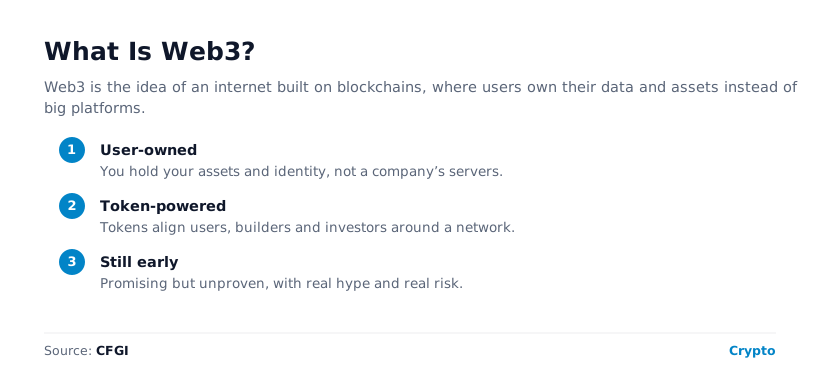
Web3 is a vision of the next internet, one built on blockchains, where users own their data, identity and assets directly rather than renting them from big platforms. If Web1 was "read" and Web2 is "read and write", Web3 is meant to be "read, write and own". The building blocks are crypto wallets, tokens and decentralised networks. It is more a direction than a finished product, and even its supporters agree it is not fully here yet.
CFGI data
Web3 narratives run hot and cold, and CFGI puts a number on them. Because it scores hundreds of assets individually every 15 minutes on a 0 to 100 scale, a sector narrative catching fire shows up as a measurable move in the relevant coins, not just a vibe on social media.
Source: CFGI methodology, 10-input 0 to 100 model.
Key takeaways
- Web3 is the idea of a blockchain-based internet built on ownership.
- The slogan is read (Web1), write (Web2), own (Web3).
- Its building blocks are wallets, tokens, smart contracts and DAOs.
- Serious critics argue it is less decentralised than it claims.
- It is an evolving vision, not a finished system.
Ownership, Not Just Access
Web1 was the read-only internet of static pages; Web2 is the interactive internet of social platforms that host, and own, your content. Web3 proposes a third step: applications built on blockchains where you hold your assets in your own wallet and carry your identity and reputation between services, rather than each platform owning your account. The promise, in one word, is ownership.
The Three Eras of the Web
| Era | You can | Who owns it |
|---|---|---|
| Web1 (1990s) | Read | Static pages, few owners |
| Web2 (2000s on) | Read and write | Big platforms own your content |
| Web3 (emerging) | Read, write and own | Users, via wallets and tokens |
How the web is said to have evolved.
The shift from Web1 to Web2 turned passive readers into active participants, but it did so on platforms owned by a handful of giant companies that monetise data and attention. Web3’s core claim is that the next shift returns ownership to users, so that leaving a service no longer means leaving your data and reputation behind.
The Building Blocks
Web3 is assembled from pieces that will be familiar from the rest of crypto.
- Wallets act as your login and identity, replacing the email-and-password account.
- [Tokens](/learn/crypto/what-is-a-token/) represent ownership, access or a vote.
- [Smart contracts](/learn/crypto/what-is-a-smart-contract/) provide the logic that runs apps without a central server.
- [DAOs](/learn/crypto/what-is-a-dao/) offer community governance instead of a corporate boardroom.
The Critics Have a Point
An honest guide to Web3 has to take its critics seriously, because some of them are serious people. Jack Dorsey, who built Twitter, has argued that you do not really own Web3, the venture-capital firms and their investors do, making it a centralised system with a decentralised label. Moxie Marlinspike, the founder of Signal, pointed out a deeper technical problem: most "decentralised apps" still quietly depend on a few centralised service providers to talk to the blockchain at all, so the decentralisation can be more cosmetic than real. Others, including Elon Musk, have dismissed Web3 as more marketing buzzword than working reality.
The Honest Summary
Web3’s boosters and its harshest critics actually agree on one thing: it is not here yet. They only disagree on whether it will replace today’s internet, sit alongside it, or quietly fade.
Promise and Reality
Where does that leave a curious newcomer? Web3 is early, genuinely experimental, and heavily debated. Supporters see open networks, user ownership and a way out of platform lock-in. Sceptics see speculation, complexity, security risks and a large gap between the grand vision and what actually works today. Both can be right at once: real, useful pieces exist, and so does an enormous amount of hype layered on top of them. The mature way to read Web3 is neither as a revolution that has already happened nor as a pure scam, but as an unfinished bet whose claims deserve scrutiny.
What Works Today
Stripped of the hype, parts of Web3 already function. You can swap and lend assets on DeFi protocols without a bank, own a digital collectible or membership as an NFT that no platform can revoke, join token-gated communities where holding a token is the entry ticket, and experiment with decentralised social apps that let you carry followers between services. These are real and used by real people. What does not yet exist is a seamless, mainstream Web3 that an ordinary person would choose over today’s apps without knowing or caring about the blockchain underneath. The gap between "works for crypto natives" and "works for everyone" is exactly where the debate, and the opportunity, sits.
Web3 and Market Sentiment
Like much of crypto, Web3 is a story, and stories drive prices. Its narrative runs hot and cold, and when it is hot, money pours into "Web3" tokens and the related coins run far ahead of any working product. That is exactly the dynamic a Crypto Fear and Greed Index captures on a 0 to 100 scale: when a sector narrative is everywhere and sentiment is pinned to greed, it is usually the moment to be most sceptical of the claims, not least. Understanding what Web3 actually is, and is not, is the best defence against being swept up in its next hype cycle.
Frequently asked questions
What is Web3?
The idea of an internet built on blockchains, where users own their data, identity and assets directly through wallets and tokens, rather than renting them from centralised platforms. The slogan is "read, write, own".
How is Web3 different from Web2?
Web2 platforms own your content and account and monetise your data; Web3 aims to let you own your assets and identity in your own wallet, and carry them between apps on decentralised networks.
What do critics say about Web3?
That it is less decentralised than it claims: that venture capital effectively owns it, that "decentralised apps" still rely on a few central service providers, and that much of it is marketing ahead of working reality.
Is Web3 real yet?
It is an evolving vision with working pieces but plenty of hype and unsolved problems, and even supporters agree it is not fully here. Treat bold claims with the same caution as any hot crypto narrative. This is education, not financial advice.
CFGI.io, Market sentiment research
The CFGI research team builds and maintains the CFGI Fear and Greed Index: a 0 to 100 sentiment score from 10 sub-indicators across hundreds of crypto assets and the equity market, refreshed every 15 minutes. We have tracked market emotion through multiple full crypto and equity cycles.
Think we missed something?
Spotted a gap, disagree with a take, or think we should cover a new topic? Message us and we'll act on your input.
Message us on TelegramKeep reading
This article is educational and is not financial advice. Crypto and equities are volatile and you can lose money. See our disclaimer.