Crypto
Using the Fear and Greed Index for Swing Trading
Quick answer
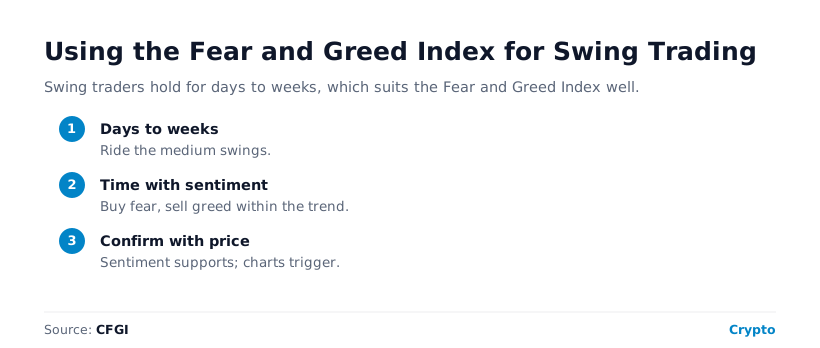
Swing trading means holding positions for days to weeks to capture a price swing, a horizon that fits the Fear and Greed Index well. Sentiment extremes often mark the turning points swing traders look for: Extreme Fear near potential bottoms, Extreme Greed near potential tops. Because the index offers multiple timeframes, you can match the daily reading to your hold. It works best as confirmation alongside price and trend, never as a standalone trigger. This is education, not financial advice.
CFGI data
Swing horizons match the index. CFGI offers multiple timeframes and refreshes every 15 minutes, so a swing trader can read the daily mood, like an asset hitting Extreme Fear, and pair it with price rather than reacting to a single number.
Source: CFGI dataset, March 2022 to June 2026.
Key takeaways
- Swing trading holds for days to weeks.
- It sits between day trading and long-term investing.
- Sentiment extremes often mark swing turning points.
- Match the timeframe to your hold; use the daily reading.
- Use the index as confirmation, not a standalone trigger.
Why Sentiment Suits Swing Trading
A swing trader is trying to catch a multi-day move, so the daily ebb and flow of fear and greed is directly relevant. Extremes are where swings tend to begin and end: deep Extreme Fear can mark exhaustion near a low, and Extreme Greed can mark froth near a high. That is the swing trader’s home ground. But sentiment alone is not a setup. The index tells you the mood; price action, levels and trend tell you whether a move is actually turning.
What Swing Trading Is
Swing trading is the style of holding a position for days to weeks to capture a single "swing", one meaningful move from a relative low to a relative high, or vice versa. It sits squarely between two other approaches. Day trading opens and closes positions within a single day, riding tiny intraday moves and demanding constant attention. Long-term investing holds for months or years, largely ignoring the swings altogether. Swing trading occupies the middle ground: slower and less frantic than day trading, but far more active than buy-and-hold investing. This middle horizon is precisely why a Fear and Greed Index suits it so well. Sentiment’s mood swings between fear and greed tend to play out over days and weeks, exactly the timescale a swing trader cares about, whereas they are often just noise to a day trader and a distraction to a long-term holder.
Why the Index’s Timeframes Fit
A practical advantage of CFGI for swing traders is that it offers multiple timeframes rather than a single number. Because the score is calculated across several horizons, a swing trader can deliberately read the timeframe that matches their hold, typically the daily reading, which captures the multi-day mood that drives a swing, while filtering out the minute-to-minute jitter that matters only to day traders. Matching the tool’s timeframe to your trading horizon is an underrated discipline: reacting to a fleeting 15-minute dip into fear is a fast way to get whipsawed out of a perfectly good multi-day swing. The skill is to let the slower, daily sentiment frame your bias, the crowd is fearful, watch for a low, and then drop to the price chart for the precise timing, rather than treating every twitch of the live gauge as a call to action.
How to Use It In a Swing Approach
- Use a timeframe that matches your hold, the daily reading for multi-day swings.
- Watch for extremes: Extreme Fear near potential bottoms, Extreme Greed near potential tops.
- Wait for price to confirm, a reversal, a level holding, before acting on the sentiment.
- Manage risk with defined stops and sizing; the index does not remove the need for that.
- Treat divergences, like price falling while fear maxes out, as signals to watch, not certainties.
Confirmation, Not a Trigger
The index sharpens timing context for swings, but it is not a buy or sell button. Let price confirm and always manage risk. This is education, not financial advice.
Sentiment Frames, Price Confirms
The throughline for the swing trader is a simple division of labour: let sentiment frame the opportunity and let price confirm the trade. An asset hitting Extreme Fear is the index telling you a swing low may be near, putting you on alert, but it is the price chart, a reversal candle, a held support level, an upturn in momentum, that actually triggers the entry. This keeps you from the classic mistake of "catching a falling knife", buying into deep fear simply because the gauge is low, while a strong downtrend keeps falling. Sentiment and price work as a team: the mood reading tells you where to look and roughly when, and the price action tells you whether the swing you are anticipating is genuinely beginning. Pair the daily mood below with your own chart work and risk plan.
Frequently asked questions
Is the Fear and Greed Index good for swing trading?
It suits it well. Swing trades last days to weeks, and sentiment’s mood swings play out on the same timescale, so its extremes often mark the turning points swing traders look for. It works best as confirmation alongside price.
What is swing trading?
Holding a position for days to weeks to capture a single "swing" from a low to a high or vice versa. It sits between day trading (intraday) and long-term investing (months to years), an active but not frantic middle horizon.
Which timeframe of the index should a swing trader use?
Typically the daily reading, which captures the multi-day mood that drives a swing, rather than the minute-to-minute jitter that matters only to day traders. Matching the tool’s timeframe to your hold avoids getting whipsawed.
Can I trade on the index alone?
No. It tells you the mood, not whether a move is turning. Let sentiment frame the opportunity and price confirm the entry, and always combine it with levels and risk management. It is not a standalone trigger. This is education, not financial advice.
CFGI.io, Market sentiment research
The CFGI research team builds and maintains the CFGI Fear and Greed Index: a 0 to 100 sentiment score from 10 sub-indicators across hundreds of crypto assets and the equity market, refreshed every 15 minutes. We have tracked market emotion through multiple full crypto and equity cycles.
Think we missed something?
Spotted a gap, disagree with a take, or think we should cover a new topic? Message us and we'll act on your input.
Message us on TelegramKeep reading
This article is educational and is not financial advice. Crypto and equities are volatile and you can lose money. See our disclaimer.