Crypto
What Is Tokenomics?
Quick answer
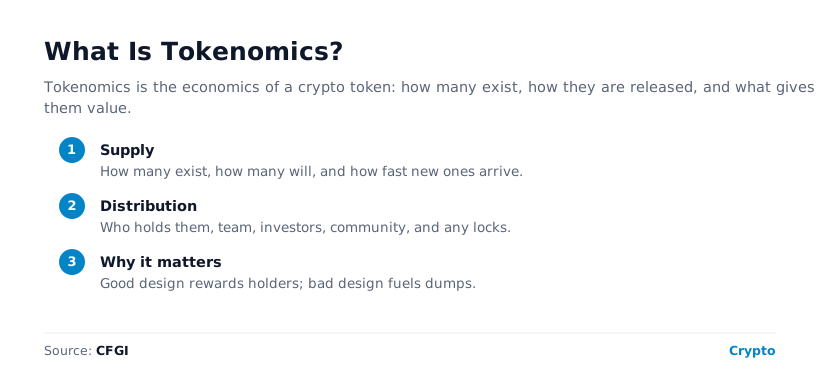
Tokenomics is the economics of a crypto token: how many there are, how new ones are created or destroyed, how they are distributed, and what they are used for. Good tokenomics align supply and demand so a token can hold value over time; weak tokenomics, like endless new supply or huge insider unlocks, tend to dilute it no matter how loud the hype. It is one of the first things to study before judging any crypto project.
CFGI data
Tokenomics decide the long run; sentiment decides the short run. CFGI scores that short-run mood for hundreds of assets individually on a 0 to 100 scale, every 15 minutes, so a token can run all the way to Extreme Greed on hype while its supply schedule is quietly working against it the whole time.
Source: CFGI methodology, 10-input 0 to 100 model.
Key takeaways
- Tokenomics is the supply, distribution and use of a token.
- Watch circulating versus total and max supply, and the gap to FDV.
- Emissions (inflation minus burns) dilute value if they outpace demand.
- Vesting unlocks can dump large insider allocations onto the market.
- Check the unlock calendar before you check the price.
What Tokenomics Covers
Tokenomics combines "token" and "economics". It asks the questions that decide whether a token can hold its value over time, rather than just spike and fade.
- Supply. Is it capped like Bitcoin, or does new supply keep arriving?
- Issuance. How fast are new tokens released, and to whom?
- Distribution. Is ownership spread out, or concentrated in a few wallets?
- Utility. What is the token actually used for that creates real demand?
Supply: Circulating, Total and Max
The first thing to untangle is the three supply numbers, because headlines often confuse them. Circulating supply is what is actually tradeable today. Total supply includes tokens that exist but are locked. Maximum supply is the hard cap of how many will ever exist. The trap to watch is "fully diluted valuation", or FDV: the token’s price multiplied by its maximum supply. A coin can look cheap on its current market cap while its FDV is enormous, which is a warning that a flood of locked tokens is still waiting to hit the market. A small circulating supply paired with a giant FDV is one of crypto’s most common red flags.
Emissions: Inflation and Deflation
Most tokens are not static; their supply changes over time. The net change is emissions, which is simply inflation minus deflation. New tokens arrive through staking rewards, liquidity-mining incentives and scheduled unlocks, all of which inflate supply. Tokens can also be removed through "burns", permanently destroying them, or buybacks, both of which are deflationary. The crucial insight is that inflation only dilutes value if supply grows faster than demand. A protocol whose users, fees or transaction volume grow faster than its token supply can appreciate even while issuing new tokens; one that prints faster than it grows will bleed value however exciting it sounds.
Vesting and Unlocks: The Cliff Risk
When a project launches, big allocations to the team, early investors and the ecosystem are usually "locked" and released gradually on a vesting schedule. Those unlocks matter enormously, because they put new sellable tokens into the hands of people who often bought in far cheaper than you. A "cliff" is a large one-time unlock, and the days around a major cliff can bring heavy selling pressure as insiders take profit.
The Habit That Protects You
Before buying a token, check its unlock calendar as carefully as its chart. Know whether a big unlock is days away, how large it is versus the circulating supply, and who it benefits.
Distribution and Utility
Two more questions round out the picture. Distribution asks who holds the token: if a handful of insider wallets control most of the supply, they can crash the price by selling, so broad, decentralised ownership is healthier. Utility asks why anyone needs the token at all, for governance votes, for staking, to pay fees, to access a service. Genuine utility ties demand to real usage; without it, a token relies entirely on the hope that someone will pay more later, which is the definition of speculation.
How to Read Tokenomics: A Checklist
- Is circulating supply close to total, or is most of it still locked?
- Is the gap between market cap and FDV reasonable, or alarmingly wide?
- Is ownership broadly distributed, without heavy insider concentration?
- Is vesting gradual, with no enormous cliff looming soon?
- Do emissions look balanced against burns and real demand?
- Does the token have genuine utility that creates ongoing need for it?
No single answer condemns a project, but a token that fails several of these is one to treat with deep scepticism, whatever the marketing promises.
Tokenomics and Market Sentiment
Tokenomics and sentiment operate on different clocks. Sentiment can lift a token for weeks on pure excitement, the kind of FOMO a Crypto Fear and Greed Index captures at the greedy end of its 0 to 100 scale, even as a punishing supply schedule works against it underneath. Tokenomics decide where the price settles once the hype fades. Reading the numbers is therefore the best defence against buying a project on excitement alone: the chart tells you how the crowd feels today, but the tokenomics tell you what the excitement is built on.
Frequently asked questions
What is tokenomics?
The economics of a crypto token: how many exist, how new ones are created or destroyed, how they are distributed and what they are used for. It decides whether a token can hold value over time.
What is fully diluted valuation (FDV)?
A token’s price multiplied by its maximum supply. A low market cap paired with a huge FDV warns that many locked tokens are still waiting to enter circulation, which can dilute the price.
Why do token unlocks matter?
Because vesting unlocks release locked tokens to teams and early investors who often bought in cheaply. A large "cliff" unlock can bring heavy selling, so checking the unlock calendar is as important as checking the price.
What makes tokenomics healthy?
Broadly: circulating supply close to total, a reasonable market-cap-to-FDV gap, decentralised distribution, gradual vesting without big cliffs, emissions balanced by burns and demand, and genuine utility. This is education, not financial advice.
CFGI.io, Market sentiment research
The CFGI research team builds and maintains the CFGI Fear and Greed Index: a 0 to 100 sentiment score from 10 sub-indicators across hundreds of crypto assets and the equity market, refreshed every 15 minutes. We have tracked market emotion through multiple full crypto and equity cycles.
Think we missed something?
Spotted a gap, disagree with a take, or think we should cover a new topic? Message us and we'll act on your input.
Message us on TelegramKeep reading
This article is educational and is not financial advice. Crypto and equities are volatile and you can lose money. See our disclaimer.