Crypto
How to Use the Crypto Fear and Greed Index
Quick answer
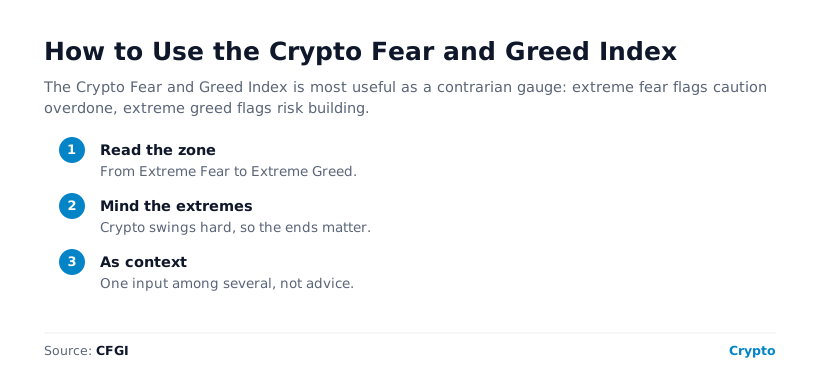
Most people use the Crypto Fear and Greed Index as a contrarian gauge. Extreme Fear, a reading under 20, suggests the crowd may be too pessimistic; Extreme Greed, over 80, suggests it may be too optimistic. Per-asset scoring lets you check whether the coin you hold is the one at an extreme, and you should judge readings against crypto’s wider range. It works best as one input alongside price, trend and your own plan, not as a buy or sell signal on its own. This is education, not financial advice.
CFGI data
CFGI scores crypto Fear and Greed from 0 to 100 across hundreds of assets every 15 minutes since March 2022. Because it scores each asset, you can check whether one coin sits at an extreme while the market does not, which is more actionable than a single market number.
Source: CFGI dataset, March 2022 to June 2026.
Key takeaways
- It is mainly used as a contrarian gauge: fear extremes versus greed extremes.
- Under 20 is Extreme Fear; 80 or above is Extreme Greed.
- Per-asset scoring lets you check one coin against the market.
- Judge readings against crypto’s wider range, not minute to minute.
- Use it with price and trend, never as a standalone signal.
The Contrarian Idea
The Crypto Fear and Greed Index is most often read against the crowd. When fear is extreme, the thinking goes, the bad news may already be priced in and selling may be overdone. When greed is extreme, risk is building because everyone is already positioned for more upside. The index does not tell you what to do; it tells you how stretched the crowd is. This contrarian framing, captured in the phrase "buy the fear, sell the greed", is the heart of how the tool is used: not as a predictor, but as a way to gauge when the crowd has become dangerously one-sided.
How People Read Each Zone
| Reading | Zone | How it is often read |
|---|---|---|
| Under 20 | Extreme Fear | Crowd very pessimistic; some look for value |
| 20 to 39 | Fear | Caution dominates |
| 40 to 59 | Neutral | No strong edge either way |
| 60 to 79 | Greed | Optimism building; risk rising |
| 80 to 100 | Extreme Greed | Crowd euphoric; some reduce exposure |
How the zones are commonly interpreted. Not signals, context.
The crucial habit is to weight the extreme zones, under 20 and over 80, and largely ignore the noisy middle around 40 to 59, where the reading carries little signal.
Per-Asset Scoring: The Crypto Edge
The single most useful feature of a tool like CFGI for crypto is that it scores hundreds of assets individually rather than publishing one market-wide number, and learning to use that is where the real edge lies. Crypto rarely moves as a single block: at any moment, Bitcoin might sit in neutral while a basket of altcoins runs in Extreme Greed, or one coin panics while the rest hold steady, the gap between the most fearful and most greedy major coins has reached 61 points. A single market average blurs all of that away. The practical upshot is to check the specific coin you actually hold or are watching, not just the headline figure: it is far more actionable to know that your coin has hit Extreme Greed than that "the market" is mildly greedy. Scanning the by-coin directory lets you spot exactly which assets are stretched, turning a vague market read into a focused, asset-level one, which is precisely the granularity crypto’s fragmented, fast-rotating market demands.
Adjust for Crypto’s Pace
Crypto’s round-the-clock, high-volatility nature changes how you should read the index in two ways. First, cadence: the score refreshes every 15 minutes across four timeframes, but that does not mean you should react to every flicker. For most purposes the daily or longer-timeframe reading, which captures the multi-day mood, is far more useful than the minute-to-minute number, which is mostly noise. Second, range: because crypto reaches both extremes more readily and deeply than stocks, you should judge a reading against crypto’s own wider history, the score has swung from a low of 12 to a high of 87, so what counts as a meaningful extreme in crypto is calibrated to that broad range. A reading of 30 is more routine in crypto than it would be in the steadier equity market. Reading the index with crypto’s pace and range in mind, rather than treating every tick as significant, is part of using it well in a market that never sleeps.
Read the Daily, Not the Flicker
The score updates every 15 minutes, but the daily and longer-timeframe reading captures the real mood; the minute-to-minute number is mostly noise. Judge extremes against crypto’s own wide 12-to-87 range.
Using It In Practice
Putting it together: check the specific coin alongside the trend and your plan, weight the extremes, read the daily mood rather than every tick, and treat persistent fear in a downtrend with respect, sentiment can stay fearful for a long time. The index is a contrarian context tool and a check on your own emotions in a notoriously emotional market, not a crystal ball. Sentiment can remain irrational longer than expected: Extreme Fear is not a guarantee of a bottom, and Extreme Greed is not a guarantee of a top. Decide your rules in advance, size positions to your risk, and use the index as one input among several. Used this way, it is a genuinely valuable steadying tool; used as a buy or sell button, it will disappoint. This is education, not financial advice.
Frequently asked questions
How do you use the Crypto Fear and Greed Index?
Most people read it as a contrarian gauge: Extreme Fear under 20 suggests pessimism may be overdone, Extreme Greed over 80 suggests risk is building. Weight the extremes, check the specific coin you hold, read the daily mood, and use it with price and trend, not as a standalone signal.
Why does per-asset scoring matter for crypto?
Because crypto rarely moves as one block: one coin can be in Extreme Greed while another panics, with the gap between major coins reaching 61 points. Checking the specific coin you hold is far more actionable than a single market-wide average that blurs the divergence away.
How often should I check it?
CFGI refreshes every 15 minutes, but the daily and longer-timeframe reading is far more useful than the minute-to-minute number, which is mostly noise. Sentiment matters most at the extremes, so checking around big moves and on the coin you hold is usually enough.
Is Extreme Fear a buy signal?
Not on its own. Extreme Fear means the crowd is very pessimistic, which can precede a bounce, but fear can persist through a downtrend. Treat it as context alongside other analysis and a plan set in advance. This is education, not financial advice.
CFGI.io, Market sentiment research
The CFGI research team builds and maintains the CFGI Fear and Greed Index: a 0 to 100 sentiment score from 10 sub-indicators across hundreds of crypto assets and the equity market, refreshed every 15 minutes. We have tracked market emotion through multiple full crypto and equity cycles.
Think we missed something?
Spotted a gap, disagree with a take, or think we should cover a new topic? Message us and we'll act on your input.
Message us on TelegramKeep reading
This article is educational and is not financial advice. Crypto and equities are volatile and you can lose money. See our disclaimer.