Crypto
CoinStats Fear and Greed Index vs CFGI
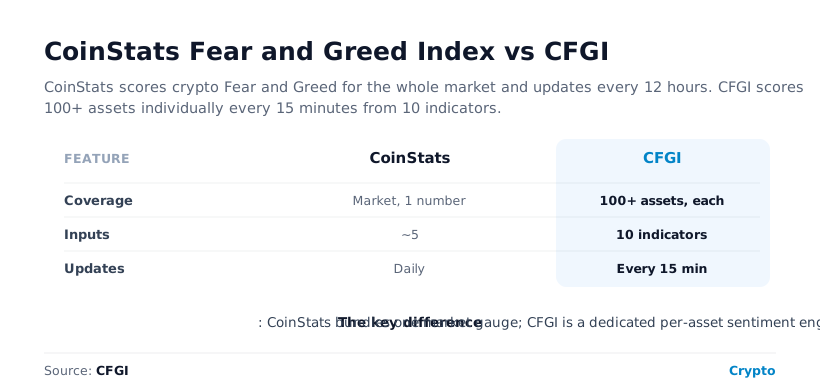
Quick answer
CoinStats publishes one crypto Fear and Greed score, from 0 to 100, for the market as a whole, refreshed every 12 hours from inputs like volatility, momentum, social sentiment, surveys, Bitcoin dominance and Google Trends. CFGI scores hundreds of assets individually from 10 indicators and refreshes every 15 minutes across 4 timeframes, and it scores stocks on the same scale too. The big differences are cadence and per-asset granularity. This is education, not financial advice.
CFGI data
CoinStats refreshes its single market score every 12 hours; CFGI refreshes every 15 minutes and scores hundreds of assets individually, as it has since March 2022. That cadence matters in crypto, where a 12-hour-old reading can miss a move that flipped the crowd from greed to fear overnight.
Source: CFGI dataset, March 2022 to June 2026.
Key takeaways
- CoinStats shows one market-wide score, updated every 12 hours.
- CFGI scores hundreds of assets individually, every 15 minutes, across 4 timeframes.
- Both share the 0 to 100 scale; CFGI uses 10 indicators.
- CFGI also scores the stock market on the same scale.
- The key differences are cadence and per-asset detail.
How Do They Differ?
CoinStats builds a single crypto Fear and Greed number for the market from volatility, market momentum, social sentiment, surveys, Bitcoin dominance and Google Trends, and refreshes it every 12 hours. CFGI scores each asset on its own, from 10 indicators, every 15 minutes across 4 timeframes. In a market that can move hard overnight, the gap between a 12-hour refresh and a 15-minute one is the gap between yesterday and now.
CoinStats vs CFGI, Side by Side
| CoinStats | CFGI | |
|---|---|---|
| Scope | Whole market, one number | hundreds of assets, scored individually |
| Inputs | 6 sentiment sources | 10 indicators |
| Update frequency | Every 12 hours | Every 15 minutes |
| Timeframes | One | 4 |
| Per-asset scores | No | Yes |
| Stocks too | No | Yes, on the same scale |
The two crypto Fear and Greed indexes compared.
Both are legitimate sentiment gauges built on the same 0 to 100 idea, so this is less about right versus wrong and more about granularity: a single daily snapshot versus a continuous, per-asset feed. It is also worth noting that, because the two indices use somewhat different inputs and update on different schedules, they will not always agree on the exact number on a given day. That is normal: two gauges measuring the same mood with different recipes will produce slightly different readings, and neither is "wrong", they are simply answering with different methods and at different moments in time.
The Cadence Gap
The most consequential difference is how often each updates. A 12-hour refresh is perfectly adequate for a once- or twice-daily glance at the overall mood. But crypto never sleeps, and it can move violently overnight, a hack, a liquidation cascade, a regulatory headline, can flip the crowd from greed to fear in hours. A reading that is up to twelve hours old can therefore describe a market that no longer exists, telling you the mood as it was last night rather than as it is now. CFGI’s 15-minute cadence is designed for exactly this: it keeps pace with a 24/7 market, so the score you read reflects the present rather than a stale snapshot. For anyone acting on sentiment intraday, that freshness is the difference that matters most.
The Per-Asset Difference
The second key difference is granularity. CoinStats, like most classic indices, produces one number for "crypto" as a whole, which blends every coin together. CFGI instead scores hundreds of assets individually, which surfaces information a single market number simply cannot hold. It can show Bitcoin sitting in greed while a particular altcoin is in deep fear, or reveal a wide divergence between coins, the gap between major coins reached 61 points on one occasion. That per-asset detail is what lets you read the specific coin you care about, rather than a market-wide average that may not describe it at all. A single number answers "how does crypto feel?"; per-asset scoring answers the more useful "how does this coin feel?"
Average Versus Specific
A market-wide score tells you the mood of "crypto"; per-asset scoring tells you the mood of the coin in front of you. They can be very different things at the same moment.
Which Fits How You Trade?
The honest answer is that it depends on how you use sentiment. For a twice-a-day check on the overall crypto mood, a market-wide index like CoinStats is perfectly sufficient, and there is nothing wrong with a simpler tool for a simpler need. If you act on sentiment intraday, or you watch specific coins rather than just "the market", the 15-minute, per-asset detail in CFGI is the meaningful difference: it can show one asset in Extreme Fear while another is greedy, and it does so as the market moves rather than twice a day. CFGI also extends the same 0 to 100 scale to the stock market, so you can compare the crypto and equity crowds directly, which a crypto-only index cannot offer.
Frequently asked questions
How often does the CoinStats Fear and Greed Index update?
CoinStats refreshes its crypto Fear and Greed score every 12 hours. CFGI refreshes every 15 minutes, so the score keeps pace with a market that can move violently overnight.
What does CFGI add over CoinStats?
Per-asset scoring and faster cadence. CFGI scores hundreds of assets individually from 10 indicators every 15 minutes across 4 timeframes, where CoinStats shows one market-wide number twice a day. CFGI also scores stocks on the same scale.
Why does per-asset scoring matter?
Because a single market number blends every coin together, hiding that Bitcoin can be greedy while an altcoin is fearful. Per-asset scoring lets you read the specific coin you care about, not just a market-wide average.
Are the scales the same?
Yes, both use the 0 to 100 Fear and Greed scale: under 20 is Extreme Fear, 80 or above is Extreme Greed. The difference is in cadence and granularity, not the scale. This is education, not financial advice.
CFGI.io, Market sentiment research
The CFGI research team builds and maintains the CFGI Fear and Greed Index: a 0 to 100 sentiment score from 10 sub-indicators across hundreds of crypto assets and the equity market, refreshed every 15 minutes. We have tracked market emotion through multiple full crypto and equity cycles.
Think we missed something?
Spotted a gap, disagree with a take, or think we should cover a new topic? Message us and we'll act on your input.
Message us on TelegramKeep reading
This article is educational and is not financial advice. Crypto and equities are volatile and you can lose money. See our disclaimer.