Crypto
Is the Crypto Fear and Greed Index Accurate?
Quick answer
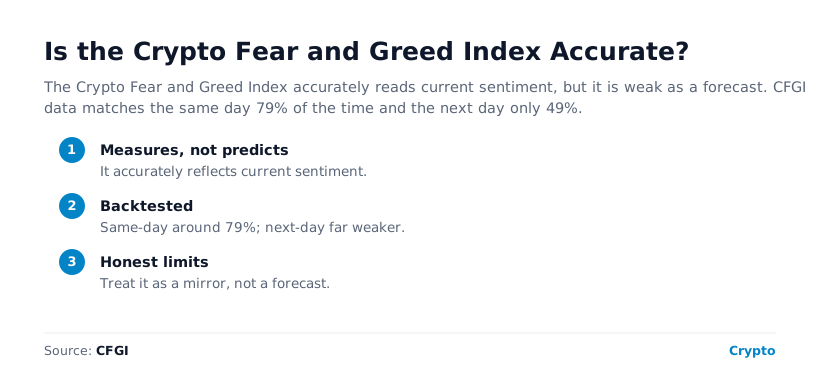
The Crypto Fear and Greed Index is accurate at what it is built to do: read current sentiment from measurable signals. As a predictor of tomorrow it is weak. CFGI data mirrors same-day market direction 79% of the time, but its agreement with the next day falls to 49%, close to a coin flip. No sentiment indicator predicts reliably, so treat it as context, not a crystal ball. This is education, not financial advice.
CFGI data
CFGI sentiment matches same-day crypto market direction 79% of the time, but only 49% the next day, on data running since March 2022. That gap is the honest answer: the index reads the present well and forecasts the future barely, which is true of sentiment indicators in general.
Source: CFGI dataset, March 2022 to June 2026.
Key takeaways
- Accurate at reading current sentiment from measurable signals.
- Weak as a forecast: CFGI matches same-day direction 79%, next-day 49%.
- No sentiment indicator predicts the next move reliably.
- Extremes cluster near turning points because the crowd is most one-sided then.
- Use it as one input alongside price, trend and your own plan.
Accurate At What, Exactly?
A Fear and Greed Index does one job: turn measurable signals into a single sentiment score. Because the inputs are measurable, the score is repeatable, the same conditions give the same reading. In that narrow sense it is accurate. The question people really mean, though, is whether it predicts price, and that is a different test entirely, and the honest answer to that question is the key to using the index without being disappointed by it.
What the Data Shows
CFGI data mirrors same-day market direction 79% of the time. That is strong, but it mostly reflects that sentiment and price move together within a day, when the market is falling, the mood is fearful, almost by definition. Push the test out one day and the agreement drops to 49%, indistinguishable from chance. So the index describes now well and forecasts tomorrow poorly. It is worth pausing on why the 79% figure, impressive as it sounds, is not evidence of prediction: a tool that reflects today’s mood will naturally agree with today’s price direction, since the two are two views of the same thing. The real test of forecasting power is the next-day number, and there the index lands on a coin flip.
| Test | Agreement | Read |
|---|---|---|
| Same day | 79% | Strong: sentiment and price move together |
| Next day | 49% | Weak: close to a coin flip |
CFGI sentiment vs market direction.
Why No Sentiment Indicator Predicts Reliably
This is not a flaw specific to CFGI, it is true of sentiment indicators in general, and there are good reasons why. First, sentiment by its nature reads the present: it is a measure of how the crowd feels now, and how it feels now contains no guaranteed information about the unpredictable events, a shock, a piece of news, a black swan, that will actually drive tomorrow’s price. Second, markets can "stay irrational" far longer than seems reasonable, so even a correct read that the crowd is stretched gives no reliable timing. And third, there is a deep reflexive paradox: if any simple indicator could reliably predict price, everyone would trade on it, and that very trading would erase the edge, predictive signals tend to destroy themselves. The honest conclusion is that no indicator, sentiment or otherwise, offers a reliable crystal ball, and any tool sold as one should be treated with deep suspicion. The Fear and Greed Index is valuable precisely because it does not pretend to predict; it measures, accurately, something real.
Prediction Is the Wrong Test
No sentiment indicator forecasts the next move reliably, because mood reads the present, the future turns on unpredictable shocks, and any signal that truly predicted would be arbitraged away. Judge the index on what it measures, not what it cannot.
Where Its Accuracy Genuinely Helps
None of this makes the index useless, far from it; it just means its value lies somewhere other than prediction. Its genuine accuracy at reading the present mood is itself worth a great deal. It gives you an objective, real-time gauge of the crowd’s emotional state, which is invaluable as a de-biasing tool, a mirror to check your own fear or greed against. And while it cannot time turns, the extremes it accurately identifies do cluster near turning points, not because the index "predicts" them, but because of exhaustion: when the crowd is genuinely maxed out on fear or greed, it has, by definition, run low on the fuel to push further in that direction. So the accurate identification of a true extreme is genuinely useful context, it flags conditions that historically precede reversals, without claiming to know the moment. Used this way, as an accurate read of present sentiment that is most informative at the extremes, the index earns its keep, just not as the forecasting tool people sometimes wish it were.
Frequently asked questions
Is the Crypto Fear and Greed Index accurate?
Yes, at what it is built for: reading current sentiment from measurable signals, repeatably. As a forecast it is weak, CFGI data matches same-day market direction 79% of the time but the next day only 49%, close to a coin flip. It reads the present well and the future barely.
Can the Crypto Fear and Greed Index predict the market?
No, and no sentiment indicator does reliably. Mood reads the present; tomorrow turns on unpredictable shocks; and any signal that truly predicted would be arbitraged away. Anything sold as a crypto crystal ball should be treated with suspicion.
Why does it agree with today but not tomorrow?
Because sentiment and price largely move together within a day, so same-day agreement is high almost by definition. The next day is a fresh question the current reading cannot answer, which is why agreement falls to a coin flip.
Is it still worth watching?
Yes, as context. It accurately reads the present mood, which is valuable as a de-biasing mirror, and the extremes it identifies cluster near turning points because of exhaustion, not prediction. Read it alongside price and trend, not as a standalone signal. This is education, not financial advice.
CFGI.io, Market sentiment research
The CFGI research team builds and maintains the CFGI Fear and Greed Index: a 0 to 100 sentiment score from 10 sub-indicators across hundreds of crypto assets and the equity market, refreshed every 15 minutes. We have tracked market emotion through multiple full crypto and equity cycles.
Think we missed something?
Spotted a gap, disagree with a take, or think we should cover a new topic? Message us and we'll act on your input.
Message us on TelegramKeep reading
This article is educational and is not financial advice. Crypto and equities are volatile and you can lose money. See our disclaimer.