Stocks
Is the Stock Market Fearful Or Greedy Right Now?
Quick answer
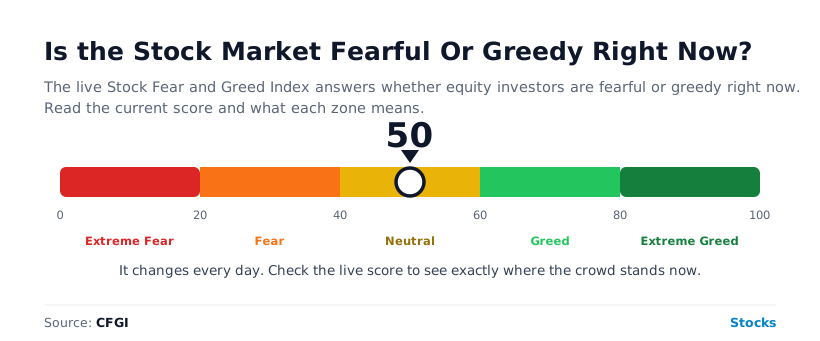
Whether the stock market is fearful or greedy right now is answered by the live Stock Fear and Greed Index below. A reading under 40 means fear is in charge, 40 to 59 is neutral, and 60 or above means greed. Under 20 is Extreme Fear and 80 or above is Extreme Greed. The gauge updates daily, in line with equity trading hours, so it reflects where the market closed its most recent session. This is education, not financial advice.
CFGI data
CFGI scores the equity crowd daily on the same 0 to 100 scale it has used since 2021, where readings have ranged from an extreme-fear 3 on 8 April 2025 to a greedy 83 on 19 December 2023. The live gauge below shows where the market sits today against that history.
Source: CFGI dataset, 2021 to June 2026.
Key takeaways
- The live gauge below shows the current equity reading.
- Under 40 is fear; 60 or above is greed; 40 to 59 is neutral.
- Under 20 is Extreme Fear; 80 or above is Extreme Greed.
- It updates daily, set by equity trading hours.
- The extremes carry the signal; one daily reading is not a trade trigger.
The Market Mood Right Now
Read the number against the zones: the lower it sits, the more fearful the equity crowd; the higher, the more greedy. The Stock Fear and Greed Index is most informative at the extremes, where the crowd is most one-sided, and least informative in the broad neutral middle.
How to Read the Score
| Score | Zone | Broad read |
|---|---|---|
| 0 to 19 | Extreme Fear | Panic, possible value |
| 20 to 39 | Fear | Caution, weak confidence |
| 40 to 59 | Neutral | No strong lean |
| 60 to 79 | Greed | Optimism, rising risk appetite |
| 80 to 100 | Extreme Greed | Euphoria, pullback risk |
What the current reading means.
The bands are guides, not switches. A move from 58 to 61 does not flip the world from neutral to greedy overnight; what matters is the broad zone and, even more, the direction of travel over recent days.
What the Number Is Built From
The reading is not an opinion poll. It is calculated from how the market is actually behaving, blending signals like price momentum, volatility, how broad the buying or selling is across stocks, and demand for safe-haven assets. CFGI combines a set of such inputs into one daily figure on the 0 to 100 scale. Because it reads behaviour rather than asking people how they feel, the gauge often captures a shift in mood that the headlines have not caught up with yet.
What a Fearful Or Greedy Reading Means
The most useful way to read the gauge is as a contrarian gut-check, in the spirit of being "fearful when others are greedy, and greedy when others are fearful". Historically, Extreme Fear has clustered near painful market bottoms, the moments that later looked like opportunities, while Extreme Greed has clustered near frothy tops. CFGI’s own equity history shows the full range: a reading as low as 3 in deep panic, and as high as the low 80s in confident, greedy stretches. A number near those edges is a prompt to slow down and check your own emotions, not a command to buy or sell.
Why "Right Now" Matters Less Than You Think
It is tempting to treat today’s number as a signal to act, but a single daily reading is weak on its own. Sentiment can sit in Extreme Greed for weeks during a strong bull run, or in Extreme Fear through a grinding sell-off, so reacting to one day’s value often means fighting a trend rather than reading it. The gauge earns its keep over time: watching whether the market is drifting toward fear or greed, and how it behaves when it reaches an extreme, tells you far more than the snapshot alone.
How to Use It
Glance at the live number once a day for context, watch the trend across the week, and pay real attention only when it pushes into an extreme. That is where the signal lives.
Does the Reading Predict the Market?
No, and it is important to be clear about that. The Stock Fear and Greed Index describes how the crowd feels today; it does not forecast tomorrow’s price. Its value is contrarian and probabilistic, not predictive: extreme readings have tended to precede reversals more often than the middle of the range, but "more often" is a long way from "reliably". Plenty of greedy markets keep climbing and plenty of fearful ones keep falling. Treat the gauge as one input that improves the odds of reading the market’s mood correctly, to be weighed alongside fundamentals, valuation and your own plan, rather than a crystal ball that tells you what happens next.
How Current the Reading Is
CFGI refreshes the stock score once per trading day, in line with the hours equity markets keep, so the gauge reflects where the market closed its most recent session. Over a weekend or a market holiday it simply holds the last value, because there is no new trading to measure. For a live, full-page view of the equity reading and its history, see the Stock Fear and Greed Index itself, and the crypto version if you want the round-the-clock market too.
Frequently asked questions
Is the stock market fearful or greedy right now?
The live gauge above shows the current reading. Under 40 means fear is in charge, 60 or above means greed, and 40 to 59 is neutral. The score updates daily, so it reflects the most recent close.
How current is the reading?
CFGI updates the stock score daily, in line with equity trading hours, so the gauge reflects where the market closed the most recent session. It holds steady over weekends and market holidays.
What counts as a fearful or greedy reading?
Under 20 is Extreme Fear and 80 or above is Extreme Greed. The extremes carry the most information; the neutral middle is mostly noise.
Should I buy or sell based on the reading?
No. It is a contrarian context tool, not a trade signal. Extreme Fear can flag value and Extreme Greed can flag caution, but an extreme can persist, so use it to check your emotions alongside other analysis. This is education, not financial advice.
CFGI.io, Market sentiment research
The CFGI research team builds and maintains the CFGI Fear and Greed Index: a 0 to 100 sentiment score from 10 sub-indicators across hundreds of crypto assets and the equity market, refreshed every 15 minutes. We have tracked market emotion through multiple full crypto and equity cycles.
Think we missed something?
Spotted a gap, disagree with a take, or think we should cover a new topic? Message us and we'll act on your input.
Message us on TelegramKeep reading
This article is educational and is not financial advice. Crypto and equities are volatile and you can lose money. See our disclaimer.