Markets
How Accurate Is the Fear and Greed Index?
Quick answer
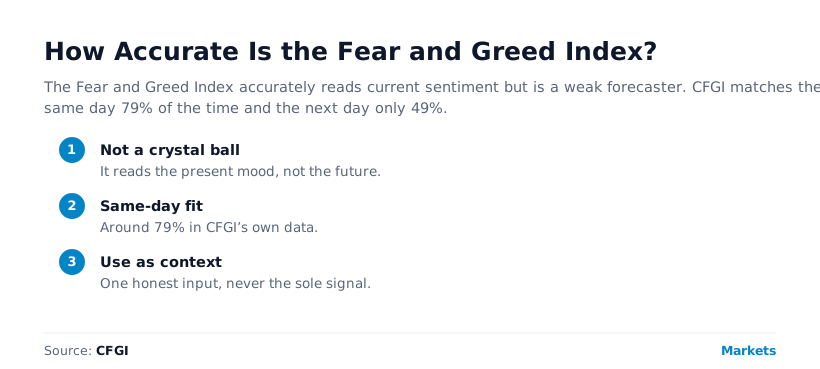
It depends what you mean by accurate. At reading current sentiment, the Fear and Greed Index is accurate: it turns measurable signals into a repeatable score, where the same conditions give the same reading. At predicting price, it is weak. CFGI data matches same-day market direction 79% of the time, but its agreement with the next day falls to 49%, close to a coin flip. The honest summary is that it is an accurate thermometer, not a forecast, and most useful at the extremes over longer horizons.
CFGI data
CFGI puts real numbers on the question: same-day, its sentiment matches market direction 79% of the time; next-day, 49%, on data since March 2022. That gap is the honest measure of accuracy, strong on the present, weak on the future, and it is the same for every sentiment gauge, not a quirk of one.
Source: CFGI dataset, March 2022 to June 2026.
Key takeaways
- It is accurate at reading current sentiment from measurable signals.
- It is weak as a forecast: CFGI matches same-day 79%, next-day 49%.
- It is a thermometer, not a crystal ball.
- Accuracy is highest at the extremes and over longer horizons.
- Buying extreme fear has worked better than selling extreme greed.
Two Meanings of Accurate
The Fear and Greed Index can be accurate in one sense and not the other, and conflating the two is the source of most disappointment with it. As a reading of how the crowd feels right now, it is accurate and repeatable: the same market conditions produce the same score, because it is built from real, measurable signals. As a prediction of where price goes next, it is weak, like every sentiment indicator ever made. Judging it as a forecasting machine is asking it to do a job it was never designed for.
What the Data Shows
| Test | Agreement | Read |
|---|---|---|
| Same day | 79% | Strong: reads the present well |
| Next day | 49% | Weak: close to a coin flip |
CFGI sentiment versus market direction.
The same-day figure mostly reflects that sentiment and price move together within a day, the gauge accurately captures the mood as it happens. The drop to 49% the next day is the honest limit, and a revealing one: 49% is essentially a coin flip, meaning the index has no reliable power to call tomorrow’s direction. It describes the present clearly and forecasts the future barely at all, which is exactly what an honest sentiment tool should admit.
Why Next-Day Is a Coin Flip
This is not a failing unique to CFGI; it is a feature of markets. Short-term price moves are dominated by news and noise that no sentiment reading can anticipate, so day-to-day direction is close to random. A gauge that measures current mood cannot predict an unexpected headline tomorrow, and any sentiment index claiming high next-day accuracy should be treated with deep suspicion. Being upfront that the next-day figure is 49% is, paradoxically, a mark of trustworthiness: it refuses to pretend the present tells you the immediate future.
Where It Is Genuinely Useful: The Extremes
The index earns its keep not day to day, but at the extremes and over longer horizons. Historical backtests consistently find that periods of Extreme Fear have been followed by above-average forward returns, while Extreme Greed has often preceded pullbacks, the classic contrarian pattern. The crucial detail is the timeframe: this edge shows up over weeks and months of holding, not overnight. So the index is best understood as a long-horizon signal for spotting unusually one-sided sentiment, not a short-term timing device. Used that way, it has real, evidence-backed value.
The Right Question
Do not ask "will the index call tomorrow?" It will not. Ask "is the crowd at an emotional extreme right now?" That is the question it answers accurately, and the one that has historically mattered.
Buying Fear Versus Selling Greed
There is an important asymmetry in how the signal performs. Buying into Extreme Fear and holding for the long term has historically been the more reliable side of the trade, because deep fear tends to mark prices that later look cheap. Selling at Extreme Greed is trickier: greed can persist for a long time during a powerful bull market, so stepping out at the first greedy reading and waiting for the next fear signal can mean missing entire rallies. The lesson is that the index is better at flagging when to be brave than at telling you precisely when to leave the party, which is one more reason to treat it as context rather than a mechanical rule.
Reading "Accuracy" Honestly
Put it all together and the honest verdict is clear. The Fear and Greed Index is an accurate, repeatable measure of present sentiment and a poor predictor of short-term price. Its value lies in spotting extremes, over longer horizons, as one input among many, never as a standalone crystal ball. Anyone selling it as a precise market-timing tool is overselling it, and anyone dismissing it as useless because it cannot call tomorrow is misunderstanding it. Accurate thermometer, not forecast, is the phrase to keep in mind.
Frequently asked questions
How accurate is the Fear and Greed Index?
Accurate at reading current sentiment, weak at forecasting. CFGI matches same-day market direction 79% of the time and the next day only 49%, so it is a thermometer, not a crystal ball.
Can I trust it to predict the market?
Not for short-term direction. Its next-day agreement is close to a coin flip, because day-to-day moves are dominated by unpredictable news. It accurately reads how the crowd feels now, which is context, not a forecast.
When is it most accurate?
At the extremes, below 20 and above 80, and over longer horizons. Historically, Extreme Fear has preceded above-average forward returns and Extreme Greed has often preceded pullbacks, over weeks and months rather than days.
Is buying fear or selling greed more reliable?
Buying into Extreme Fear and holding has historically been the more reliable side, while selling at Extreme Greed is harder because greed can persist and you can miss big rallies. Treat both as context, not mechanical rules. This is education, not financial advice.
CFGI.io, Market sentiment research
The CFGI research team builds and maintains the CFGI Fear and Greed Index: a 0 to 100 sentiment score from 10 sub-indicators across hundreds of crypto assets and the equity market, refreshed every 15 minutes. We have tracked market emotion through multiple full crypto and equity cycles.
Think we missed something?
Spotted a gap, disagree with a take, or think we should cover a new topic? Message us and we'll act on your input.
Message us on TelegramKeep reading
This article is educational and is not financial advice. Crypto and equities are volatile and you can lose money. See our disclaimer.