Stocks
What Is a Stock Split?
Quick answer
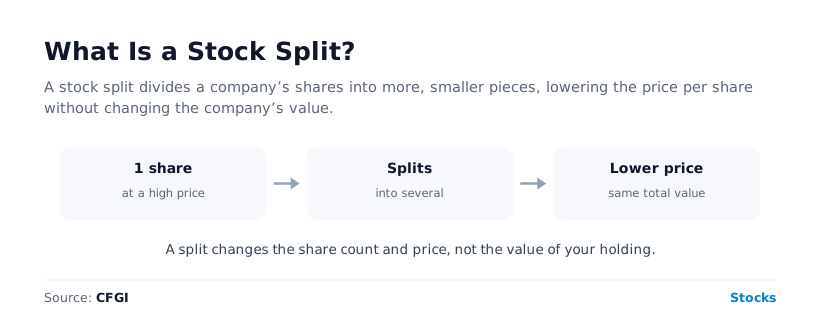
A stock split increases the number of shares while cutting the price of each one in proportion, so the total value you hold does not change. A 2-for-1 split turns one share worth 100 into two worth 50 each, and a 10-for-1 turns one share worth 1,000 into ten worth 100. The company is no bigger or smaller afterwards; the same pie is simply cut into more slices, usually to make the headline price look more affordable.
CFGI data
The bump a stock often gets when it announces a split is almost pure attention, not value, which makes it a clean example of the gap CFGI is built to measure. The Stock Fear and Greed Index reads the market’s emotion on a 0 to 100 scale in real time, and a split "pop" is sentiment moving while the underlying business stands perfectly still.
Key takeaways
- A split divides shares into more, smaller pieces and lowers the price to match.
- The company’s value and your stake are unchanged; only the share count moves.
- Companies split to make a high price look affordable and improve liquidity.
- The "split pop" reflects attention and momentum, not the split itself.
- A reverse split raises the price by combining shares, and often signals distress.
More Slices, Same Pie
In a 2-for-1 split, every share becomes two and the price per share halves. The ratio can be anything: 3-for-1, 4-for-1, even 20-for-1. Whatever the number, the maths is symmetrical, so the value you hold is identical the instant before and the instant after. Nothing about the business changes, and the market capitalisation, the real measure of the company’s size, does not move at all.
A worked example makes it concrete. Say you own 10 shares of a company trading at 900, a holding worth 9,000. The company announces a 3-for-1 split. Afterwards you own 30 shares trading at 300, still worth exactly 9,000. You are no richer and no poorer. Only the share count and the per-share price have changed, in opposite directions, by the same factor.
Why Companies Split Their Stock
If a split changes nothing fundamental, why bother? The reasons are practical and psychological rather than financial.
- Affordability. A four-figure share price can feel out of reach to smaller investors. A lower headline price widens the pool of potential buyers.
- Liquidity. More shares at a lower price usually means tighter spreads and easier trading, which markets reward with smoother pricing.
- Options and employees. Cheaper shares make options contracts and employee share schemes easier to size and award.
- Signalling. Choosing to split tends to say "management expects the price to keep rising", a quiet vote of confidence.
Notice that none of these add a cent of value. They change who finds the stock convenient to buy, not what the company earns, which is why a split is best understood as marketing for the share price, not a change in the business behind it.
The Big Splits of Recent Years
The largest, most successful companies split most visibly, because runaway success is what pushes a share price into the hundreds or thousands in the first place.
| Company | Ratio | When |
|---|---|---|
| NVIDIA | 10-for-1 | June 2024 |
| Amazon | 20-for-1 | June 2022 |
| Alphabet (Google) | 20-for-1 | July 2022 |
| Tesla | 3-for-1 | August 2022 |
| Apple | 4-for-1 | August 2020 |
Notable stock splits, 2020 to 2024.
Each of these companies was already a market leader when it split. That pattern is the key to reading splits correctly: the split did not make them great, their success made the split necessary. Confusing the two is the most common mistake investors make.
Does a Split Make a Stock Go Up?
Often it looks that way, and there is a real effect to explain. Studies find an "announcement premium": shares tend to drift up around the date a split is revealed. But dig into why and the magic fades. Two duller forces are at work. First, selection: companies only reach split-worthy prices by performing well, so they were already on a strong run. Second, attention and signalling: the announcement puts the stock in the headlines and hints that management is confident.
When researchers strip out prior momentum and company quality, the split-specific gain shrinks or vanishes. The split itself, the act of swapping one share for several, creates no value, and any pop that is not backed by real earnings or growth tends to fade back toward where it started.
The Takeaway
Buying a stock just because it announced a split is not a strategy. Judge the business, the earnings and the valuation. The split is a footnote, not a reason.
Reverse Splits and What They Signal
A reverse split runs the process backwards: it combines shares to raise the price, turning ten shares worth 1 each into one share worth 10. The value is again unchanged, but the motive usually is not flattering. Companies most often do reverse splits to lift a sagging price back above an exchange’s minimum, frequently 1 US dollar, and avoid being delisted. Where a forward split tends to whisper confidence, a reverse split often signals trouble, which is why the market usually treats the two very differently.
Splits, Attention and Sentiment
A stock split is one of the cleanest demonstrations of the difference between price action and value. Nothing real changes, yet the crowd can react, buying the attention and the implied confidence. That reaction is sentiment, and sentiment is what the Stock Fear and Greed Index measures on a 0 to 100 scale. When a high-profile split lands in a greedy market, the pop can be sharp; in a fearful one, the same news can barely register. Knowing the mood of the market helps you tell a real move from a passing burst of investor sentiment.
Frequently asked questions
What is a stock split?
A move that increases the number of shares while cutting the price of each in proportion, so total value is unchanged. A 2-for-1 split turns one 100 share into two 50 shares; a 10-for-1 turns one 1,000 share into ten 100 shares.
Does a stock split make me richer?
No. You own more shares at a lower price, but the total value is the same and the company is worth exactly what it was. A split changes the share count, not your wealth or your stake.
Do stocks go up after a split?
Sometimes around the announcement, but mostly because the company was already performing well and the news draws attention. Strip out that momentum and the split itself adds no value, so any unsupported pop tends to fade.
What is a reverse stock split?
The opposite of a normal split: shares are combined to raise the price, like 1-for-10. It is often used to keep a falling price above an exchange’s minimum and avoid delisting, so it usually signals distress. This is education, not financial advice.
CFGI.io, Market sentiment research
The CFGI research team builds and maintains the CFGI Fear and Greed Index: a 0 to 100 sentiment score from 10 sub-indicators across hundreds of crypto assets and the equity market, refreshed every 15 minutes. We have tracked market emotion through multiple full crypto and equity cycles.
Think we missed something?
Spotted a gap, disagree with a take, or think we should cover a new topic? Message us and we'll act on your input.
Message us on TelegramKeep reading
This article is educational and is not financial advice. Crypto and equities are volatile and you can lose money. See our disclaimer.