Stocks
What Is a Stock Rating?
Quick answer
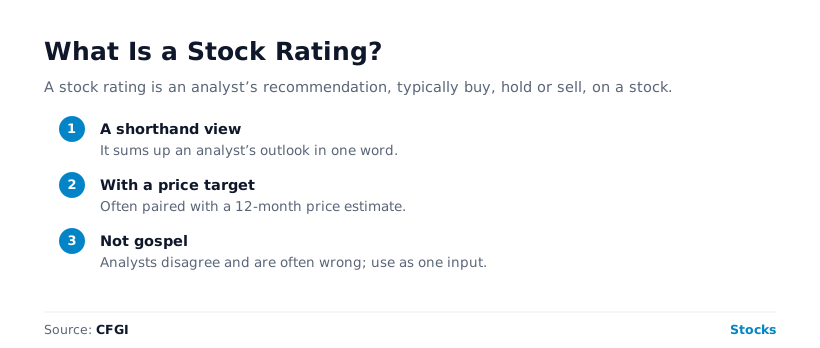
A stock rating is a professional analyst’s recommendation on a stock, usually a label like buy, hold or sell, or overweight, neutral and underweight. It summarises how the analyst expects the stock to perform, and it usually comes with a 12-month price target. Ratings carry real research, but they lean bullish by design, they lag big moves, and they cluster, so they are one input to weigh, not an answer to act on.
CFGI data
Analyst ratings are slow, expert and backward-looking. CFGI’s Stock Fear and Greed Index reads the market on a 0 to 100 scale through every trading day: where a rating tells you what one analyst concluded weeks ago, the index tells you what the whole market is feeling today, which is why the two are best read together rather than apart.
Key takeaways
- A stock rating is an analyst’s buy, hold or sell view, usually with a price target.
- A consensus rating averages many analysts into one figure.
- Fewer than 10% of all ratings are "sell", so the scale is skewed bullish.
- Price targets land within their window only about half the time.
- The change in a rating often matters more than its level.
The Analyst’s Verdict
Banks and research firms employ analysts who follow a handful of companies closely, build financial models, and publish a rating: a short label for whether they expect the stock to outperform, perform in line, or underperform the market. Most ratings come with a 12-month price target, the level the analyst thinks the stock will reach. When many analysts cover the same name, their views are averaged into a consensus rating and an average target, which is the figure most investors actually see.
Reading the Scale
There is no single standard, which trips people up. The same opinion can wear different words at different firms.
| Bullish | Neutral | Bearish |
|---|---|---|
| Buy | Hold | Sell |
| Overweight | Equal-weight | Underweight |
| Outperform | Market perform | Underperform |
The three common rating vocabularies line up like this.
Some firms add a fifth tier, strong buy and strong sell, on either end. The label matters less than the direction and, crucially, the change: an upgrade from hold to buy can move a stock more than a rating that was already a buy.
Why Almost Nothing Is a "Sell"
Here is the part most beginners miss. Ratings are not evenly spread. Across the market, fewer than 10% of all analyst ratings are "sell". The label is so rare that seasoned investors read a downgrade to "hold" or "neutral" as the closest an analyst will politely get to telling you to sell.
The skew is not an accident. Many analysts work at firms that also do investment banking for the companies they cover, and a "sell" rating on a banking client is awkward business. Academic studies have isolated the effect: analysts make measurably worse calls on stocks their own firm underwrote, while rating other companies just fine, which points to bias rather than incompetence. A rating is an informed opinion, but it is an opinion produced inside a system that prefers good news.
The Practical Read
Treat "hold" as a soft sell and a genuine "sell" as a loud alarm. The base rate of optimism is the context every rating should be read against.
Do Ratings and Price Targets Work?
Price targets are confident but not precise. Studies find that 12-month targets are reached within their window only about half the time, and analysts are better at calling direction than the exact level. Ratings also lag: by the time a wave of downgrades arrives, the bad news, and much of the fall, is usually already in the price. They cluster too, because analysts read the same filings and each other, so a whole group can be bullish together right at a top.
How to Actually Use a Rating
- Watch the revision, not just the level. A fresh upgrade or downgrade is new information; a standing "buy" is old news.
- Read the price target as a range and a direction, not a promise of an exact number.
- Discount the bullish baseline. Compare a stock’s rating mix to the market’s, not to zero.
- Cross-check the slow expert view against the fast crowd view, which is where sentiment comes in.
Ratings, Consensus and Sentiment
A rating and a Fear and Greed Index answer different questions. The rating tells you what a trained analyst concluded about one company over a 12-month horizon. The index tells you, on a 0 to 100 scale, how fearful or greedy the whole market is right now. One is slow, expert and skewed optimistic; the other is fast, broad and emotional. Read together, they triangulate: a strong consensus buy on a stock while the market is gripped by extreme fear is a very different picture from the same rating in the middle of euphoria.
Frequently asked questions
What is a stock rating?
An analyst’s recommendation on a stock, usually buy, hold or sell, summarising how they expect it to perform, almost always paired with a 12-month price target.
Why are there so few "sell" ratings?
Because the scale is skewed bullish: fewer than 10% of all ratings are "sell". Analysts often work at firms with banking ties to the companies they cover, so they rarely issue an outright sell. A downgrade to "hold" is often the real warning.
Are analyst price targets accurate?
Only loosely. Studies show 12-month targets are reached within their window about half the time, and analysts are better at direction than at the exact level. Treat a target as a range, not a promise.
How is a price target set?
Analysts build a model of the company, often a discounted cash flow or a valuation multiple applied to forecast earnings, and derive a fair value about 12 months out. The consensus target is just the average of those estimates, so it is only as reliable as the assumptions behind it.
What is a consensus rating?
The average of many analysts’ ratings on the same stock, giving a broad sense of professional opinion. CFGI surfaces analyst consensus alongside its own sentiment reading. This is education, not financial advice.
CFGI.io, Market sentiment research
The CFGI research team builds and maintains the CFGI Fear and Greed Index: a 0 to 100 sentiment score from 10 sub-indicators across hundreds of crypto assets and the equity market, refreshed every 15 minutes. We have tracked market emotion through multiple full crypto and equity cycles.
Think we missed something?
Spotted a gap, disagree with a take, or think we should cover a new topic? Message us and we'll act on your input.
Message us on TelegramKeep reading
This article is educational and is not financial advice. Crypto and equities are volatile and you can lose money. See our disclaimer.