Markets
What Is the Endowment Effect?
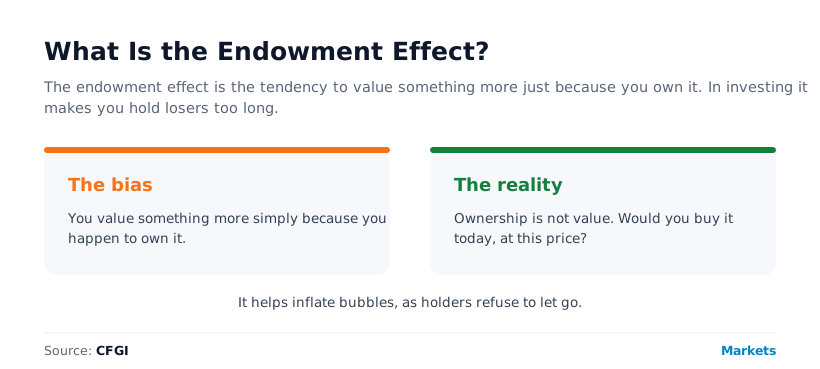
Quick answer
The endowment effect is the tendency to value something more highly simply because you own it. In investing, it makes you reluctant to sell a holding you would never choose to buy at its current price, because owning it makes it feel more valuable than it is. It is one of the biases that keeps people clinging to positions long after the case for them has gone, and it quietly nudges whole portfolios toward inertia and over-concentration.
CFGI data
The endowment effect inflates what you own; CFGI values nothing. Its 0 to 100 score reads exactly the same whether or not you hold the asset, refreshed daily for stocks since 2021 and every 15 minutes for crypto. That outside view, indifferent to your ownership, is precisely the perspective the endowment effect denies you.
Source: CFGI methodology, 0 to 100 sentiment model.
Key takeaways
- The endowment effect is over-valuing something just because you own it.
- In the classic mug study, owners demanded about twice what buyers would pay.
- It stems from loss aversion: giving up what you own feels like a loss.
- It makes investors hold positions they would never buy today.
- The antidote is the fresh-cash test.
Owning It Makes It Feel Worth More
People consistently demand more to give up something they own than they would pay to acquire the exact same thing. That gap is the endowment effect. Applied to a stock, it shows up as a simple test most investors quietly fail: if you would not buy this holding at today’s price with fresh cash, why are you still holding it? The honest answer is often that ownership itself has inflated your sense of its worth, not any real change in the asset.
The Famous Mug Experiment
The defining proof came from a study by Daniel Kahneman, Jack Knetsch and Richard Thaler in 1990. They randomly gave half a group of students a coffee mug worth about 6 dollars, and gave the other half nothing, then let them trade. In a rational market the mugs should have changed hands at around their 6 dollar value. Instead, the new owners demanded a median of about 5.25 dollars to part with their mug, while buyers would offer only around 2.25 to 2.75. Owning the mug for barely half an hour had roughly doubled its perceived value. Nothing about the mug had changed, only who held it.
Why It Happens: Loss Aversion
The endowment effect is loss aversion wearing a different hat. Once you own something, giving it up registers in the mind as a loss, and loss aversion means losses hurt about twice as much as equivalent gains feel good. So the pain of handing over your mug looms larger than the pleasure a buyer expects from getting it, and the two prices drift apart. Richard Thaler, who coined the term in 1980, showed that you do not even need to feel attached to an object; simply being handed ownership is enough to switch on the brain’s loss-aversion circuitry. It is automatic, and it is strong.
How It Hurts Investors
In a portfolio, the endowment effect is costly in quiet ways. It makes investors cling to underperforming positions they would never buy fresh, because selling feels like surrendering something valuable. It breeds over-concentration, people hold far too much of an inherited stock or their own employer’s shares, treating "my stock" as special. And it reinforces the disposition effect, the reluctance to crystallise a loss. Each is a case of ownership, rather than analysis, steering the decision, and together they quietly anchor a portfolio to the past.
The Tell
If you find yourself unable to explain why you would buy a holding today, only why you do not want to let it go, the endowment effect is probably in the driving seat.
The Fresh-Cash Test
The cleanest antidote is a single question, sometimes called the fresh-cash test: if this position were converted to cash right now, would I buy it back at today’s price? If the answer is no, then ownership, not conviction, is keeping you in it, and that is reason enough to reconsider. The trick is that it forces you to look at the holding from the outside, as a buyer rather than an owner, which is exactly the perspective the endowment effect strips away. Applied honestly across a portfolio, it is one of the simplest ways to break free of inertia.
Beyond the Stock Market
The endowment effect is everywhere once you notice it, and businesses exploit it deliberately. Free trials, "try it at home for 30 days" offers and money-back guarantees all work by handing you ownership first, knowing that once the item feels like yours, parting with it becomes painful. The same instinct makes people overprice their homes and struggle to declutter their possessions. Recognising the bias in everyday life makes it easier to catch in your investing, where its cost is measured not in a 6 dollar mug but in years of holding the wrong position.
The Endowment Effect and Sentiment
The endowment effect distorts your private valuation of what you hold; a sentiment gauge offers the opposite, an impersonal outside view. A Fear and Greed Index scores the crowd’s mood on a 0 to 100 scale with complete indifference to whether you own the asset, which is precisely the detachment ownership erodes. Reading the gauge will not tell you what to do, but it is a useful reminder that the market does not share your attachment, and that the value of a holding is set by the crowd, not by the comfort of having owned it.
Frequently asked questions
What is the endowment effect?
The tendency to value something more highly just because you own it. In investing it makes a holding feel more valuable than it is, so you cling to positions you would never buy at the current price.
What was the mug experiment?
A 1990 study by Kahneman, Knetsch and Thaler in which students given a coffee mug demanded a median of about 5.25 dollars to sell it, while buyers offered only around 2.25 to 2.75. Owning it briefly roughly doubled its perceived value.
Why does the endowment effect happen?
Because of loss aversion: once you own something, giving it up registers as a loss, and losses hurt about twice as much as equivalent gains feel good. So owners price out higher than buyers.
How do you counter the endowment effect?
Use the fresh-cash test: ask whether you would buy each holding today at its current price. If not, ownership, not analysis, may be keeping you in it. This is education, not financial advice.
CFGI.io, Market sentiment research
The CFGI research team builds and maintains the CFGI Fear and Greed Index: a 0 to 100 sentiment score from 10 sub-indicators across hundreds of crypto assets and the equity market, refreshed every 15 minutes. We have tracked market emotion through multiple full crypto and equity cycles.
Think we missed something?
Spotted a gap, disagree with a take, or think we should cover a new topic? Message us and we'll act on your input.
Message us on TelegramKeep reading
This article is educational and is not financial advice. Crypto and equities are volatile and you can lose money. See our disclaimer.