Markets
What Is the Sunk Cost Fallacy?
Quick answer
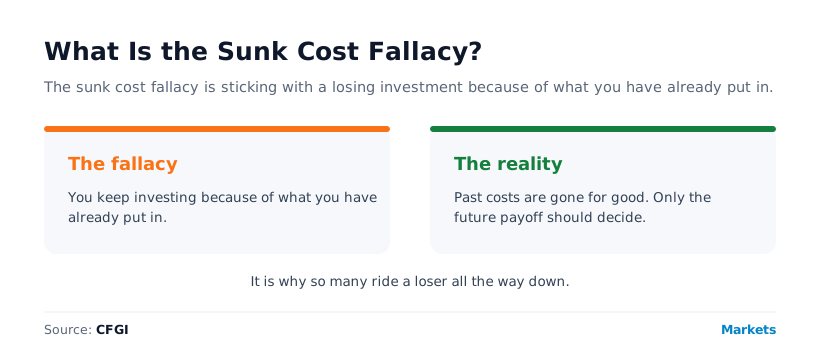
The sunk cost fallacy is the urge to keep going with something because of what you have already spent on it, even when quitting would be the better choice. In investing it means holding a losing position because you have already lost so much, hoping to break even. But the money already lost is gone either way, whether you hold or sell. The only question that rationally matters is what the position is worth from here, forward, not what it has already cost you.
CFGI data
The sunk cost fallacy asks how much you have already lost; CFGI only reads now. Its 0 to 100 score reflects current sentiment with no memory of what a position has cost you, the purely forward-looking view the fallacy works so hard to block. The market does not care what you paid, and neither does the gauge.
Source: CFGI methodology, 0 to 100 sentiment model.
Key takeaways
- Sunk costs are money, time or effort already spent and unrecoverable.
- The fallacy is letting those past costs drive future decisions.
- The Concorde jet is the classic example of sunk-cost thinking.
- In investing it means holding losers to try to break even.
- Only the future value of a position should matter.
Throwing Good Money After Bad
A sunk cost is money, time or effort you have already spent and cannot get back. The fallacy is letting it dictate what you do next. In markets it sounds like: "I have already lost 40%, I cannot sell now." But the past loss is exactly the same whether you hold or sell, so it should play no part in the decision. The rational question is forward-looking: is this the best place for my money from today onward, not how much it has already cost to get here. Almost everyone knows this in theory and ignores it in practice.
The Concorde Fallacy
The bias is so closely tied to one example that academics call it the "Concorde fallacy". Britain and France poured billions into developing the supersonic Concorde jet, and even once it was clear the aircraft would never be commercially profitable, the governments kept funding it, reasoning that they had already invested too much to stop. They continued for decades. The money already spent could not be recovered by pressing on, yet the feeling that quitting would "waste" it kept the project alive long past the point of sense. It is the perfect illustration: the more you have sunk into something, the harder it becomes to walk away, even when walking away is plainly the right call.
Why It Happens
The sunk cost fallacy is powered by deeper instincts. Closing a losing position means crystallising a loss, and loss aversion makes that pain feel about twice as sharp as an equivalent gain feels good, so we delay it. There is also ego: selling at a loss means admitting we were wrong, and holding on lets us cling to the hope of being proven right. And we are wired to avoid "waste", to feel that abandoning something already paid for is throwing it away. All three combine to keep us pouring good resources after bad, long after a clear-eyed look would say stop.
Beyond Investing
The fallacy runs through ordinary life. People sit through films they are not enjoying because they paid for the ticket, stay in the wrong job or course because of the years already invested, and finish meals they no longer want because the food is bought. In business it is more expensive: it helps explain why so many mergers fail, why companies like Kodak, Nokia and Blockbuster kept funding dying business models long after the world had moved on. Spotting the pattern away from the markets, in those small everyday "I have come this far" moments, makes it far easier to catch when real money is on the line.
How It Traps Investors
In a portfolio, the sunk cost fallacy does specific damage. It keeps people anchored to losing positions purely because of the loss already taken, waiting indefinitely to "get back to even". Worse, it can lead to averaging down into a weak position with no real conviction, just to lower the break-even point, throwing more money at a decision that was wrong the first time. The hidden cost is opportunity: money trapped in a dead investment, held only because of what it cost, cannot work in a better one. The loss is not really crystallised by selling; it was crystallised when the value fell, and refusing to sell just freezes it in place.
The Fresh-Start Test
Ask: if I held this as cash today, would I buy this exact position now? If not, the only thing keeping you in it is what it has already cost, which is the fallacy itself.
How to Avoid It
Beating the sunk cost fallacy is less about willpower than about reframing. Judge every position on its future prospects alone, using current data and a cold assessment of where it goes from here, not on what it has cost you to reach this point. Acknowledge the past loss honestly, then set it aside, because it is identical whether you stay or go. Separating the emotion from the decision is hard, which is why a simple rule, the fresh-start test, helps so much: it forces the forward-looking question the fallacy is built to suppress.
The Sunk Cost Fallacy and Sentiment
The sunk cost fallacy is a backward-looking bias, fixated on what a position has already cost you. A sentiment gauge offers the cure: a purely present-tense, impersonal view. A Fear and Greed Index scores the crowd’s mood on a 0 to 100 scale with no knowledge or care of what you paid, which is exactly the detachment the fallacy strips away. The market is not trying to get you back to even, and reading the gauge is a small reminder that the only thing that matters from here is what happens next, not what already happened to get you here.
Frequently asked questions
What is the sunk cost fallacy?
The urge to keep going with something because of what you have already spent on it, even when quitting is the better choice. In investing it means holding a loser to try to break even.
What is the Concorde fallacy?
Another name for the sunk cost fallacy, after the Concorde jet, which Britain and France kept funding for decades despite knowing it would never be profitable, because they had already invested so much.
How does the sunk cost fallacy affect investing?
It keeps people anchored to losing positions because of past losses, sometimes averaging down without conviction, rather than judging whether the position is the best use of their money from today onward.
How do you avoid it?
Use the fresh-start test: ask what you would do if you held cash today, ignoring what the position has already cost. The past loss is the same either way, so only the future should drive the decision. This is education, not financial advice.
CFGI.io, Market sentiment research
The CFGI research team builds and maintains the CFGI Fear and Greed Index: a 0 to 100 sentiment score from 10 sub-indicators across hundreds of crypto assets and the equity market, refreshed every 15 minutes. We have tracked market emotion through multiple full crypto and equity cycles.
Think we missed something?
Spotted a gap, disagree with a take, or think we should cover a new topic? Message us and we'll act on your input.
Message us on TelegramKeep reading
This article is educational and is not financial advice. Crypto and equities are volatile and you can lose money. See our disclaimer.