Markets
What Is Prospect Theory?
Quick answer
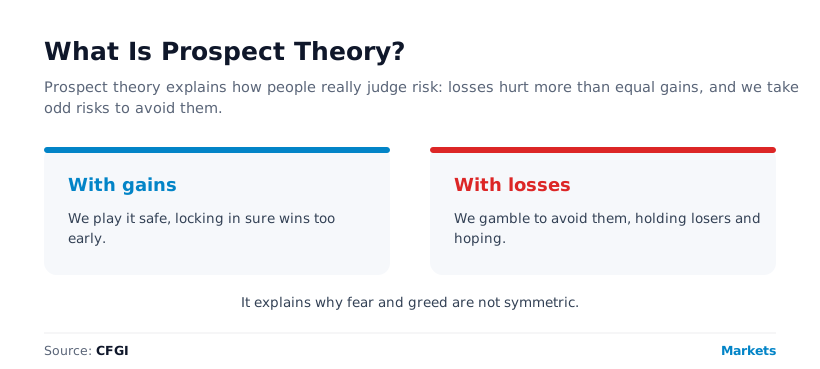
Prospect theory is a foundational idea in behavioural finance describing how people actually make decisions under risk, as opposed to how pure logic says they should. Its central insight is that losses feel about twice as painful as equivalent gains feel good, and that people judge outcomes as changes from a reference point rather than in absolute terms. Those two quirks lead us to take irrational risks to avoid losses and to lock in gains too early, and together they are the framework behind much of market psychology.
CFGI data
Prospect theory says losses hurt about twice as much as equal gains, and CFGI shows that asymmetry at market scale: its score tends to plunge toward Extreme Fear, below 20 on its 0 to 100 scale, faster and deeper than it ever climbs to Extreme Greed. Fear is sharper than greed, exactly as the theory predicts.
Source: CFGI methodology, 0 to 100 sentiment model.
Key takeaways
- Prospect theory describes how people really make decisions under risk.
- Losses hurt about twice as much as equal gains please, called loss aversion.
- Outcomes are judged against a reference point, not in absolute terms.
- How a choice is framed as a gain or loss changes the decision.
- It underpins behavioural finance and explains why markets overshoot.
How People Really Weigh Risk
Classical economics assumed people weigh gains and losses evenly and rationally, maximising expected outcomes like a calculator. Prospect theory showed that real humans do nothing of the sort. We feel the pain of a loss far more intensely than the pleasure of an equal gain, a phenomenon called loss aversion, and we judge every outcome relative to a reference point, usually where we started, rather than in absolute terms. Those two facts quietly bend almost every financial decision we make.
Where It Came From
Prospect theory was introduced in 1979 by the psychologists Daniel Kahneman and Amos Tversky, in a paper that became one of the most cited in all of economics. It was deliberately "descriptive", a model of how people actually behave, in contrast to the older "expected utility" theory of how a perfectly rational agent should behave. The work reshaped economics by putting real psychology at its centre, and Kahneman received the Nobel Memorial Prize in Economics for it in 2002. Tversky, who had died in 1996, was acknowledged as co-author but could not share the prize.
The Four Moving Parts
- Reference point. People judge outcomes as gains or losses from a starting point, not as final wealth. The same balance feels like a win or a loss depending on where you began.
- Loss aversion. Losses loom larger than gains, by roughly two to one.
- An S-shaped value function. We are cautious with gains (taking a sure win) but risk-seeking with losses (gambling to get back to even).
- Probability weighting. We overweight tiny probabilities, which is why lotteries and insurance both sell, and underweight large ones.
Loss Aversion: The Core
The heart of the theory is that losing hurts more than winning feels good. Experiments put the ratio at roughly two to one: for many people, the pain of losing 1,000 is only offset by the pleasure of gaining around 2,000. This is not a small bias to correct; it is wired deep, and it explains a huge amount of seemingly irrational behaviour, from refusing a fair coin-flip bet to clinging desperately to a position that is clearly going wrong. Once you see loss aversion, you see it everywhere in how people handle money.
The Framing Effect
Because outcomes are judged against a reference point, the way a choice is worded changes the decision, even when the facts are identical. A medical treatment described as having a "95% survival rate" is chosen far more often than the same treatment described as having a "5% mortality rate". One frames the outcome as a gain, the other as a loss, and loss aversion does the rest. Marketers, brokers and headline writers exploit this constantly, "save 100 pounds" lands very differently from "do not lose 100 pounds", which is why understanding framing is a quiet form of self-defence.
The Practical Guard
When a choice feels obvious, ask how it is framed. Reword it from gain to loss, or loss to gain, and see if your preference survives. Often it will not.
Why It Matters for Markets
Prospect theory explains some of investing’s most reliable mistakes. The "disposition effect" is the tendency to sell winners too early, to bank a sure gain, while holding losers far too long, gambling to avoid crystallising a loss, the exact opposite of the sensible "cut losses, let winners run". Scaled across millions of investors, this asymmetry helps drive the violent overshoots a Fear and Greed Index is built to measure. It is, in short, the science of why a market falls faster than it rises, and why panic is so much more contagious than optimism.
Prospect Theory and Sentiment
If losses hurt twice as much as gains, then fear should move a market more forcefully than greed, and it does. Sell-offs are sharper and faster than rallies, and sentiment tends to collapse toward Extreme Fear more violently than it builds toward greed. That is exactly the asymmetry a 0 to 100 sentiment gauge captures. Knowing the psychology behind it helps you do the hard, contrarian thing: recognise that the deepest fear, the moment loss aversion is screaming loudest, has often been the moment of greatest opportunity.
Frequently asked questions
What is prospect theory?
A behavioural-finance framework describing how people really make decisions under risk: losses feel about twice as painful as equal gains, and outcomes are judged relative to a reference point rather than in absolute terms.
Who developed prospect theory?
Psychologists Daniel Kahneman and Amos Tversky, in a landmark 1979 paper. It became a cornerstone of behavioural finance, and Kahneman won the Nobel Memorial Prize in Economics for the work in 2002.
What is the framing effect?
The finding that how a choice is worded, as a gain or as a loss, changes the decision even when the facts are identical. "95% survival" and "5% mortality" describe the same outcome but lead to different choices.
How does prospect theory affect investing?
It explains the disposition effect: investors hold losers too long to avoid locking in a loss, while selling winners too early to secure a gain. Scaled up, this asymmetry helps drive market overshoots. This is education, not financial advice.
CFGI.io, Market sentiment research
The CFGI research team builds and maintains the CFGI Fear and Greed Index: a 0 to 100 sentiment score from 10 sub-indicators across hundreds of crypto assets and the equity market, refreshed every 15 minutes. We have tracked market emotion through multiple full crypto and equity cycles.
Think we missed something?
Spotted a gap, disagree with a take, or think we should cover a new topic? Message us and we'll act on your input.
Message us on TelegramKeep reading
This article is educational and is not financial advice. Crypto and equities are volatile and you can lose money. See our disclaimer.