Markets
What Are Animal Spirits?
Quick answer
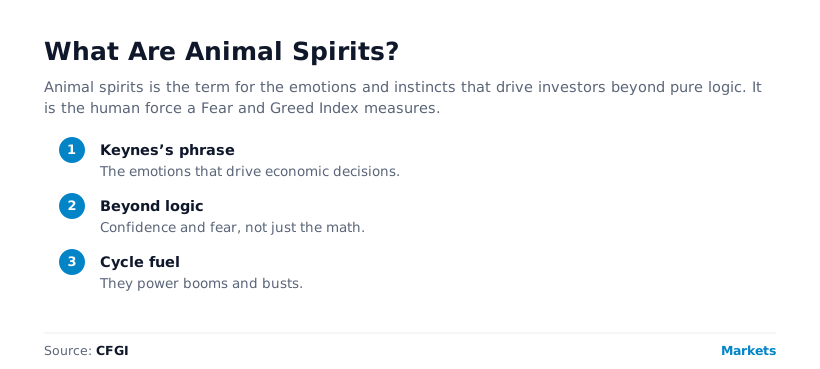
Animal spirits is a term, coined by economist John Maynard Keynes in 1936, for the emotions, instincts and gut confidence that drive economic and investment decisions beyond cold calculation. Because the future is genuinely uncertain, investing takes a "spontaneous urge to action" that no spreadsheet can fully justify. It is why markets overshoot in both directions: optimism and pessimism feed on themselves rather than tracking the facts. Animal spirits are exactly the human force a Fear and Greed Index is built to measure. This is education, not financial advice.
CFGI data
Animal spirits are what a sentiment index quantifies. The swings Keynes described, confidence and fear feeding on themselves, are precisely what CFGI captures as a 0 to 100 score, from the equity 3 on 8 April 2025 to greed highs near 83. The index puts a number on the mood.
Source: CFGI dataset, 2021 to June 2026.
Key takeaways
- Animal spirits are the emotions and instincts driving economic decisions.
- John Maynard Keynes coined the term in his 1936 General Theory.
- They are the "spontaneous urge to action" that overcomes uncertainty.
- Akerlof and Shiller revived the idea after the 2008 crisis.
- They are the human force a Fear and Greed Index measures.
The Emotion Behind the Economy
Keynes used animal spirits to describe the spontaneous confidence, or loss of it, that drives people to act when the future is genuinely uncertain. Investment, spending and risk-taking depend not only on careful calculation but on a gut sense of optimism or dread. When animal spirits run high, money flows and markets rise; when they collapse, activity freezes. This is why markets are not coldly rational: the same facts can be greeted with greed or fear depending on the mood, and the mood often amplifies itself.
Where the Term Comes From
The phrase entered economics through John Maynard Keynes’s landmark 1936 book, The General Theory of Employment, Interest and Money. In one of its most quoted passages, Keynes argued that most decisions to do something positive, whose payoff unfolds over many years, "can only be taken as the result of animal spirits, a spontaneous urge to action rather than inaction, and not as the outcome of a weighted average of quantitative benefits multiplied by quantitative probabilities". In plain terms: you cannot calculate your way to most big decisions, because the numbers do not exist yet. What gets people to act anyway is an instinctive, emotional confidence, the animal spirits.
A spontaneous urge to action rather than inaction, and not the outcome of a weighted average of quantitative benefits multiplied by quantitative probabilities.
Why They Matter: The Leap of Action
Keynes’s insight is deeper than "people are emotional". His point is that the future is fundamentally unknowable, so no amount of analysis can fully justify building a factory, founding a company or buying a stock for the long run. Faced with that uncertainty, a purely rational calculator would freeze, unable to act without complete information. Animal spirits are what break the deadlock: a spontaneous urge to do something rather than nothing. In this sense they are not a flaw but the very engine of investment and enterprise, the optimism that gets things built. The flip side is that when that confidence drains away, the same uncertainty becomes paralysing, and economies seize up.
Akerlof and Shiller’s Revival
The idea returned to prominence after the 2008 financial crisis, when Nobel economists George Akerlof and Robert Shiller wrote a book titled "Animal Spirits", arguing that mainstream economics had stripped psychology out of its models and missed how the economy really works. They broke animal spirits into elements like confidence, a sense of fairness, susceptibility to corruption, "money illusion", and, crucially, the "stories we tell ourselves", the narratives that sweep through a market and shape behaviour. Their work helped explain why bubbles, panics and recessions keep happening in ways that purely rational models cannot, and put behavioural psychology back at the centre of how booms and busts unfold.
Animal Spirits In the Cycle
Scaled across an economy, animal spirits drive the boom-and-bust cycle. When confidence is high, optimism feeds spending, investment and risk-taking, which lifts prices and profits, which feeds still more confidence, an upward spiral that can inflate into euphoria and bubbles. When confidence cracks, the loop reverses: fear freezes investment and spending, prices fall, and the gloom justifies itself into recession. Because the same set of facts can be read with greed or with dread depending on the prevailing mood, animal spirits are why markets and economies swing far more violently than the underlying fundamentals alone would suggest. The mood is not a sideshow; it is a driving force.
The Mood Is the Mechanism
Animal spirits explain why optimism and pessimism are self-fulfilling: confidence creates the conditions that justify more confidence, and fear creates the conditions that justify more fear.
Measuring the Mood
Animal spirits sound abstract, but a Fear and Greed Index turns them into something measurable. By distilling the crowd’s optimism and dread into one 0 to 100 score, it puts a number on the very force Keynes described, the emotional engine beneath the reasons emotions move markets. Nearly a century after Keynes named them, animal spirits are no longer just a literary flourish but something you can read off a gauge: high readings mark confidence running hot, low readings mark its collapse. The index is, in effect, a thermometer for the animal spirits that move markets and economies alike.
Frequently asked questions
What are animal spirits?
A term coined by John Maynard Keynes in his 1936 General Theory for the emotions, instincts and gut confidence that drive economic and investment decisions beyond pure calculation, a "spontaneous urge to action".
Why did Keynes think they matter?
Because the future is genuinely uncertain, so no calculation can fully justify long-term investment. Animal spirits are the instinctive optimism that gets people to act anyway, making them the engine of enterprise, and their collapse the cause of slumps.
What did Akerlof and Shiller add?
Their 2009 book "Animal Spirits" revived the idea after the financial crisis, breaking it into confidence, fairness, corruption, money illusion and the "stories we tell ourselves", and arguing these explain bubbles and busts that rational models miss.
How do animal spirits relate to the Fear and Greed Index?
They are exactly what it measures. The index turns the crowd’s optimism and dread into a single 0 to 100 score, putting a number on the mood Keynes described. This is education, not financial advice.
CFGI.io, Market sentiment research
The CFGI research team builds and maintains the CFGI Fear and Greed Index: a 0 to 100 sentiment score from 10 sub-indicators across hundreds of crypto assets and the equity market, refreshed every 15 minutes. We have tracked market emotion through multiple full crypto and equity cycles.
Think we missed something?
Spotted a gap, disagree with a take, or think we should cover a new topic? Message us and we'll act on your input.
Message us on TelegramKeep reading
This article is educational and is not financial advice. Crypto and equities are volatile and you can lose money. See our disclaimer.