Markets
What Is Anchoring Bias In Investing?
Quick answer
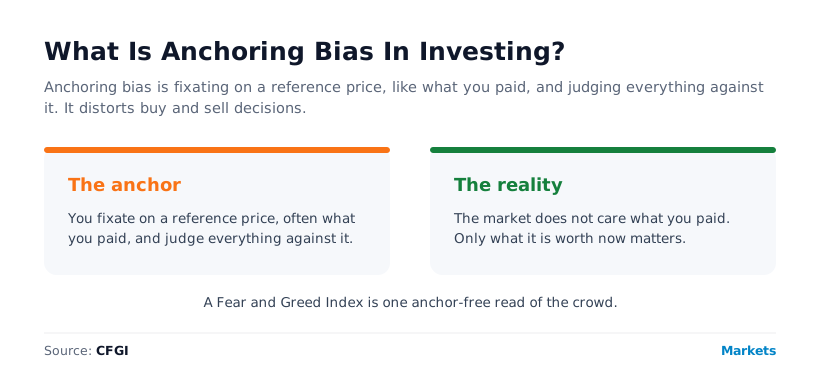
Anchoring bias is the tendency to fixate on a reference number, often the price you paid or a recent high, and judge every later decision against it. It makes investors refuse to sell below their entry, or wait for a stock to return to an old peak that no longer reflects reality. The anchor feels meaningful but is usually irrelevant to what the asset is worth now, and combined with loss aversion it produces the "break-even disease" of holding losers forever. This is education, not financial advice.
CFGI data
Anchoring is one reason sentiment and price can diverge: a crowd anchored to old highs stays hopeful even as conditions worsen. A sentiment score built from current signals, like CFGI’s 0 to 100 reading, sidesteps the anchor by reading the market as it is now, not against a past price.
Source: CFGI dataset, March 2022 to June 2026.
Key takeaways
- Anchoring is fixating on a reference price and judging against it.
- It comes from the "anchor and adjust" mental shortcut.
- Common anchors are your entry price and the 52-week high.
- With loss aversion it causes "break-even disease".
- The anchor is usually irrelevant to current value.
When a Number Sticks
Anchoring is a mental shortcut: the first number we see shapes how we judge later ones. In investing, the most powerful anchor is the price you paid. Sell below it and it feels like a defeat, so people hold losers, waiting to break even, long after the case for holding has gone. Recent highs anchor too. A stock that fell from 100 to 60 can feel cheap because it was once 100, even if 60 is now generous. The anchor frames the decision, but it has nothing to do with what the asset is worth today.
Where It Comes From: Anchor and Adjust
Anchoring was identified by psychologists Amos Tversky and Daniel Kahneman, the founders of behavioural finance, as part of how people estimate under uncertainty. Faced with an unknown, the mind grabs a starting number, an "anchor", and then adjusts away from it, but the adjustment is almost always too small, so the final judgement stays stuck near the anchor. Their famous experiments showed this works even with totally arbitrary anchors that subjects knew were random. In markets, that means a number with no bearing on an asset’s true worth, like the price you happened to pay, can quietly dominate your thinking simply because it was your starting point.
The Anchors That Trip Up Investors
A handful of reference points do most of the damage. The purchase price is the strongest, becoming the benchmark against which every later decision is unfairly judged. The 52-week high is another: a stock trading well below its yearly peak feels like a bargain even when its fundamentals have deteriorated, and research shows investors are oddly reluctant to push a price above that high even when good news justifies it. Round numbers, a stock "should" be worth 100, an analyst’s price target, and the level you "could have sold at" all act as anchors too. None of them tell you what the asset is worth now, yet each can hijack a decision that should rest only on current facts.
The Anchor Is a Sunk Fact
What you paid, and what a stock once hit, are history. The market neither knows nor cares about your entry price. Only the current case for owning it matters.
Break-Even Disease
Anchoring turns genuinely dangerous when it combines with loss aversion. Anchored to your purchase price, and feeling the pain of a loss about twice as keenly as a gain, selling below that anchor becomes psychologically excruciating, so you refuse to do it. The result is the "break-even disease": holding a losing position indefinitely, not because you still believe in it, but purely to avoid crystallising a loss against your anchor and "get back to even". This is one of the most common and costly mistakes in investing, because it ties up money in failing positions and amplifies losses, all to protect a number that exists only in your own head.
How to Avoid Anchoring
The cure is to consciously judge an asset on its current case rather than your history with it. The single most powerful question to ask is: "Knowing nothing about what I paid, would I buy this today at this price?" If the answer is no, your entry price is the only reason you are still holding, which is anchoring at work. Deliberately ignore the 52-week high, treat your purchase price as a sunk fact the market is indifferent to, and re-evaluate each holding as if you were considering it fresh. Using present-tense measures, current fundamentals, current sentiment, rather than remembered prices, keeps your decisions tied to reality instead of to an anchor.
Anchoring Versus Current Sentiment
A Fear and Greed Index helps because it reads the market from current signals, not against a remembered price. When you notice yourself anchored to an old number, waiting for a stock to "come back" to your entry or to its former high, a fresh read of where the crowd actually stands can reset the frame and pull your attention back to the present. The gauge does not know or care what you paid; it only describes the market as it is now. That present-tense honesty is a quiet antidote to a bias that lives entirely in the past.
Frequently asked questions
What is anchoring bias?
Fixating on a reference number, often the price you paid or a recent high, and judging later decisions against it even when the anchor is no longer relevant. It stems from the "anchor and adjust" mental shortcut identified by Tversky and Kahneman.
What are common anchors in investing?
The purchase price is the strongest, followed by the 52-week high, round numbers, analyst price targets and the level you "could have sold at". None reflect what the asset is worth now, yet each can hijack a decision.
What is "break-even disease"?
When anchoring combines with loss aversion: anchored to your entry price, selling below it feels too painful, so you hold a losing position indefinitely just to "get back to even", tying up money and amplifying losses.
How do you avoid anchoring?
By asking "would I buy this today at this price, knowing nothing about what I paid?", ignoring the 52-week high, and judging each holding on its current case using present-tense measures like a sentiment index. This is education, not financial advice.
CFGI.io, Market sentiment research
The CFGI research team builds and maintains the CFGI Fear and Greed Index: a 0 to 100 sentiment score from 10 sub-indicators across hundreds of crypto assets and the equity market, refreshed every 15 minutes. We have tracked market emotion through multiple full crypto and equity cycles.
Think we missed something?
Spotted a gap, disagree with a take, or think we should cover a new topic? Message us and we'll act on your input.
Message us on TelegramKeep reading
This article is educational and is not financial advice. Crypto and equities are volatile and you can lose money. See our disclaimer.