Markets
Using the Fear and Greed Index With Moving Averages
Quick answer
A moving average smooths price to show the underlying trend; the Fear and Greed Index shows the emotion behind it. Used together, they add context: a fearful reading while price holds above a rising moving average is very different from fear during a downtrend. The combination helps you separate a healthy pullback from a genuine breakdown, which neither tool reveals alone, because the index measures emotion and the moving average measures direction. This is education, not financial advice.
CFGI data
Trend plus sentiment beats either alone. CFGI supplies the mood, one 0 to 100 score per asset across four timeframes, while a moving average supplies the trend. Reading them side by side is more informative than reacting to a sentiment tick in isolation.
Source: CFGI dataset and standard technical-analysis definitions, June 2026.
Key takeaways
- A moving average shows the trend; the index shows the emotion.
- The index does not measure direction, which is why trend pairs so well.
- Fear above a rising average differs from fear in a downtrend.
- The four combinations of trend and mood each tell a different story.
- Neither tool is a signal on its own.
Why Combine Them
A moving average, say the 50-day or 200-day, averages recent prices into a single line that filters out noise and reveals the trend. It answers "which way is this really going?" The Fear and Greed Index answers a different question: "how does the crowd feel about it?" One is structure, the other is emotion. The two pair so well precisely because they capture different things: the index deliberately measures mood, not direction, so the moving average supplies exactly the piece it is missing. The insight comes from reading them together, because the same fear reading means something very different depending on whether price is above or below its key averages.
What a Moving Average Tells You
A moving average is one of the oldest and simplest trend tools. It plots the average closing price over a chosen window, smoothing out the daily jitter to reveal the prevailing direction. Two are especially watched: the 50-day, a medium-term gauge, and the 200-day, the classic long-term trend line. The basic readings are intuitive, price above a rising 200-day average signals a healthy uptrend, while price below a falling one signals a downtrend, and the averages often act as support or resistance. Traders also watch crossovers, the celebrated "golden cross" (the 50-day rising above the 200-day) and the ominous "death cross" (the reverse), as signals of a shift in trend. For our purposes, the key job is simple: telling you which way the market is genuinely heading.
How to Use the Two Together
- Identify the trend: is price above or below its rising 200-day average?
- Read the sentiment: is the crowd fearful, neutral or greedy?
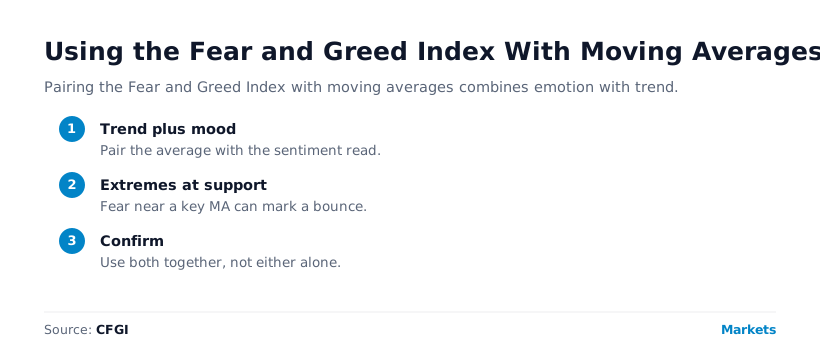
- Fear in an uptrend (price above a rising average) can mark a healthy pullback within strength.
- Greed in a downtrend can flag a fragile bounce rather than a real recovery.
- Let the two agree before leaning on either, and keep your own plan central.
Context, Not Signals
Neither a moving average nor the index is a trade trigger by itself. Their value is in the context they create together. This is education, not financial advice.
The Four Combinations
Crossing the trend with the mood gives four situations, each with a distinct meaning.
| Sentiment | In an uptrend | In a downtrend |
|---|---|---|
| Fear | A possible healthy pullback to buy | Could be capitulation, or more pain |
| Greed | A strong but maturing rally, watch risk | A likely bear-market rally or bull trap |
Trend and sentiment, combined.
The most actionable corners are the diagonals: fear within a healthy uptrend is the classic "buy the dip" setup, while greed within a downtrend is the classic warning of a bull trap or fragile bounce. The trend is what tells you which interpretation of the sentiment to trust. The off-diagonals are gentler: fear in a downtrend and greed in an uptrend are, broadly, the market doing what its trend suggests, so they call for less second-guessing. It is the corners where mood and trend conflict that demand the most attention, because that is where the crowd’s emotion and the market’s direction are telling you different stories.
Context, Not a System
It is worth stressing that this is a framework for context, not a mechanical trading system. A moving average lags, by construction it reflects the past, and the Fear and Greed Index reads the present mood without forecasting the next move, so neither, nor the two together, is a guaranteed signal. What the combination does well is sharpen judgement: it stops you from reading a scary sentiment reading in a vacuum and reminds you to ask "fearful relative to what trend?" Pairing the emotion the index supplies with the direction the moving average supplies, and weighing both against your own plan, turns two limited tools into a more complete picture than either could offer alone.
Frequently asked questions
How do moving averages and the Fear and Greed Index work together?
The moving average shows the trend (direction), and the index shows the emotion (mood). Because the index deliberately does not measure direction, the moving average supplies exactly the missing piece, and together they help separate a healthy pullback from a genuine breakdown.
What does fear above a rising moving average mean?
It can mark a healthy pullback within an uptrend, fear during underlying strength, which is the classic "buy the dip" setup. That is very different from fear in a confirmed downtrend, which may be capitulation or simply more pain to come.
What are the four combinations of trend and sentiment?
Fear in an uptrend (a possible buyable pullback), greed in an uptrend (a maturing rally, watch risk), fear in a downtrend (possible capitulation or more pain), and greed in a downtrend (a likely bear-market rally or bull trap). The trend tells you which reading to trust.
Is this a trading system?
No. Both tools provide context, not signals, a moving average lags and the index does not forecast. The combination sharpens judgement; it does not replace a plan. This is education, not financial advice.
CFGI.io, Market sentiment research
The CFGI research team builds and maintains the CFGI Fear and Greed Index: a 0 to 100 sentiment score from 10 sub-indicators across hundreds of crypto assets and the equity market, refreshed every 15 minutes. We have tracked market emotion through multiple full crypto and equity cycles.
Think we missed something?
Spotted a gap, disagree with a take, or think we should cover a new topic? Message us and we'll act on your input.
Message us on TelegramKeep reading
This article is educational and is not financial advice. Crypto and equities are volatile and you can lose money. See our disclaimer.