Markets
How to Read the Fear and Greed Index
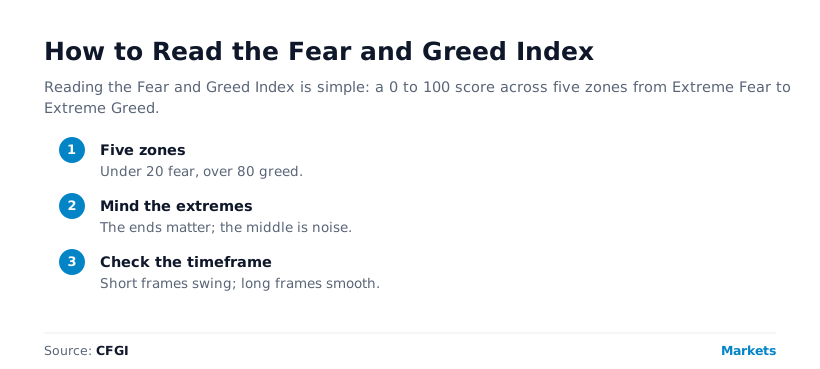
Quick answer
The Fear and Greed Index is a single number from 0 to 100, split into five zones: Extreme Fear, Fear, Neutral, Greed and Extreme Greed. Low means the crowd is fearful; high means it is greedy. To read it well, look at the zone, the direction it is moving, and the timeframe that matches your horizon, weight the extremes over the noisy middle, and treat it as context for caution rather than as a direct buy or sell signal. This is education, not financial advice.
CFGI data
CFGI puts the number in context: one 0 to 100 score per asset, refreshed every 15 minutes across four timeframes since March 2022. Reading it well means using the zone and the trend together, not reacting to a single tick.
Source: CFGI dataset, March 2022 to June 2026.
Key takeaways
- The index runs 0 to 100 across five zones, low fear to high greed.
- Read the zone, the direction and the timeframe together.
- Weight the extremes; the neutral middle is mostly noise.
- Treat extremes as context for caution, not direct signals.
- Combine it with price, trend and your own plan.
The Five Zones
| Score | Zone | What it means |
|---|---|---|
| 0 to 19 | Extreme Fear | Crowd is very fearful |
| 20 to 39 | Fear | Caution dominates |
| 40 to 59 | Neutral | Balanced mood |
| 60 to 79 | Greed | Confidence dominates |
| 80 to 100 | Extreme Greed | Crowd is very greedy |
The five zones of the 0 to 100 scale.
At its simplest, reading the index is just reading the zone: a low number means fear, a high number means greed, and the middle means the crowd is balanced. But reading it well takes a few more steps. The exact band boundaries vary slightly between providers, some split the zones at 25 and 75 rather than 20 and 80, but the idea is identical: the further the number sits from the neutral centre, the more one-sided, and therefore the more notable, the crowd’s mood has become.
The Zone and the Direction
Start with the zone, where the crowd is standing right now, but do not stop there, because the direction the score is travelling matters just as much as its level. A reading of 35 that has been falling fast out of greed tells a very different story than a 35 that has been climbing out of the single digits: the first is a market cooling and growing nervous, the second is one recovering its confidence. So always read the number as a moving thing, not a snapshot. Is sentiment rising toward greed or sliding toward fear? That trend often carries more information than the static level, because it shows the momentum of the crowd’s mood.
Match the Timeframe to Your Horizon
The next step is to read the right timeframe for who you are. CFGI scores sentiment across several timeframes, and using the wrong one is a classic error. A day trader needs the short-term reading, which captures the mood of the current session, while a long-term investor needs the long-term reading and should ignore the intraday noise entirely. Reading a short-term fear spike as if it were a long-term signal, or vice versa, leads you to act on a mood that has nothing to do with your actual holding period. Pick the timeframe that matches how long you intend to hold, and the reading suddenly becomes relevant to your decisions.
Weight the Extremes, Ignore the Middle
The single most important habit is to pay attention at the extremes and largely ignore the middle. The index is most informative when it reaches Extreme Fear (under 20) or Extreme Greed (over 80), where the crowd is most one-sided and therefore most likely to be stretched. Around the neutral 50, the score is mostly noise and carries little signal. So do not hunt for meaning in every small move through the middle; wait for the gauge to reach an extreme, and even then, treat it as a prompt to slow down and check your own emotion, not as an automatic instruction to trade.
The Key Mistake
Extreme Fear is not an instant buy, nor Extreme Greed an instant sell. The index reads the mood; it does not time the market. Use it as one input among several. This is education, not financial advice.
Reading It With Everything Else
Put the steps together and the method is straightforward.
- Read the zone: is the crowd fearful, neutral or greedy right now?
- Read the direction: is the score rising toward greed or falling toward fear?
- Pick the timeframe that matches you: short-term for trading, longer for investing.
- Weight the extremes over the middle, and treat them as a prompt to check your own emotion.
- Combine it with price, trend, valuation and your own plan rather than reading it in isolation.
Done this way, the index becomes a steady, glanceable read on the crowd’s emotional state, one valuable input among several, rather than a button you press. The live gauge below is where you put it into practice.
Frequently asked questions
How do you read the Fear and Greed Index?
Read the 0 to 100 score by its zone, from Extreme Fear to Extreme Greed, then check the direction it is moving and the timeframe that matches your horizon. Weight the extremes over the middle and treat them as context, not direct signals.
What is a high or low reading?
Under 20 is Extreme Fear; 80 and above is Extreme Greed; around 50 is Neutral. Low means the crowd is fearful, high means greedy. The extremes carry the most information.
Why does the direction matter, not just the level?
Because a score of 35 falling out of greed means a market cooling and growing nervous, while a 35 climbing out of the single digits means one recovering confidence. The trend of sentiment often carries more information than the static number.
Is Extreme Fear a buy signal?
Not directly. The index reads the mood, not the right moment to trade. Extremes are best used as a prompt to check your own emotion and your plan, combined with price and trend. This is education, not financial advice.
CFGI.io, Market sentiment research
The CFGI research team builds and maintains the CFGI Fear and Greed Index: a 0 to 100 sentiment score from 10 sub-indicators across hundreds of crypto assets and the equity market, refreshed every 15 minutes. We have tracked market emotion through multiple full crypto and equity cycles.
Think we missed something?
Spotted a gap, disagree with a take, or think we should cover a new topic? Message us and we'll act on your input.
Message us on TelegramKeep reading
This article is educational and is not financial advice. Crypto and equities are volatile and you can lose money. See our disclaimer.