Crypto
Is Extreme Fear a Buy Signal?
Quick answer
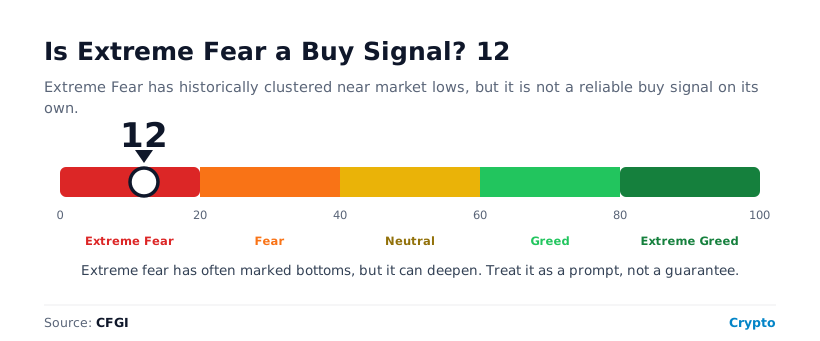
Extreme Fear is not a reliable buy signal on its own. It has clustered near market lows historically, because the crowd is most pessimistic when selling is most exhausted, and buying into fear has a better record than selling into greed. But fear can stay extreme through a long downtrend, so acting at the first extreme risks catching a falling knife. CFGI data reads the present well and the next day barely, so Extreme Fear is best treated as a reason to look for value, confirmed by trend and a plan, not a trigger. This is education, not financial advice.
CFGI data
CFGI sentiment matches same-day market direction 79% of the time but the next day only 49%, on data since March 2022. That gap is why Extreme Fear is a context cue, not a signal: it describes a stretched crowd now, not a bottom tomorrow.
Source: CFGI dataset, March 2022 to June 2026.
Key takeaways
- Extreme Fear has clustered near lows, but is not a standalone buy signal.
- Buying fear is more reliable than selling greed, but still not a trigger.
- Fear can persist through a downtrend, the "falling knife" risk.
- CFGI forecasts the next day only 49% of the time.
- Used safely, it is a prompt to look for value and accumulate gradually.
Why It Is Not a Signal On Its Own
There is a real pattern: bottoms often form when Extreme Fear is at its deepest, because by then most sellers have sold. But the pattern is loose. In a deep downtrend, the index can read Extreme Fear for weeks while price keeps falling, and a buyer who acts at the first extreme gets run over. So the honest answer is that Extreme Fear improves the odds you are near a low, without ever guaranteeing it.
Why Buying Fear Beats Selling Greed
There is a genuine asymmetry that makes the buy-the-fear idea more credible than its mirror. Fear is sharp and self-exhausting: panic tends to burn out quickly, because selling pressure runs out when the frightened have already sold, so prices often snap back hard from deep-fear lows. Greed is the opposite, slow and stubborn, able to persist for months in a bull run. This is why buying into Extreme Fear has historically been the more reliable contrarian side, while selling at the first Extreme Greed is far less so. The crypto score’s fall to 17 during the Terra collapse in May 2022, for instance, came near a significant low. The asymmetry tilts the odds toward the brave buyer, but it does not remove the risk.
The Asymmetry, In One Line
Panic exhausts itself; euphoria lingers. That is why "be greedy when others are fearful" is easier to act on than its opposite, even though neither is a guarantee.
The Catch: Catching a Falling Knife
The danger is that Extreme Fear can stay extreme for a long time. In a sustained downtrend or a genuine structural break, the score can sit deep in fear for weeks while prices grind lower, and a buyer who steps in at the first extreme is "catching a falling knife", buying again and again into a market that keeps falling. This is why the cause of the fear matters enormously: deep fear driven by a passing scare is very different from fear driven by a real collapse, like a major platform’s insolvency. CFGI’s own data is blunt about the limit, next-day direction is essentially a coin flip, so Extreme Fear tells you the crowd is stretched, not that the bottom is in today.
How People Use It Safely
Used carefully, Extreme Fear is a prompt, not a trigger.
- Treat Extreme Fear as a reason to look for value, not an instruction to buy now.
- Accumulate gradually rather than all at once, since you cannot know the exact bottom.
- Wait for the trend to actually start turning, rather than catching a falling market.
- Check the specific asset: CFGI scores 100+ individually, so confirm the coin you want is the one at an extreme.
- Size positions to what you can afford to lose entirely.
The unglamorous version, scaling in slowly and confirming with the trend, captures much of the contrarian edge while surviving the times the knife keeps falling.
The Defensive Value of Extreme Fear
Perhaps the greatest value of an Extreme Fear reading is defensive rather than offensive. When the gauge screams Extreme Fear and you feel the overwhelming urge to sell everything, that is precisely the moment history suggests you should slow down, not capitulate with the crowd. Even if you never buy the dip, simply not panic-selling into deep fear is often the more valuable discipline, because that is when panic selling tends to crystallise losses near a low. So whether you see Extreme Fear as a cautious buying opportunity or just a reason to hold your nerve, the reading earns its keep by countering the very emotion it measures.
Frequently asked questions
Does buying Extreme Fear work?
Sometimes, and more reliably than selling Extreme Greed, because panic exhausts itself faster than euphoria. But fear can also persist in a downtrend, and CFGI matches the next day only 49% of the time, so it is a context cue, not a guaranteed buy signal.
How low is Extreme Fear?
Any reading under 20 on the 0 to 100 scale. The deeper the reading, the more stretched the crowd, but depth alone does not mark a bottom.
What is the "falling knife" risk?
That Extreme Fear stays extreme through a sustained decline, so a buyer who steps in at the first extreme keeps buying into a market that keeps falling. The cause of the fear, a passing scare versus a real collapse, matters enormously.
What is a safer way to use it?
Treat it as a prompt to look for value, accumulate gradually rather than all at once, wait for the trend to begin turning, confirm with other analysis, and manage position size. Its defensive use, not panic-selling, is often the most valuable. This is education, not financial advice.
CFGI.io, Market sentiment research
The CFGI research team builds and maintains the CFGI Fear and Greed Index: a 0 to 100 sentiment score from 10 sub-indicators across hundreds of crypto assets and the equity market, refreshed every 15 minutes. We have tracked market emotion through multiple full crypto and equity cycles.
Think we missed something?
Spotted a gap, disagree with a take, or think we should cover a new topic? Message us and we'll act on your input.
Message us on TelegramKeep reading
This article is educational and is not financial advice. Crypto and equities are volatile and you can lose money. See our disclaimer.