Crypto
What Is a Crypto ICO?
Quick answer
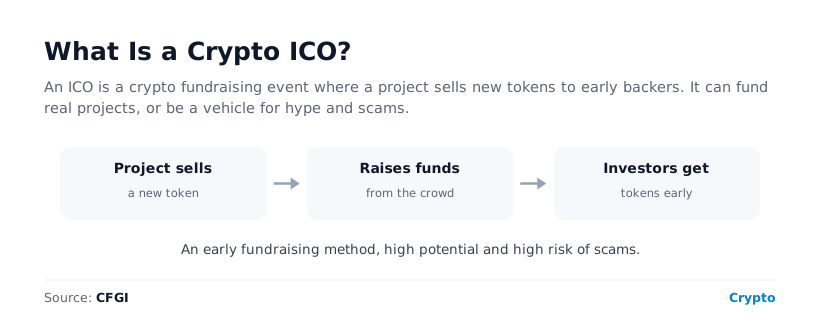
An ICO, or initial coin offering, is a crypto fundraising event in which a project sells a brand-new token to early backers to raise money, loosely the crypto cousin of a stock IPO. ICOs can fund genuine projects, but they are lightly regulated and have a long history of hype and outright scams, especially around greedy market peaks. The 2017 boom showed both the promise and the danger: billions raised, and the large majority of projects later failed or turned out to be frauds.
CFGI data
ICO booms are greed events you can almost date by the gauge. They cluster at market tops, when the crowd will fund almost any idea, the conditions CFGI reads as Extreme Greed, 80 or above on its 0 to 100 scale. CFGI has tracked that mood since March 2022, and a fresh wave of token-sale hype is usually a sign sentiment has run hot.
Source: CFGI dataset, March 2022 to June 2026.
Key takeaways
- An ICO sells a new token to raise money for a crypto project.
- It is loosely the crypto version of a stock IPO, with far less regulation.
- The 2017 boom raised billions, but around 78% of those ICOs were scams.
- The SEC treats many ICO tokens as unregistered securities under the Howey test.
- ICOs have largely been replaced by exchange and DEX launches (IEOs and IDOs).
Fundraising With a New Token
In an ICO, a project creates a new token and sells it to backers, usually before the product even exists, to raise capital. Buyers hand over established crypto like Ether and receive the new token, hoping it will rise in value as the project grows and attracts users. It echoes a stock IPO, but with one enormous difference: an IPO comes with audited accounts, regulators and disclosure rules, while a classic ICO often came with little more than a whitepaper and a promise.
How an ICO Works
The mechanics are simple, which is part of the appeal and the danger. A team publishes a whitepaper describing the project and the token, sets a fundraising target, and opens a sale, sometimes a private pre-sale for big backers first, then a public round. Contributors send crypto to a smart contract and receive the new tokens in return. If the token later lists on exchanges and rises, early buyers profit; if the project stalls or vanishes, they are left holding a token worth nothing. Because creating a token is cheap and quick, almost anyone can run one, with or without a real product behind it.
The 2017 Gold Rush
ICOs exploded in 2017, raising an estimated 5 billion dollars in a single year as retail investors piled in, terrified of missing the next Bitcoin. The headline raises were staggering: the EOS project pulled in around 4 billion dollars, and the messaging app Telegram raised some 1.7 billion for its planned token. Money poured into projects with no product, no revenue and, sometimes, no real team, on the strength of a slick whitepaper and a rising market. It was a textbook mania.
The Reckoning: Scams and Failures
The hangover was brutal. One widely cited study found that around 78% of the ICOs conducted in 2017 were identified as scams. The typical outcome for a buyer was disastrous: research put the median return on ICO tokens at roughly minus 87%, and by 2020 only about one in eight projects had achieved any meaningful success at all.
The Hard Lesson
In a token sale, the easy part is raising money and the hard part is building something real. The 2017 numbers showed how rarely the second part followed the first.
The Regulators Arrive: The Howey Test
The scale of the losses brought regulators in force, especially the US Securities and Exchange Commission. Its key tool is the decades-old "Howey test", which treats something as a security if it involves an investment of money, in a common enterprise, with an expectation of profit from the efforts of others. Most ICO tokens fit that description neatly, which meant many had been sold as unregistered securities. The SEC pursued high-profile cases: Telegram returned more than 1.2 billion dollars to investors and paid a penalty, and EOS’s issuer settled as well. The crackdown effectively ended the open ICO era.
What Replaced ICOs
Fundraising did not disappear; it moved behind more guardrails. Initial Exchange Offerings (IEOs) run the sale through a crypto exchange that vets the project and stakes its reputation on it. Initial DEX Offerings (IDOs) launch tokens directly on a decentralised exchange via smart contracts, often through a "launchpad". Both add a layer of screening the wild ICOs lacked, and sit somewhere between the anything-goes ICO and the heavily regulated IPO. None of them, though, removes the basic risk: a token can still go to zero.
ICOs, Hype and Sentiment
Token-sale manias are one of the clearest sentiment signals in crypto. They erupt when the Crypto Fear and Greed Index is deep in greed and the crowd will fund almost any idea, and they dry up the moment fear returns. So a sudden flood of new token launches is worth reading as a thermometer, not just an opportunity. Judge the tokenomics and the team rather than the marketing, and treat the loudest fundraising hype, arriving at peak greed, as the moment for the most caution.
Frequently asked questions
What is a crypto ICO?
An initial coin offering: a fundraising event where a project sells a newly created token to early backers to raise money, loosely the crypto version of a stock IPO but with far less regulation.
Why did ICOs get a bad reputation?
Because the 2017 boom was riddled with fraud. About 78% of that year’s ICOs were identified as scams, the median token return was around minus 87%, and only a small fraction of projects ever succeeded.
Are ICOs legal?
It depends on the token and jurisdiction. In the US, the SEC treats many ICO tokens as unregistered securities under the Howey test, and has pursued major cases. Selling tokens without complying with securities rules can be illegal.
What replaced ICOs?
Largely IEOs, run through a vetting exchange, and IDOs, launched on a decentralised exchange. Both add screening the open ICO lacked, but the underlying risk that a token goes to zero remains. This is education, not financial advice.
CFGI.io, Market sentiment research
The CFGI research team builds and maintains the CFGI Fear and Greed Index: a 0 to 100 sentiment score from 10 sub-indicators across hundreds of crypto assets and the equity market, refreshed every 15 minutes. We have tracked market emotion through multiple full crypto and equity cycles.
Think we missed something?
Spotted a gap, disagree with a take, or think we should cover a new topic? Message us and we'll act on your input.
Message us on TelegramKeep reading
This article is educational and is not financial advice. Crypto and equities are volatile and you can lose money. See our disclaimer.