Crypto
Fear and Greed Index vs Funding Rates
Quick answer
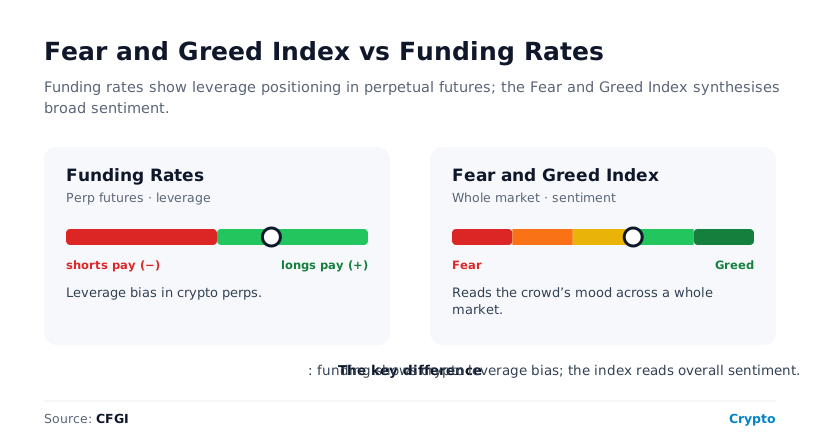
Funding rates measure one thing: the cost of holding leveraged perpetual-futures positions, which reveals whether traders are crowded long or short. The Fear and Greed Index is broader, synthesising 10 indicator groups into a single 0 to 100 sentiment score. Funding rates are a sharp read of derivatives positioning, and a strong contrarian signal at extremes; the Fear and Greed Index is a balanced read of overall mood. They complement each other well. This is education, not financial advice.
CFGI data
Funding rates are a derivatives-only signal; CFGI is a synthesis. CFGI blends 10 indicators, momentum and volatility among them, into one 0 to 100 score across hundreds of assets and four timeframes since March 2022, so it captures sentiment even where there is little futures activity.
Source: CFGI dataset and public derivatives-market information, June 2026.
Key takeaways
- Funding rates show leverage positioning in perpetual futures.
- Positive funding means crowded longs; negative means crowded shorts.
- At extremes, funding is a contrarian signal.
- The Fear and Greed Index synthesises 10 broad indicators.
- Funding is a sharp positioning read; the index is a balanced mood read.
Positioning vs Synthesised Sentiment
A funding rate is the periodic payment between long and short holders of a perpetual futures contract. Persistently positive funding means traders are crowded long and paying to stay there, a sign of greed and leverage; persistently negative funding means the opposite. It is a precise, real-time read of derivatives positioning. The Fear and Greed Index measures something wider. Funding-style positioning is only part of the picture; the index also weighs volatility, momentum, volume and more into a single 0 to 100 score, so it does not depend on the futures market alone.
| Funding rates | Fear and Greed Index | |
|---|---|---|
| Measures | Leverage positioning | Broad sentiment |
| Source | Perpetual futures | 10 indicator groups |
| Reads | Crowded long or short | Fear to greed, 0 to 100 |
| Coverage | Liquid futures markets | hundreds of assets |
| Best as | A leverage signal | A balanced gauge |
Funding rates versus the Fear and Greed Index.
How Funding Rates Work
Funding exists to solve a quirk of "perpetual" futures, contracts that, unlike traditional futures, never expire. To keep a perpetual’s price tethered to the underlying spot price, exchanges levy a small payment, the funding rate, exchanged directly between traders every few hours (typically every 1 to 8 hours). When the perpetual trades above spot, signalling that longs are in demand, the rate is positive and longs pay shorts; when it trades below spot, the rate is negative and shorts pay longs. The size and sign of that payment is therefore a direct, real-time confession of how the leveraged crowd is positioned and how much it is willing to pay to hold that position. A small positive rate is normal in a healthy uptrend, reflecting mild bullishness; it is the extremes that carry the real signal, because they reveal when positioning has become dangerously one-sided.
Funding Rates As a Contrarian Signal
At the extremes, funding rates become a powerful contrarian signal, in much the same spirit as a Fear and Greed Index. When funding turns sharply and persistently positive, well above its normal level, it means the market has become heavily, expensively long: a crowd of over-leveraged bulls all paying through the nose to stay in the trade. Historically, such extreme positive funding has often preceded corrections, because that crowded long positioning is acutely vulnerable to a liquidation cascade if the price so much as wobbles. The mirror is even more striking: extremely negative funding, where the market is heavily and expensively short, has historically preceded major relief rallies, the market being "most coiled for an upside move when pessimism is most expensive". In both cases the logic is the contrarian’s: when leveraged positioning becomes wildly one-sided, the conditions are ripe for a violent move against that crowd, exactly the kind of stretched extreme the Fear and Greed Index is also built to flag.
The Extremes Carry the Signal
Extreme positive funding (a crowded, expensive long) has often preceded corrections; extreme negative funding (a crowded, expensive short) has often preceded relief rallies. One-sided positioning sets up the reversal.
Using Them Together
The two pair naturally. When the Fear and Greed Index reads Extreme Greed and funding is high and rising, leverage and mood agree, an over-extended, fragile setup primed for a sharp reversal. When the index reads fear but funding is flipping positive, positioning may be turning before broad sentiment, a divergence worth a closer look. One gives the mood, the other gives the leverage behind it, and the most useful moments are when they either strongly agree (confirming an extreme) or clearly diverge (hinting that one is leading the other). For a crypto trader, reading funding alongside the index is a way to see not just how the crowd feels, but how aggressively it has bet on that feeling with borrowed money, which is often what determines how the next move plays out.
Frequently asked questions
What is a funding rate?
A periodic payment (every 1 to 8 hours) exchanged between long and short holders of a perpetual futures contract, used to keep the perpetual’s price near spot. Positive funding means longs pay shorts (crowded long, bullish); negative means shorts pay longs (crowded short, bearish).
Are funding rates a contrarian signal?
At the extremes, yes. Extreme positive funding (a crowded, expensive long) has historically preceded corrections via liquidation cascades; extreme negative funding (a crowded short) has often preceded relief rallies, the market being most coiled for an upside move when pessimism is most expensive.
Which is better, funding rates or the Fear and Greed Index?
Neither is better; they answer different questions. Funding rates read derivatives positioning sharply; the index reads overall mood broadly, across hundreds of assets and even where futures activity is thin. Many traders watch both.
Can funding and the Fear and Greed Index disagree?
Yes, and that can be useful. Leveraged positioning sometimes turns before broad sentiment, so a divergence between the two, like fear in the index but funding flipping positive, is worth a closer look. This is education, not financial advice.
CFGI.io, Market sentiment research
The CFGI research team builds and maintains the CFGI Fear and Greed Index: a 0 to 100 sentiment score from 10 sub-indicators across hundreds of crypto assets and the equity market, refreshed every 15 minutes. We have tracked market emotion through multiple full crypto and equity cycles.
Think we missed something?
Spotted a gap, disagree with a take, or think we should cover a new topic? Message us and we'll act on your input.
Message us on TelegramKeep reading
This article is educational and is not financial advice. Crypto and equities are volatile and you can lose money. See our disclaimer.