Crypto
What Is Total Value Locked?
Quick answer
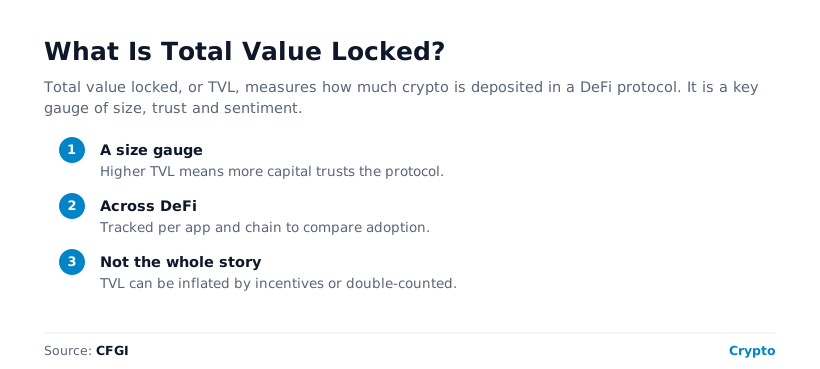
Total value locked, or TVL, is the total dollar value of crypto deposited in a DeFi protocol or across DeFi as a whole. It is the headline measure of how much money trusts a given protocol, and a rough gauge of the size and health of decentralised finance. Rising TVL usually signals confidence and greed; falling TVL signals fear and retreat. It is genuinely useful, but it has real quirks, and reading it without knowing them can badly mislead you.
CFGI data
TVL moves with crowd sentiment. It swells when the crowd is greedy and risk-hungry and drains when fear takes over, mirroring the swings CFGI scores from 0 to 100. Big TVL inflows often coincide with the greedy end of the scale, and the great DeFi TVL crash of 2022 lined up with exactly the kind of deep fear the gauge records.
Source: CFGI dataset and public DeFi data, to June 2026.
Key takeaways
- TVL is the total dollar value of crypto deposited in DeFi.
- It gauges a protocol’s size and the trust placed in it.
- DeFi TVL peaked near 180 billion dollars in 2021, then crashed.
- It is distorted by token prices, double-counting and leverage.
- It measures size and confidence, not safety, quality or profit.
How Much Money Trusts a Protocol
When users supply assets to a DeFi protocol, to lend, to provide liquidity, or to farm yield, those deposits are its TVL. A higher TVL means more capital is willing to sit inside that protocol’s smart contracts, which is often read as a sign of trust, traction and depth. Comparing TVL across protocols is a quick way to gauge their relative size, the DeFi equivalent of comparing the assets under management of rival funds.
How TVL Is Measured and Tracked
TVL is simply the dollar value of everything deposited in a protocol at a given moment. The metric was popularised by aggregators, most famously DeFiLlama, which track TVL across hundreds of protocols and dozens of chains and present it in one place. That lets you see not just a single protocol’s size but the shape of the whole ecosystem: which chains dominate, where money is flowing, and how the sector is growing or shrinking. Ethereum has long held the largest share of global DeFi TVL, with newer chains competing for the rest.
The 2021 Peak and the Crash
TVL’s history reads like a map of crypto’s mood. It surged through the "DeFi Summer" of 2020 and the bull market that followed, peaking at roughly 180 billion dollars in late 2021, an astonishing amount of capital to have flowed into a few years of experimental finance. Then came the reckoning: through the 2022 to 2023 bear market, amid the Terra and FTX collapses, total DeFi TVL crashed by around 80%, falling to the region of 36 billion. Much of that drop was confidence evaporating, and some was simply the falling prices of the tokens locked inside, a distinction that turns out to matter a great deal.
Why TVL Can Mislead
TVL is one of the most quoted and most misunderstood numbers in crypto, because three quirks can distort it badly.
- Price moves it. Because it is measured in dollars, TVL falls when token prices fall even if nobody withdraws a thing, so a price crash shrinks TVL on its own.
- Double-counting. Deposit ETH into one protocol, receive a token for it, then deposit that token into another, and the same underlying ETH is counted in both protocols’ TVL.
- Leverage inflation. Deposit 1 million dollars, borrow 700,000 against it and redeposit that, and you have added 1.7 million to TVL from just 1 million of real capital.
Aggregators try to adjust for double-counting, but none of these can be fully scrubbed out, so a headline TVL figure is best treated as an estimate, not a precise truth.
What TVL Does Not Tell You
Just as important is what TVL leaves out. A high TVL says a lot of money trusts a protocol; it says nothing about whether that trust is justified. TVL does not measure a protocol’s security, the quality of its code, its profitability, or its resilience to a hack or a bank run. Plenty of protocols with enormous TVL have been drained by exploits or collapsed when confidence broke, and the money fled as fast as it arrived. TVL is a measure of size and popularity, not of safety, and confusing the two is a classic and costly mistake.
The Reframe
A big TVL means a protocol is popular, not that it is safe. Treat it as a measure of scale and confidence, and judge security and quality separately.
What TVL Is Good For
Used with its limitations in mind, TVL is genuinely useful. It gives a fast read on the relative size of competing protocols and chains, and its trend over time is a strong pulse on confidence in DeFi as a whole, rising when capital is flowing in, falling when it is fleeing. The most reliable signal is usually the direction and the comparison rather than the precise number: TVL steadily climbing across a sector tells you money is gaining trust, while a sharp, broad drain tells you it is being pulled to safety. Read alongside other metrics, it is a valuable, if imperfect, gauge.
TVL and Market Sentiment
At heart, TVL is a confidence meter, and confidence is what sentiment is made of. It swells when the crowd is greedy and willing to lock up capital chasing yield, and it drains when fear takes over and people retreat to safety, the same swings a Crypto Fear and Greed Index tracks on a 0 to 100 scale. A surge of TVL into ever-riskier protocols often coincides with the greedy end of that scale, which, as ever in crypto, is the moment to be most careful. Reading TVL and the sentiment gauge together gives a fuller view of how much trust DeFi is actually earning.
Frequently asked questions
What is total value locked?
The total dollar value of crypto deposited in a DeFi protocol or across DeFi as a whole. It gauges how much capital trusts a protocol and the overall size of decentralised finance.
Why does TVL matter?
It is a quick measure of a protocol’s relative size and the confidence placed in it, and its trend is a strong pulse on DeFi sentiment. Rising TVL signals trust and greed; falling TVL signals fear and retreat.
Can TVL be misleading?
Yes. It moves with token prices even without new deposits, the same assets can be double-counted across linked protocols, and leverage can inflate it. It also says nothing about a protocol’s security or quality. Read it as a pulse, not a precise figure.
How high has DeFi TVL been?
Total DeFi TVL peaked near 180 billion dollars in late 2021, then crashed by around 80% through the 2022 to 2023 bear market amid the Terra and FTX collapses. This is education, not financial advice.
CFGI.io, Market sentiment research
The CFGI research team builds and maintains the CFGI Fear and Greed Index: a 0 to 100 sentiment score from 10 sub-indicators across hundreds of crypto assets and the equity market, refreshed every 15 minutes. We have tracked market emotion through multiple full crypto and equity cycles.
Think we missed something?
Spotted a gap, disagree with a take, or think we should cover a new topic? Message us and we'll act on your input.
Message us on TelegramKeep reading
This article is educational and is not financial advice. Crypto and equities are volatile and you can lose money. See our disclaimer.