Crypto
What Is Market Cap In Crypto?
Quick answer
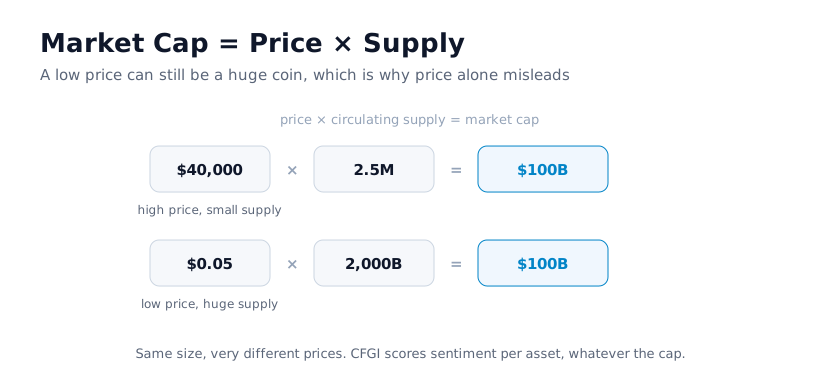
Market cap, short for market capitalisation, is the total value of a cryptocurrency: its price multiplied by the number of coins in circulation. It is the standard way to measure how big a coin is, and a far better one than price alone, because a low price can hide a huge supply. It sorts coins into large, mid and small-cap tiers by size and risk, and it frames the size of the belief behind an asset. This is education, not financial advice.
CFGI data
Size and sentiment are different things, and CFGI keeps them apart. TRON, a fraction of Bitcoin’s market cap, has swung across a wider mood range than Bitcoin itself, 8 to 90 versus Bitcoin’s 9 to 89 on the same 0 to 100 scale, tracked every 15 minutes since March 2022. Market cap does not set the mood.
Source: CFGI dataset, March 2022 to June 2026.
Key takeaways
- Market cap is price multiplied by circulating supply.
- It measures a coin’s size far better than price alone.
- Fully diluted valuation counts all coins that will ever exist.
- Cap sorts coins into large, mid and small-cap tiers by risk.
- CFGI scores sentiment per asset, independent of market cap.
What Is Market Cap?
Market cap is the total market value of a coin: take its price and multiply by the number of coins in circulation. A coin priced at 2 with 10 billion coins in circulation has a larger market cap (20 billion) than a coin priced at 100 with 100 million coins (10 billion). Size lives in the cap, not the sticker price. This is one of the most important and most misunderstood ideas for a crypto newcomer: a coin trading at a few cents is not "cheaper" or more likely to soar than one trading at thousands of dollars, what matters is the total value, not the per-coin price.
Why Use Market Cap Instead of Price?
Price on its own is misleading because supplies differ wildly. A coin can look "cheap" at a low price yet be enormous once you account for billions of coins. Market cap normalises that, which is why it is used to rank coins and to calculate things like Bitcoin dominance. It also exposes a common beginner’s trap: the belief that a low-priced coin has more "room to grow" to reach the price of a major one. For a small coin with a vast supply to reach Bitcoin’s price, its market cap would have to balloon to many times the size of the entire global economy, which is why thinking in terms of cap, not price, instantly reveals which "100x" dreams are mathematically absurd.
A Caution
Market cap reflects the last traded price across all coins, including ones that rarely trade. It is the best simple size gauge, not a promise that the whole cap could be cashed out at that price.
Circulating Supply, Total Supply and FDV
There is an important subtlety in that phrase "circulating supply". Many coins do not have all their tokens in circulation: some are locked, reserved for the team, or scheduled to be released gradually over years. This creates a few different "supplies" worth distinguishing. "Circulating supply" is the coins available and trading now, and the standard market cap uses this. "Total supply" includes coins that exist but are locked, and "max supply" is the total that will ever exist. "Fully diluted valuation" (FDV) is the price multiplied by the max supply, in other words, what the market cap would be if every coin that will ever exist were already circulating. The gap between market cap and FDV matters because future token releases ("unlocks") add new supply, which can dilute holders and weigh on the price. A coin with a small circulating cap but an enormous FDV has a lot of dilution still to come, a red flag the headline market cap alone can hide.
Market Cap Tiers and Risk
Just as in stocks, market cap sorts crypto into rough tiers that correspond to risk and maturity. "Large-cap" coins, like Bitcoin and Ethereum, are the biggest and most established: more liquid, more widely held, and generally (by crypto standards) less volatile, the relative blue-chips of the asset class. "Mid-cap" coins are smaller and riskier but still substantial. "Small-cap" and "micro-cap" coins sit at the speculative far end: tiny, thinly traded, wildly volatile, and capable of enormous gains or total collapse. The general rule is that as you move down the cap tiers, both the potential reward and the risk rise sharply, a small-cap can multiply many times over or go to zero in a way a large-cap rarely does. Understanding which tier a coin sits in is essential context for judging how much risk you are actually taking, and it is information the per-coin price simply does not give you.
How Does Market Cap Relate to Sentiment?
Cap measures size; sentiment measures mood. A giant coin can sit in fear while a tiny altcoin runs on extreme greed, the two are genuinely independent. CFGI keeps them apart by scoring each asset’s fear and greed individually, so the mood of a small coin is never drowned out by the size of a large one. The data bears this out: TRON, a fraction of Bitcoin’s market cap, has swung across a slightly wider mood range than Bitcoin itself, which shows that a coin’s size does not dictate or constrain its sentiment. This is exactly why per-asset scoring matters, a single market-wide number is dominated by the largest coins by cap, drowning out the distinct moods of everything smaller, while per-asset scoring gives every coin its own voice regardless of size. Compare size and sentiment side by side on the by-coin directory.
Frequently asked questions
What is market cap in crypto?
The total market value of a coin: its current price multiplied by its circulating supply. It is the standard measure of a coin’s size, and a far better one than the per-coin price, because a low price can hide a huge supply.
Why use market cap instead of price?
Because supplies differ wildly, so price alone is misleading: a "cheap" low-priced coin can be enormous once you count billions of coins. Cap normalises that, and reveals why many low-priced coins reaching a major coin’s price is mathematically impossible.
What is fully diluted valuation (FDV)?
Price multiplied by the maximum supply, what the market cap would be if every coin that will ever exist were circulating. A large gap between market cap and FDV signals a lot of future token unlocks and dilution still to come, which the headline cap can hide.
Does market cap affect a coin’s sentiment score?
No. CFGI scores each asset’s fear and greed on its own 0 to 100 scale, independent of market cap, so size never hides a small coin’s mood. TRON, far smaller than Bitcoin, has swung across a wider mood range. This is education, not financial advice.
CFGI.io, Market sentiment research
The CFGI research team builds and maintains the CFGI Fear and Greed Index: a 0 to 100 sentiment score from 10 sub-indicators across hundreds of crypto assets and the equity market, refreshed every 15 minutes. We have tracked market emotion through multiple full crypto and equity cycles.
Think we missed something?
Spotted a gap, disagree with a take, or think we should cover a new topic? Message us and we'll act on your input.
Message us on TelegramKeep reading
This article is educational and is not financial advice. Crypto and equities are volatile and you can lose money. See our disclaimer.