Stocks
What Is Day Trading?
Quick answer
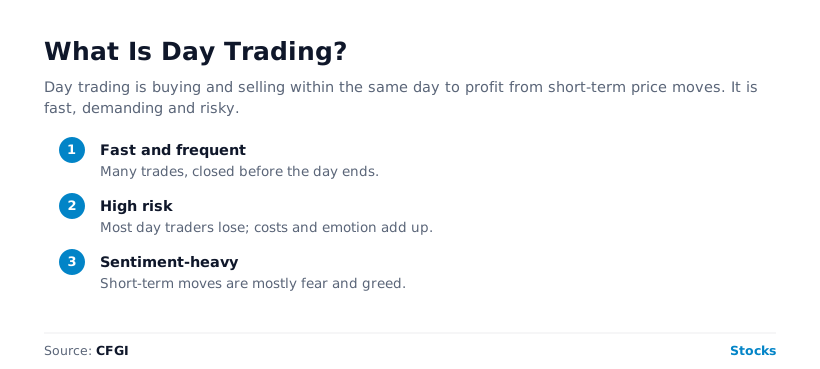
Day trading is the practice of buying and selling assets within the same trading day, aiming to profit from short-term price moves rather than holding for the long term. It is fast-paced and demands constant attention, discipline and tight risk control. The hard truth is that most day traders lose money, in part because short-term moves are dominated by the very fear and greed that are hardest to predict and easiest to get swept up in.
CFGI data
Day traders live and die on short-term sentiment, the swings a Fear and Greed Index captures. Extremes can mark turning points, but intraday the signal is noisy: CFGI’s next-day agreement with market direction is roughly 49%, close to a coin flip, which is a blunt warning for anyone trying to trade the index hour to hour.
Source: CFGI dataset; stocks since 2021, crypto since March 2022.
Key takeaways
- Day trading means opening and closing positions within the same day.
- It targets short-term moves, not long-term growth.
- Studies consistently show around 70% of day traders lose money.
- Only about 1% are consistently profitable over five years.
- Discipline and risk control matter more than prediction.
Trading the Short Term
A day trader opens and closes positions within hours or minutes and rarely holds anything overnight, trying to capture small price moves over and over. It is the opposite end of the spectrum from investing, which holds assets for years to capture long-term growth. Day trading leans on technical patterns, news flow and raw speed, and the costs, spreads, fees, and short-term taxes, quietly stack up with every trade.
The Brutal Odds
The single most important fact about day trading is how few people win at it, and the research is remarkably consistent. Across multiple markets and decades, studies find that roughly 70% of day traders end up with net losses. A University of California study found only about 13% were profitable over a six-month window, and just 1% were consistently profitable over five years or more.
A landmark study of an entire market in Brazil was even starker: of those who kept day trading for more than 300 days, around 97% lost money, and barely 1% earned more than a bank teller’s starting salary. These are not stories about reckless gamblers; they are the typical outcome for ordinary, determined people. Going in aware of the base rate is the single most useful thing a beginner can do.
Why It Is So Hard
Short-term price action is mostly noise and emotion, which makes it close to unpredictable. On the other side of nearly every trade sits a professional desk or an algorithm with faster data, lower costs and no feelings. Meanwhile the trader’s own costs compound: spreads, fees and taxes nibble at every position, so even a strategy that is right more than half the time can still lose money once friction is counted. The market does not have to beat you; the costs and the competition usually do.
The Rules: Pattern Day Trading and Leverage
In the US, day trading came with a long-standing guardrail. From 2001, the "pattern day trader" rule flagged anyone making four or more day trades in five business days in a margin account and required them to keep at least 25,000 US dollars in that account. That threshold kept many small traders on the sidelines for a quarter of a century. In 2026, regulators moved to scrap the 25,000 dollar minimum and retire the pattern-day-trader label, with the changes taking effect from June and brokers given until 2027 to implement them.
Lower barriers do not change the maths, though. Many short-term strategies, especially scalping, which fires off dozens or hundreds of trades a day for tiny gains, lean on heavy leverage to make small moves meaningful. Leverage magnifies the losses just as fast as the wins, so easier access to it raises the stakes rather than the odds.
The Quiet Cost
Removing the 25,000 dollar floor opens day trading to far more people. The loss statistics, built over 25 years of that floor being in place, are unlikely to improve simply because entry got cheaper.
Discipline Over Prediction
The rare survivors rarely talk about prediction. They talk about process: a written plan, strict position sizing, pre-set stop-losses, and the emotional control to follow all three when a trade goes wrong. The losing pattern is almost always the same, holding losers in hope and cutting winners in fear, which is sentiment overriding the plan. Treated as a disciplined job rather than a thrill, day trading is merely very hard. Treated as a way to get rich quickly, it is a reliable way to do the opposite.
Day Trading and Market Sentiment
Day traders are, in effect, betting on short-term sentiment, the same fear and greed the Stock Fear and Greed Index measures on a 0 to 100 scale. The catch is that sentiment is most useful at extremes and over longer horizons, not minute to minute. CFGI is built to flag when the crowd is unusually fearful or greedy, context that helps a patient investor far more than a scalper. Using a sentiment gauge to avoid emotional decisions is often more valuable than using it to time the next ten minutes.
Frequently asked questions
What is day trading?
Buying and selling assets within the same trading day to profit from short-term price moves, rather than holding for the long term. It is fast-paced and demands constant attention and risk control.
Is day trading profitable?
For most people, no. Studies consistently find around 70% of day traders lose money, only about 13% are profitable over six months, and roughly 1% are consistently profitable over five years. This is education, not financial advice.
Do you still need 25,000 dollars to day trade in the US?
The long-standing pattern-day-trader rule required a 25,000 dollar minimum in a margin account, but in 2026 regulators moved to scrap that minimum and retire the designation, with changes phasing in from June. Lower barriers do not change the underlying odds.
How is day trading different from investing?
Day trading targets quick, intraday moves and closes positions the same day; investing holds assets for years to capture long-term growth and compounding.
CFGI.io, Market sentiment research
The CFGI research team builds and maintains the CFGI Fear and Greed Index: a 0 to 100 sentiment score from 10 sub-indicators across hundreds of crypto assets and the equity market, refreshed every 15 minutes. We have tracked market emotion through multiple full crypto and equity cycles.
Think we missed something?
Spotted a gap, disagree with a take, or think we should cover a new topic? Message us and we'll act on your input.
Message us on TelegramKeep reading
This article is educational and is not financial advice. Crypto and equities are volatile and you can lose money. See our disclaimer.