Stocks
What Is a SPAC?
Quick answer
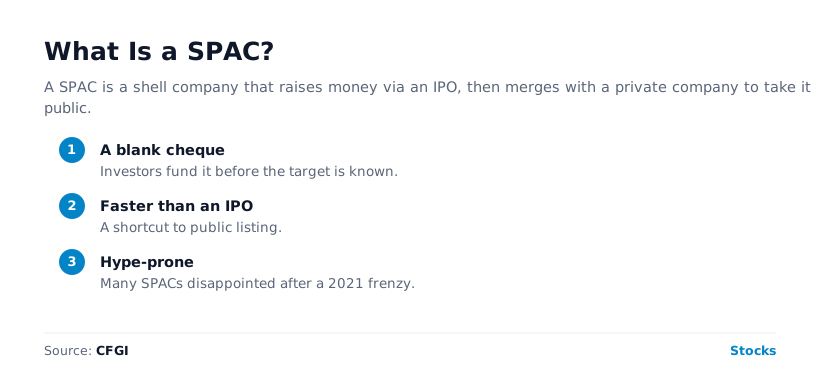
A SPAC, or special purpose acquisition company, is a shell company with no operations that raises money through an IPO for one purpose: to find and merge with a private company, taking it public. It is an alternative route to a traditional listing, sometimes called a blank-cheque company because investors hand over money before knowing what it will buy. SPACs boomed spectacularly on hype in 2021 and then collapsed, a textbook example of a greed-driven cycle that mostly rewarded the people who created them.
CFGI data
SPAC manias are a greed marker. Their boom and bust tracked the broader risk cycle, peaking when the crowd was most willing to fund blank-cheque bets, the conditions CFGI reads as Extreme Greed, 80 or above on its 0 to 100 scale. The 2021 frenzy and the bust that followed are what that part of the scale looks like in real life.
Source: CFGI methodology and public market history, to June 2026.
Key takeaways
- A SPAC is a shell company that raises money to acquire another and take it public.
- The merger that does this is called the de-SPAC.
- The sponsor typically gets about 20% of shares for a token outlay.
- In 2021, 613 SPACs raised around 145 billion dollars, then most collapsed.
- Founders won big while many public investors lost heavily.
A Blank-Cheque Company
A SPAC lists on an exchange through an IPO while holding no business at all, just cash and a promise. Investors back the team running it, the "sponsor", largely on trust, since at the IPO stage they often do not know what the SPAC will buy. The SPAC then hunts for a private company to merge with. When it succeeds, that company takes over the SPAC’s stock-market listing and becomes publicly traded, having skipped the traditional IPO process entirely.
How a SPAC Works: The De-SPAC
The lifecycle runs to a clock. After raising cash, a SPAC typically has one to two years to find a target and complete a merger, the "de-SPAC", or it must return the money. The cash sits in trust, usually priced at 10 dollars a share, in the meantime. Crucially, before a merger completes, shareholders have a redemption right: they can choose to take their 10 dollars back rather than stay in for the deal. That right is meant to protect investors, but as you will see, when most people use it the economics of the whole structure can turn toxic.
The Sponsor’s Promote
Here is the part that explains everything else. The sponsor is compensated through a "promote": typically around 20% of the post-IPO shares, handed to them for a nominal outlay, often on the order of 25,000 dollars. In other words, the people running the SPAC can end up owning a fifth of the company for almost nothing, with far less regulatory scrutiny than a normal IPO requires. That structure creates a powerful incentive to complete some deal, almost any deal, before the deadline, because the sponsor’s huge payoff depends on a merger happening, not on it being a good one.
Follow the Incentives
The sponsor gets paid for doing a deal, not for doing a good deal. That single fact is the key to understanding why so many SPAC mergers worked out badly for everyone except the sponsor.
The 2020 to 2021 Boom
As markets roared back from the COVID shock, SPACs exploded. The peak came in 2021, with 613 SPACs listing and raising around 145 billion dollars, a 91% jump on the year before. Celebrities and stars lent their names, from Shaquille O’Neal to Alex Rodriguez, and one investor, Chamath Palihapitiya, was crowned the "SPAC King" for championing the format. For a moment, the blank-cheque company looked like the future of going public, a faster, hotter, hype-friendly alternative to the staid old IPO.
The Reckoning: Who Actually Won
The hangover was severe and the outcomes were lopsided. Companies taken public through SPACs lost, on average, around two-thirds of their value, and studies found that non-redeeming shareholders underperformed the market by a median of roughly 49% on deals from the boom, while SPAC founders earned a positive return of nearly 200%. The "redemption death spiral" made it worse: when most shareholders redeemed their 10 dollars, the sponsor’s fixed 20% promote ballooned to half the remaining company or more, so the few public investors who stayed were left owning a sliver of a diluted business. The structure, it turned out, was built to reward sponsors first.
Tighter regulation and a colder market ended the frenzy, though SPACs periodically return in more disciplined forms.
SPAC Versus IPO
| SPAC | Traditional IPO | |
|---|---|---|
| How it works | Merge with a listed cash shell | Company lists itself directly |
| Speed | Often faster | Slower, more process |
| Disclosure | Lighter at the outset | Heavy, audited upfront |
| Sponsor reward | Large promote for little | No equivalent |
Two routes to a public listing.
A SPAC can be a legitimate, quicker route to the public market, especially for companies that find the IPO process daunting. But the lighter disclosure and the sponsor’s outsized incentive are exactly why investors need to read a SPAC deal far more carefully than the hype usually invites.
SPACs and Market Sentiment
The whole SPAC saga is a sentiment story drawn in capital letters. The format thrived only when risk appetite was extreme, when investors would fund a team with a cheque and a promise, and it died when fear returned. That arc maps directly onto a Stock Fear and Greed Index: the 2021 peak coincided with the kind of Extreme Greed the gauge flags at 80 and above on its 0 to 100 scale. When a financing fad like this is everywhere and the crowd is euphoric, the SPAC experience is a reminder that the loudest moment is usually the one that rewards caution most.
Frequently asked questions
What is a SPAC?
A special purpose acquisition company: a shell company that raises money via an IPO, then merges with a private company to take it public. It is also called a blank-cheque company, because investors commit before the target is known.
What is a de-SPAC?
The merger in which a SPAC combines with a private company. The private company takes over the SPAC’s listing and becomes publicly traded, completing the SPAC’s purpose.
What is the sponsor promote?
The sponsor’s reward: typically about 20% of the post-IPO shares for a nominal outlay, often around 25,000 dollars. It creates a strong incentive to complete a deal before the deadline, whether or not it is a good one.
Are SPACs risky?
They can be. Investors often commit before the target is known, disclosure is lighter than an IPO, and incentives favour sponsors. Companies taken public via SPACs in the 2021 boom lost about two-thirds of their value on average. This is education, not financial advice.
CFGI.io, Market sentiment research
The CFGI research team builds and maintains the CFGI Fear and Greed Index: a 0 to 100 sentiment score from 10 sub-indicators across hundreds of crypto assets and the equity market, refreshed every 15 minutes. We have tracked market emotion through multiple full crypto and equity cycles.
Think we missed something?
Spotted a gap, disagree with a take, or think we should cover a new topic? Message us and we'll act on your input.
Message us on TelegramKeep reading
This article is educational and is not financial advice. Crypto and equities are volatile and you can lose money. See our disclaimer.