Markets
What Is the Disposition Effect?
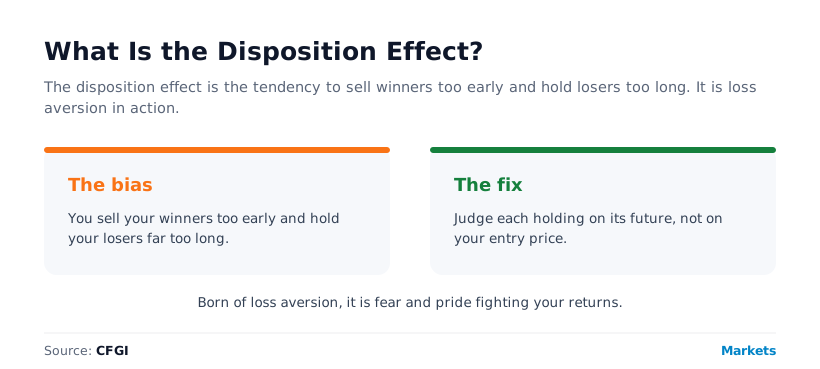
Quick answer
The disposition effect is the well-documented tendency of investors to sell winning positions too early, to lock in a gain, while holding losing positions too long, to avoid realising a loss. It is the opposite of good practice, which is usually to let winners run and cut losers, and it is even worse than it looks, because it is also tax-inefficient. The effect is driven by loss aversion and the discomfort of admitting a mistake, the same emotions a Fear and Greed Index tracks. This is education, not financial advice.
CFGI data
The disposition effect is fear and regret at the individual level. The discomfort that makes people hold losers is the same emotion that, multiplied across the crowd, shows up as fear on CFGI. Recognising the bias is part of using sentiment as a check on yourself.
Source: CFGI dataset and behavioural-finance research, June 2026.
Key takeaways
- The disposition effect is selling winners early and holding losers too long.
- It is the opposite of letting winners run and cutting losers.
- It is driven by loss aversion and the dislike of admitting mistakes.
- It is also tax-inefficient, making it doubly backwards.
- It quietly hurts long-run returns.
Selling Winners, Marrying Losers
Imagine two positions: one up 20%, one down 20%. The disposition effect predicts most investors will sell the winner, to bank the gain and feel smart, and hold the loser, to avoid crystallising the loss and admitting they were wrong. Over time this is backwards: it caps gains and lets losses run. The root is loss aversion: a realised loss hurts about twice as much as an equal gain pleases, so people avoid taking it, and the discomfort of being wrong reinforces the hold.
Why We Do It
The bias runs on a particular quirk of how we think about gains and losses. A loss on paper still feels reversible, "it might come back", but the moment you sell, it becomes real, permanent and undeniable, an admission that the decision to buy was a mistake. Loss aversion makes that realisation painful, and ego makes it worse, because nobody likes to be proven wrong. Selling a winner, by contrast, delivers an immediate hit of pleasure and the satisfaction of "being right". So we are pulled toward the action that feels good now, banking the win, and away from the action that hurts now, taking the loss, even though, for our long-term wealth, the priorities should often be reversed.
The Cost to Returns
The disposition effect is a documented, measurable drag on returns, and the reason is the asymmetry it creates. By selling winners early, you cut off your best positions just as they may be hitting their stride, capping the very gains that drive a portfolio. By holding losers, you let your worst positions keep bleeding, and you tie up capital in failing investments that could have been redeployed into better ones. The old market wisdom is to "let your winners run and cut your losers short"; the disposition effect makes investors do precisely the opposite, "cut the flowers and water the weeds". Studies of real brokerage accounts confirm it costs ordinary investors real money over time, quietly and consistently.
Let Winners Run, Cut Losers
The disposition effect inverts the right rule. Good practice lets winners keep growing and cuts losers before they deepen; the bias does the reverse, capping gains and nursing losses.
The Tax Irony
Here is the part that makes the disposition effect truly perverse: it is usually tax-inefficient too. In many tax systems, selling a winner triggers a taxable capital gain, while selling a loser generates a capital loss that can be used to offset gains and lower your tax bill, a practice called "tax-loss harvesting". So the rational, tax-smart move is closer to the opposite of the bias: defer selling winners (to delay the tax) and consider realising some losers (to capture the tax benefit). The disposition effect leads investors to do exactly the wrong thing on both fronts at once, hurting their returns and their tax position simultaneously. It is one of the clearest cases where a behavioural bias quietly works against you in more ways than one.
How to Counter It
The cure is to judge each position on its current case rather than your history with it. The most powerful question to ask of any holding, winner or loser, is: "knowing nothing about what I paid, would I buy this today?" If the answer is no, the only reason you are still holding is the anchor to your entry price, which is the bias at work. Setting rules in advance helps too, predefined exit criteria and a rebalancing schedule remove the in-the-moment, emotional decision. And separating the choice from your ego, accepting that a loss is information, not a personal failing, makes it far easier to act on the merits rather than on the urge to avoid pain.
The Disposition Effect and Sentiment
The same emotions behind the disposition effect, fear of loss and regret, are what a Fear and Greed Index measures at the level of the whole crowd. The reluctance to sell a loser that makes one investor cling on is the same reluctance, multiplied across millions, that keeps a falling market from finding a bottom until capitulation finally forces the selling. Recognising the bias in yourself is part of using sentiment as a mirror: when you are clinging to a loser, ask whether it is genuine conviction or just the urge to avoid the loss, and when the gauge shows the crowd gripped by the same fear, remember that you are part of that crowd, and prone to the very bias it reflects.
Frequently asked questions
What is the disposition effect?
The tendency to sell winning positions too early to lock in a gain, while holding losing positions too long to avoid realising a loss. It is the opposite of good practice, which is to let winners run and cut losers.
What causes the disposition effect?
Loss aversion, a realised loss hurts about twice as much as an equal gain pleases, plus the discomfort of admitting a mistake. A paper loss feels reversible until you sell, while banking a winner delivers an immediate hit of pleasure.
Why is it tax-inefficient?
Because selling a winner triggers a taxable gain, while selling a loser can generate a loss to offset gains and cut your tax bill ("tax-loss harvesting"). The bias makes investors do the wrong thing for both returns and tax at once.
How do you counter it?
By judging each position on its current case, asking "would I buy this today, knowing nothing about what I paid?", setting exit rules in advance, and treating a loss as information rather than a personal failing. This is education, not financial advice.
CFGI.io, Market sentiment research
The CFGI research team builds and maintains the CFGI Fear and Greed Index: a 0 to 100 sentiment score from 10 sub-indicators across hundreds of crypto assets and the equity market, refreshed every 15 minutes. We have tracked market emotion through multiple full crypto and equity cycles.
Think we missed something?
Spotted a gap, disagree with a take, or think we should cover a new topic? Message us and we'll act on your input.
Message us on TelegramKeep reading
This article is educational and is not financial advice. Crypto and equities are volatile and you can lose money. See our disclaimer.