Crypto
Fear and Greed Index Timeframes Explained
Quick answer
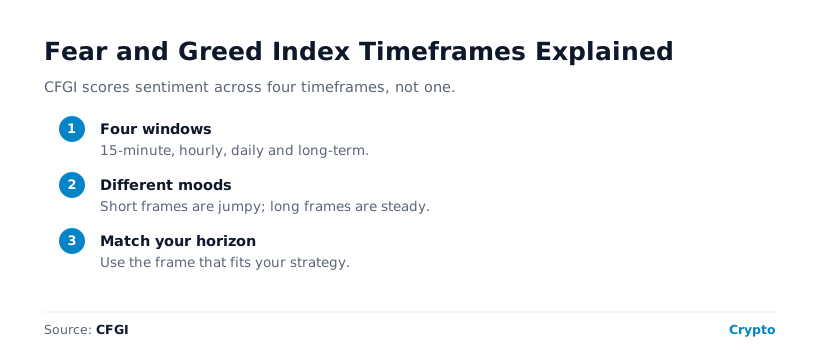
Most fear and greed indices give one number. CFGI gives four, one for each of several timeframes, because the crowd’s short-term mood and its longer-term mood are genuinely different things. A day trader needs the short-term reading; a long-term investor needs the longer one. When the timeframes disagree, that gap is itself a useful signal. Matching the timeframe to your horizon is one of the most important, and most overlooked, steps in using the index well. This is education, not financial advice.
CFGI data
Four timeframes is a core CFGI feature, not a detail. Refreshed every 15 minutes since March 2022, the short-term score can read fear while the long-term score reads greed, the same asset, two horizons. Picking the one that matches you, and reading the gap between them, is what makes the reading relevant.
Source: CFGI dataset, March 2022 to June 2026.
Key takeaways
- CFGI scores sentiment across four timeframes, not one.
- Each timeframe looks at a different window, short reacts fast, long is smooth.
- Short and long-term mood are often different on the same asset.
- A disagreement between timeframes is a signal, not noise.
- Matching the timeframe to your horizon is essential.
Why One Number Is Not Enough
Sentiment looks different depending on how far you zoom out. A sharp one-day drop can read as Extreme Fear on a short timeframe while the longer-term trend is still firmly greedy. A single number forces those two truths into one and loses information in the process. CFGI keeps them separate by scoring multiple timeframes, so you can see both the immediate mood and the bigger picture at once.
| Horizon | Use the... | Best for |
|---|---|---|
| Hours to a day | Short timeframe | Day trading |
| Days to weeks | Medium timeframe | Swing trading |
| Weeks to months | Longer timeframe | Position trading |
| Months and beyond | Long timeframe | Investing |
Match the timeframe to your horizon.
How the Timeframes Work
The four readings are built from the same underlying signals, but measured over different lookback windows. A short timeframe weights the most recent hours and days heavily, so it reacts fast and swings around with every sharp move. A long timeframe smooths over weeks and months, so it changes slowly and reflects the prevailing trend rather than the latest wobble. This is why all four can be refreshed every 15 minutes yet still tell different stories: a fresh data point moves the short reading a lot and the long reading barely at all, exactly as it should.
When the Timeframes Disagree
The most valuable information often hides in the gap between timeframes, because a disagreement is a signal in its own right. Short-term fear sitting underneath long-term greed usually means a pullback within an ongoing uptrend, a dip rather than a reversal, which to a buyer can look like an opportunity. The opposite, short-term greed beneath long-term fear, can mean a relief bounce inside a downtrend, the kind of move that traps the over-eager. When all four timeframes line up, fearful together or greedy together, the signal is at its strongest and most one-directional. When they split, the market is in transition, and that transition is precisely what the multi-timeframe view is designed to reveal.
The Read In One Line
Timeframes aligned means a strong, clear mood. Timeframes split means a market in transition, and the direction of the split, short fear under long greed, or the reverse, tells you which way.
Picking the Right One for You
The first rule is to match the timeframe to your own holding period. A day trader who holds for hours should read the short timeframe; a long-term investor who holds for years should read the long one. Reading the short-term score to make a long-term decision, or the long-term score to time a day trade, is one of the most common ways people misuse a sentiment index, and it leads to acting on a mood that has nothing to do with their actual horizon. Choose the timeframe that fits how long you genuinely intend to hold, and the reading suddenly becomes relevant.
Reading Multiple Timeframes Together
Beyond picking one, experienced users read several at once, the same way traders use multiple chart timeframes. The long timeframe sets the context, is the bigger trend fearful or greedy?, while the short timeframe helps with the entry, is the crowd briefly panicking within that trend? A long-term investor, for example, might use the long-timeframe reading to judge the overall climate and the short-timeframe reading to spot a moment of acute fear to add into. The timeframes are not rivals to choose between so much as layers to combine, each answering "how does the crowd feel?" over a different stretch of time.
The Trap of the Wrong Timeframe
Getting the timeframe wrong is quietly costly. A long-term investor who watches the short-term score will be rattled by every intraday flicker of Extreme Fear and tempted to act on noise that means nothing for a multi-year plan. A short-term trader who only watches the long score will miss the fast shifts that actually matter to their next trade. In both cases the index is working perfectly; the mistake is reading the wrong horizon. Knowing which timeframe is yours is half the skill of using a multi-timeframe sentiment gauge at all.
See It Live
Frequently asked questions
How many timeframes does the Fear and Greed Index have?
CFGI scores sentiment across four timeframes, from short-term to long-term, rather than giving a single number. This lets you match the reading to your horizon and see how the mood differs across them.
Which timeframe should I use?
The one that matches how long you hold: short-term for day trading, medium for swing trading, longer for position trading and the long timeframe for investing. Mismatching them is a common error.
What does it mean when the timeframes disagree?
It signals a market in transition. Short-term fear under long-term greed often means a pullback within an uptrend; short-term greed under long-term fear can mean a bounce within a downtrend. The direction of the split is the clue.
Can I read more than one timeframe at once?
Yes, and it is often best to. Use the long timeframe for context and the short one for timing, the way traders combine multiple chart timeframes. They are layers to combine, not rivals to choose between. This is education, not financial advice.
CFGI.io, Market sentiment research
The CFGI research team builds and maintains the CFGI Fear and Greed Index: a 0 to 100 sentiment score from 10 sub-indicators across hundreds of crypto assets and the equity market, refreshed every 15 minutes. We have tracked market emotion through multiple full crypto and equity cycles.
Think we missed something?
Spotted a gap, disagree with a take, or think we should cover a new topic? Message us and we'll act on your input.
Message us on TelegramKeep reading
This article is educational and is not financial advice. Crypto and equities are volatile and you can lose money. See our disclaimer.