Markets
Fear and Greed Index and Position Sizing
Quick answer
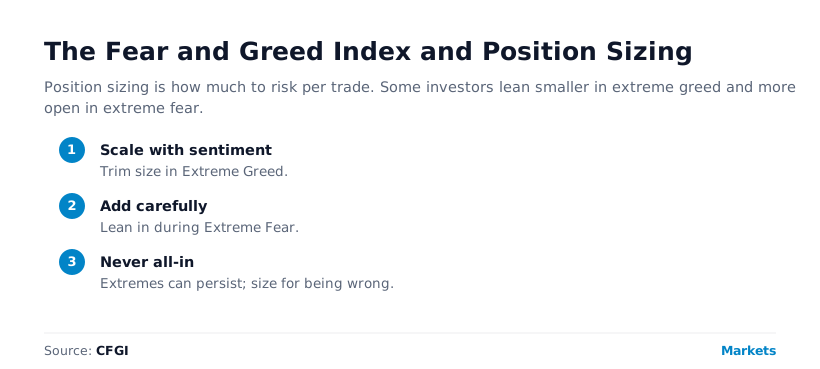
Position sizing is the decision of how much to put into any single trade or investment, and it is one of the most important risk controls there is. Some investors let sentiment inform it: sizing down when the crowd is in Extreme Greed and risk of a reversal is high, and being more willing to add when Extreme Fear has already done the damage. The aim is to manage risk, not to predict, and never to size beyond what you can afford to lose. This is education, not financial advice.
CFGI data
Sentiment can scale your risk. When CFGI sits in Extreme Greed, a reversal is more likely, an argument for smaller size; when it has plunged to lows like the equity 3 on 8 April 2025, much of the fall may be done. The index informs how much to risk, not whether you will be right.
Source: CFGI dataset, 2021 to June 2026.
Key takeaways
- Position sizing is how much to risk per trade.
- It is one of the most important risk controls.
- Sizing too big risks ruin even with a good strategy.
- Some size down in Extreme Greed and stay open in Extreme Fear.
- The aim is managing risk, not predicting.
Why Size Matters More Than Entry
Many investors obsess over what to buy and ignore how much, yet position size often matters more for long-run results than the entry itself. Risking too much on a single idea can turn one bad call into a serious loss. Sizing sensibly is what keeps any single mistake survivable. Sentiment can feed into that decision: when the crowd is at an extreme, the odds of a sharp move rise, which is exactly when controlling size matters most. You can be right about a stock and still be ruined by owning too much of it at the wrong moment.
What Position Sizing Is, and the Risk of Ruin
Position sizing is simply how much capital you commit to a given position, and it is, quietly, one of the most decisive choices in all of investing. A common professional approach is to risk only a small, fixed percentage of your total capital on any single trade, often 1 to 2%, so that no individual loss can do serious damage. The deep reason this matters is a concept called "risk of ruin": if you bet too large a share of your capital on each idea, then even a winning strategy can be wiped out by a normal, unlucky string of losses, because a big enough drawdown is mathematically hard to recover from (a 50% loss requires a 100% gain just to break even). Conservative sizing is what keeps you alive through the inevitable rough patches, so your edge has time to play out. Most blown-up accounts are not the result of bad analysis; they are the result of good analysis ruined by sizing far too big.
How Sentiment Can Inform Sizing
- Set a base rule for how much you risk per position, and keep it conservative.
- Consider sizing down when the index is in Extreme Greed, when reversals are more likely.
- Be more willing to add gradually when Extreme Fear has already driven prices down.
- Never let a sentiment reading push you above your maximum risk per position.
- Use it to scale risk, not to bet bigger on a hunch.
Risk First
Sentiment-informed sizing is about reducing risk at extremes, not increasing it. The index should never be a reason to exceed your risk limits. This is education, not financial advice.
Scaling In and Out With Sentiment
One practical way to combine sizing with sentiment is to scale into and out of positions gradually rather than all at once, which sidesteps the impossible task of calling the exact top or bottom. Instead of deploying all your intended capital in a single trade, you build a position in tranches. As the index sinks deeper into Extreme Fear and prices fall, you might add in steady increments, "averaging in" to accumulate more at lower prices while keeping each addition small and within your risk limits. As the index climbs into Extreme Greed, you might do the reverse, trimming in stages to lock in some gains and reduce exposure as the crowd grows euphoric. This staged approach turns sentiment into a guide for the pace of your buying and selling rather than a single make-or-break decision, and crucially, it keeps you from the all-or-nothing bets that sizing discipline exists to prevent. You are adjusting how much, gradually, in response to how stretched the mood has become.
Build Positions In Tranches
Rather than one big bet, scale in as fear deepens and trim as greed builds, in small increments within your risk limits. It sidesteps calling the exact turn and keeps any single decision survivable.
Always Risk First
The non-negotiable principle underneath all of this is that sentiment-informed sizing must only ever reduce risk at the extremes, never increase it. It is dangerously easy to twist the logic, to feel so confident at Extreme Fear that you bet far bigger than your rules allow, or so swept up in Extreme Greed that you pile in larger to chase the move. That is exactly backwards, and it is how the discipline becomes its opposite. The index can be a sensible input into the question of how much to risk, smaller when conditions are fragile, perhaps more willing to accumulate gradually when fear has already done its work, but it must always operate inside hard, predetermined limits on your maximum exposure to any one position. Used that way, position sizing informed by sentiment is a genuine risk tool. Used as an excuse to bet bigger on a strong feeling, it is just gambling with extra steps. This is education, not financial advice.
Frequently asked questions
What is position sizing?
The decision of how much capital to put into a single trade or investment. A common approach risks only a small, fixed percentage (often 1 to 2%) per trade, so no individual loss can do serious damage. It is one of the most important risk controls.
What is the risk of ruin?
The danger that sizing too big lets a normal, unlucky string of losses wipe you out, even with a winning strategy, because large drawdowns are hard to recover from (a 50% loss needs a 100% gain to break even). Conservative sizing keeps you in the game.
How can the Fear and Greed Index inform sizing?
Some investors size down in Extreme Greed, when reversals are more likely, and are more willing to add gradually in Extreme Fear, when much of a fall may already be done. A staged "scaling" approach turns sentiment into a guide for the pace of buying and selling.
Should sentiment make me bet bigger?
No. Sentiment-informed sizing is about reducing risk at extremes, never exceeding your risk limits. Using an extreme reading as an excuse to bet larger is exactly backwards. It manages risk; it does not predict outcomes. This is education, not financial advice.
CFGI.io, Market sentiment research
The CFGI research team builds and maintains the CFGI Fear and Greed Index: a 0 to 100 sentiment score from 10 sub-indicators across hundreds of crypto assets and the equity market, refreshed every 15 minutes. We have tracked market emotion through multiple full crypto and equity cycles.
Think we missed something?
Spotted a gap, disagree with a take, or think we should cover a new topic? Message us and we'll act on your input.
Message us on TelegramKeep reading
This article is educational and is not financial advice. Crypto and equities are volatile and you can lose money. See our disclaimer.