Crypto
What Is Proof of Work?
Quick answer
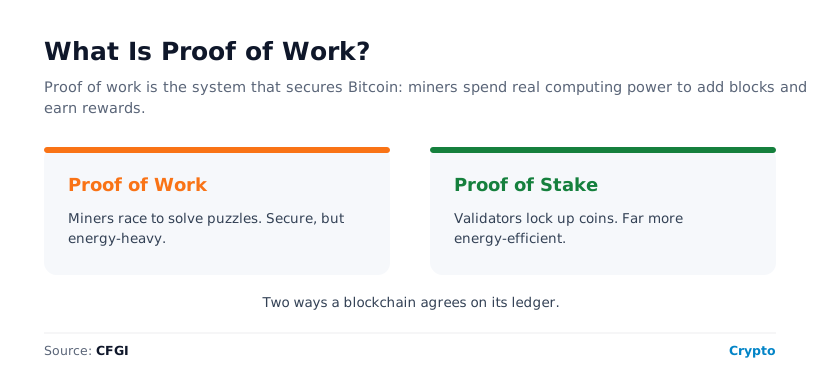
Proof of work is the method a blockchain like Bitcoin uses to agree on its records without a central authority. Miners compete to solve a hard mathematical puzzle using real computing power and electricity, and the winner adds the next block and earns the reward. Rewriting history would mean redoing all that work faster than the entire rest of the network, which is what makes the chain expensive to attack. The spent energy is not a side effect. It is the security.
CFGI data
Bitcoin’s security story drives its mood. CFGI has tracked crypto sentiment on a 0 to 100 scale since March 2022, swinging from a fearful 12 to a greedy 87, and proof-of-work milestones like the roughly four-yearly halving, which cuts new supply, tend to pull sentiment toward greed in the year that follows.
Source: CFGI dataset, March 2022 to June 2026.
Key takeaways
- Proof of work secures a blockchain through real, costly computing effort.
- Miners race to solve a puzzle; the winner adds the block and is paid.
- Security scales with hash power, so big chains are hard to attack and small ones are not.
- Bitcoin uses about 170 TWh a year, comparable to a mid-size country.
- Ethereum’s 2022 switch to proof of stake cut its energy use by over 99%.
Security Through Spent Effort
A public blockchain needs a way for strangers to agree on which transactions are real without trusting a bank. Proof of work does it by making the right to add a block expensive. Miners take the pending transactions and race to find a number, a "nonce", that makes the block’s fingerprint fall below a target. There is no shortcut. They simply guess trillions of times a second until one of them gets lucky.
The network tunes the difficulty roughly every two weeks so that, no matter how much computing power joins, a new Bitcoin block still arrives about every 10 minutes. The winner adds the block and collects the reward. Everyone else checks the answer in an instant and moves on to the next race.
Why Spending Makes It Secure
The genius is in what an attacker would have to do. To rewrite a past transaction, you would need to rebuild that block and every block after it, and out-pace the honest network doing the same, which means controlling more than half of all the computing power on Earth pointed at that chain. This is the "51% attack". For Bitcoin, assembling that hardware and electricity would cost billions and burn money every second it ran. The defence is not clever cryptography alone; it is raw economics.
The Energy Question
That security has a bill. Bitcoin’s network draws roughly 170 terawatt-hours of electricity a year, in the same range as a mid-size country like Poland, and a single transaction can use around 1,100 kilowatt-hours, enough to power an average US home for over a month. Critics see waste. Defenders argue the energy is the entire point, that it is what stands between your savings and a rewrite, and that mining increasingly uses stranded gas, surplus hydro and other power that would otherwise be lost. Whichever side you take, the cost is real and it is deliberate.
When Proof of Work Actually Fails
Proof of work is only as strong as the hash power behind it, and smaller chains do not have much. The 51% attack is not just theory for them.
- Bitcoin Gold (2018): an attacker seized the majority of its hash power and double-spent around 18 million US dollars.
- Ethereum Classic (2019 and 2020): attacked repeatedly, with double-spends of roughly 1.1 million and then 5.6 million US dollars.
The lesson is precise: proof-of-work security is not a property of the idea, it is a property of the hash rate. Bitcoin is safe because attacking it is absurdly expensive. A copycat chain with a fraction of the mining power is not.
Proof of Work Versus Proof of Stake
The main alternative is proof of stake, which secures the chain with capital instead of electricity: validators lock up coins and lose them if they cheat. The clearest demonstration came in September 2022, when Ethereum switched from proof of work to proof of stake in an upgrade called the Merge and cut its energy use by more than 99%. Proof of work is battle-tested and famously hard to capture; proof of stake is efficient and cheaper to run. Both chase the same goal, agreement without a boss, by very different means.
Proof of Work and Market Sentiment
Proof of work shapes Bitcoin’s emotional calendar. The halving, which cuts the block reward roughly every four years, tightens new supply and has historically been a magnet for optimism. Spikes in the hash rate signal miner confidence, and crackdowns or energy debates can spread fear. All of it shows up in the Crypto Fear and Greed Index, which reads the market’s mood on a 0 to 100 scale. Understanding what secures the network helps you tell a real shift from a passing headline.
Frequently asked questions
What is proof of work?
A system that secures a blockchain by making miners spend real computing power to solve a puzzle and add each block. Redoing that work to rewrite history is what makes the network expensive to attack.
What is a 51% attack?
An attack where someone controls more than half of a chain’s computing power and can rewrite recent history to double-spend coins. It is effectively impossible on Bitcoin but has happened on smaller proof-of-work chains like Bitcoin Gold and Ethereum Classic.
Why does proof of work use so much energy?
Because the security comes from real computing effort: miners burn electricity solving puzzles, around 170 TWh a year for Bitcoin. That energy cost is the defence, and also the main criticism of the system.
Which cryptocurrencies use proof of work?
Bitcoin is the best known. Many newer chains use proof of stake instead, and Ethereum moved from proof of work to proof of stake in 2022, cutting its energy use by over 99%. This is education, not financial advice.
CFGI.io, Market sentiment research
The CFGI research team builds and maintains the CFGI Fear and Greed Index: a 0 to 100 sentiment score from 10 sub-indicators across hundreds of crypto assets and the equity market, refreshed every 15 minutes. We have tracked market emotion through multiple full crypto and equity cycles.
Think we missed something?
Spotted a gap, disagree with a take, or think we should cover a new topic? Message us and we'll act on your input.
Message us on TelegramKeep reading
This article is educational and is not financial advice. Crypto and equities are volatile and you can lose money. See our disclaimer.