Crypto
Crypto Fear and Greed Index vs Glassnode
Quick answer
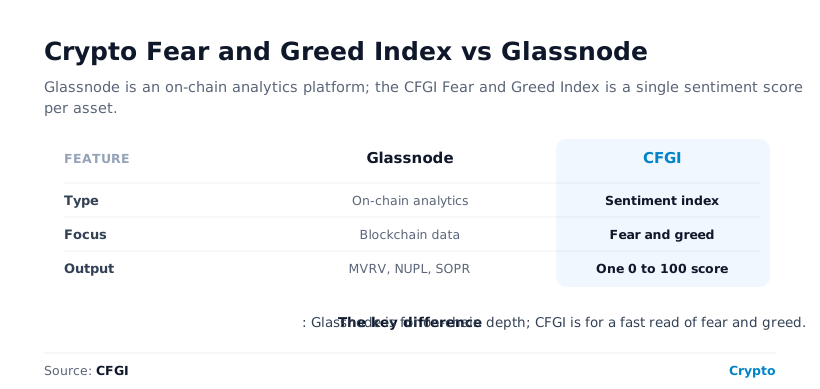
Glassnode is an on-chain analytics platform: it tracks what is happening on the blockchain itself, wallet flows, holder behaviour, supply dynamics, across hundreds of detailed metrics like MVRV and NUPL. The CFGI Crypto Fear and Greed Index synthesises 10 indicator groups into a single 0 to 100 sentiment score per asset. Glassnode is for deep on-chain research; CFGI is for a fast, comparable read of fear and greed. This is education, not financial advice.
CFGI data
On-chain data is one lens; CFGI is a synthesis. CFGI folds 10 indicators into one 0 to 100 score across hundreds of assets and four timeframes since March 2022, so you get a comparable sentiment read without having to interpret raw on-chain charts yourself.
Source: CFGI dataset and public Glassnode product information, June 2026.
Key takeaways
- Glassnode tracks detailed on-chain metrics from the blockchain.
- Its signature metrics include MVRV and NUPL.
- CFGI synthesises 10 indicators into one 0 to 100 score.
- Glassnode suits deep research; CFGI suits fast, comparable reads.
- On-chain data is one input to sentiment, not the whole of it.
On-Chain Depth vs Synthesised Sentiment
Glassnode reads the blockchain directly: coins moving between wallets, how long holders have held, exchange inflows and outflows, and much more. For understanding the on-chain mechanics of a move, it is among the most detailed tools available, and it publishes its own fear and greed style indicator built from that data. The CFGI Crypto Fear and Greed Index takes a wider basket, 10 indicator groups, not just on-chain, and compresses it to one 0 to 100 score per asset. Where Glassnode gives depth on one dimension, CFGI gives a balanced read across several.
| Glassnode | CFGI | |
|---|---|---|
| Focus | On-chain blockchain data | 10 indicators blended |
| Output | Detailed metric charts | One 0 to 100 score |
| Per asset | Yes, deep | Yes, hundreds of assets |
| Timeframes | Configurable | 4 (15m to long-term) |
| Best for | On-chain research | Fast, comparable read |
Glassnode versus CFGI.
What Glassnode Offers
Glassnode is, first and foremost, the specialist’s tool for on-chain analysis, turning the raw, public data of the blockchain into hundreds of categorised metrics with years of history. Its real value is in signature on-chain measures that have no equivalent in traditional markets. Two of the most famous are MVRV (Market Value to Realised Value), which compares an asset’s market price to the average price at which all the coins last moved, a gauge of whether holders are sitting on aggregate profit or loss, and NUPL (Net Unrealised Profit/Loss), which tracks the overall profit state of the network. Beyond these, it covers exchange inflows and outflows (coins moving to exchanges to sell, or off them to hold), whale movements, miner behaviour, supply held by long-term versus short-term holders, and much more. For an analyst who wants to read the actual on-chain behaviour of holders, rather than just price, Glassnode offers a depth of factual, blockchain-derived data that is hard to match.
On-Chain Data Versus Sentiment
The deeper distinction is between what these two things actually measure. On-chain data is a record of what holders are doing, a hard, factual ledger of coins moving, accumulating and being spent, while a sentiment index is a read of how the crowd is feeling. The two are related but not identical: on-chain behaviour is one important source of sentiment (CFGI uses on-chain flows as part of its score), but raw on-chain metrics are not, by themselves, a fear-and-greed reading. A metric like MVRV at an extreme can signal holders are wildly in profit or deep in loss, which correlates with greed or fear, but interpreting it requires expertise and context. This is the trade-off: Glassnode hands you the rich, factual raw material and asks you to read it; a Fear and Greed Index does the interpreting for you, folding on-chain signals together with volatility, momentum and the rest into a single conclusion about the crowd’s mood.
A Ledger of Action, Not a Read of Mood
On-chain data records what wallets do; a sentiment index reads how the crowd feels. On-chain behaviour is one input to sentiment, but raw metrics need expert interpretation to become a fear-and-greed read.
Which Should You Use?
If your edge is reading on-chain flows, Glassnode is a deep, specialist tool, the kind of platform a serious on-chain analyst lives in. If you want an immediate, objective gauge of fear and greed across many assets, without first having to learn how to interpret MVRV or NUPL, CFGI is built for that. As ever, the synthesised score and the deep data work well side by side: CFGI for the read, Glassnode for the on-chain why. A common workflow is to use a Fear and Greed Index to spot when the crowd has reached an extreme, then turn to a tool like Glassnode to investigate whether the on-chain behaviour of holders confirms or contradicts that mood, the quick signal and the deep confirmation, each playing to its strength.
Frequently asked questions
What is Glassnode?
An on-chain analytics platform that turns raw blockchain data into hundreds of metrics, including signature measures like MVRV and NUPL, plus exchange flows, whale moves and holder behaviour. It is among the most detailed tools for on-chain research.
Is Glassnode a Fear and Greed Index?
Glassnode is primarily an on-chain analytics platform, though it publishes a fear and greed style indicator from that data. The CFGI index blends 10 indicators, on-chain being one input, into a single 0 to 100 score per asset.
What is the difference between on-chain data and sentiment?
On-chain data is a factual record of what holders are doing; sentiment is a read of how the crowd feels. On-chain behaviour is one source of sentiment, but raw metrics like MVRV need expert interpretation to become a fear-and-greed reading, which an index does for you.
Can you use both?
Yes. CFGI gives a fast read of fear and greed across many assets; Glassnode lets you dig into the on-chain flows behind it. A common workflow is the index for the signal, Glassnode for the on-chain confirmation. This is education, not financial advice.
CFGI.io, Market sentiment research
The CFGI research team builds and maintains the CFGI Fear and Greed Index: a 0 to 100 sentiment score from 10 sub-indicators across hundreds of crypto assets and the equity market, refreshed every 15 minutes. We have tracked market emotion through multiple full crypto and equity cycles.
Think we missed something?
Spotted a gap, disagree with a take, or think we should cover a new topic? Message us and we'll act on your input.
Message us on TelegramKeep reading
This article is educational and is not financial advice. Crypto and equities are volatile and you can lose money. See our disclaimer.